




Here's how it works

01. Edit your va form 10 0137 online
Type text, add images, blackout confidential details, add comments, highlights and more.

02. Sign it in a few clicks
Draw your signature, type it, upload its image, or use your mobile device as a signature pad.

03. Share your form with others
Send va form 10 0137 fillable via email, link, or fax. You can also download it, export it or print it out.
How to use or fill out VA Form 10-0137 with Our Platform

- Click ‘Get Form’ to open VA Form 10-0137 in the editor.
- Begin with Part I: Personal Information. Fill in your name, last four digits of your SSN, address, and phone numbers. Ensure accuracy as this information is crucial for identification.
- Move to Part II: Durable Power of Attorney for Health Care. Here, appoint a Health Care Agent by entering their details and initialing your choice. If you wish to appoint an alternate agent, complete that section as well.
- In Part III: Living Will, specify your preferences regarding life-sustaining treatments. Carefully read each situation and place your initials in the corresponding box that reflects your wishes.
- Complete any optional sections for mental health preferences or additional care instructions if applicable. Remember to initial and date any extra pages you attach.
- Finally, sign the form in Part IV and ensure two witnesses sign as well. If notarization is needed outside VA facilities, complete the optional notary section.
Start using our platform today to easily fill out VA Form 10-0137 online for free!
Fill out va form 10 0137 online
It's free
It's free
See more va form 10 0137 versions
We've got more versions of the va form 10 0137 form. Select the right va form 10 0137 version from the list and start editing it straight away!
Got questions?
We have answers to the most popular questions from our customers. If you can't find an answer to your question, please contact us.
Contact us
What are the drawbacks of an advance directive?
Disadvantages of advance directives include inaccessibility in emergencies, outdated or vague language not matching specific situations, legal complexities like witness/notary rules, potential conflict with family/doctors, and the risk they become obstacles to necessary conversations, sometimes leading to aggressive care similar to having none at all due to poor implementation or interpretation. Implementation Accessibility Issues Inaccessibility: Directives often arent found or accessible to providers during urgent care, making them useless. Legal Barriers: State laws can be complex, requiring specific execution (witnesses, notarization) that isnt met, invalidating the document. Poor Readability: Forms are often written above a 12th-grade reading level, making them hard to understand, especially for older adults. Vagueness: Generic language (life support) can be misinterpreted; specific details about treatments (ventilation, feeding tubes) are often missing. Clinical Communication Problems Obstacle to Planning: They can hinder crucial conversations about goals of care, sometimes paradoxically leading to more aggressive care. Outdated Wishes: Wishes expressed years earlier may not reflect current desires as situations change. Conflicts: Disagreements between family, agents, and providers can arise, potentially leading to court battles and care delays. Limited Scope: Living wills often focus only on end-of-life care, ignoring other critical aspects like pain management or care settings. Agent Proxy Issues Poor Agent Selection: Choosing someone who isnt assertive or who might impose their own values instead of the patients is a common error. Conflicting Agents: Naming multiple agents with immediate authority can cause disagreement and gridlock. For legal advice, consult a professional. What are the limitations of advance directives? | Korsinsky Klein LLPDec 11, 2024 While they may be effective at communicating your wishes, advance directives are also subject to several limitations. Korsinsky Klein LLPAdvance Directives May Derail Advance Care Planning - Penn LDIApr 26, 2022 However, some research studies have shown that patients with advance directives may receive just as much aggressive enPenn LDI
Which is better, a living will or an advance directive?
If you want to be absolutely certain that your wishes are carried out, an advance directive may be your best choice. A medical power of attorney empowers your health care agent to speak with your physicians and enforce your health care wishes.
What is VA form 10 0137?
Use VA Form 10-0137 to give specific people permission to make health care decisions for you, and to let VA health care providers know your wishes for medical, mental health, long-term, and other types of care.Dec 18, 2025
Why would a physician not honor an advance directive?
A doctor or institution can refuse to honor your advance directives for moral or religious reasons or if the care you request is not medically appropriate. In many states, a doctor or facility that refuses to honor an advance directive must make an effort to transfer care to another doctor or facility.Feb 24, 2015
Can a family member override an advance directive?
When can an advance directive be overruled? Family members cant overrule an advance directive, but your medical team may be able to change your directive if its ambiguous or clashes with their policies or beliefs.Mar 7, 2024
Security and compliance
At DocHub, your data security is our priority. We follow HIPAA, SOC2, GDPR, and other standards, so you can work on your documents with confidence.
Learn more


Related forms

Nj enter
The document is a legal agreement between a landlord and tenant in New Jersey, where the tenant consents to vacate the p ...
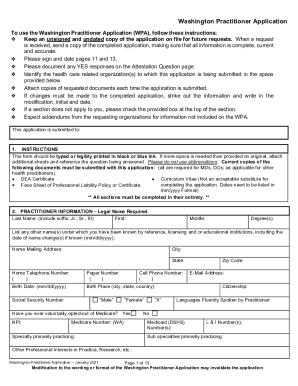
Credentialing application applications
The Washington Practitioner Application (WPA) provides detailed instructions for healthcare practitioners applying for c ...
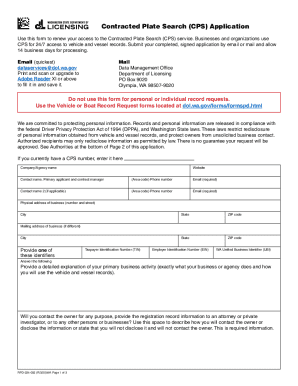
Ivips
The document outlines the application process for renewing access to the Contracted Plate Search (CPS) service, which pr ...
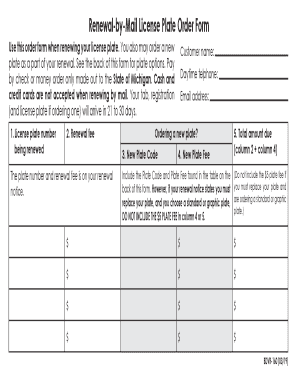
Mi renewal plate form
The document is a Renewal-by-Mail License Plate Order Form for renewing or ordering new license plates in Michigan. It o ...
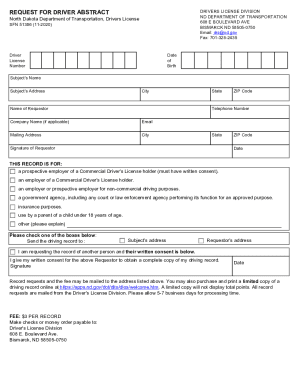
North dakota request for
The document is a request form for obtaining a driver's abstract from the North Dakota Department of Transportation. It ...
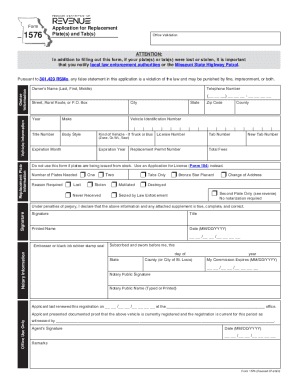
Plate plates missouri
The document is an application form (Form 1576) for replacing lost, stolen, mutilated, or destroyed vehicle license plat ...

Renew registration
The document outlines the online E-file services provided by the Division of Motorist Services for International Registr ...
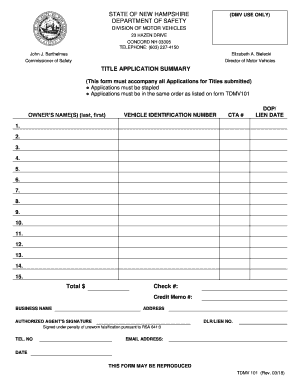
Tdmv101
The document is a Title Application Summary form from the New Hampshire Department of Safety's Division of Motor Vehicle ...
People also ask
What to say to a doctor to get VA benefits?
To talk to a VA doctor about a claim, be specific about service-related injuries, document symptoms thoroughly (including impact on daily life), clearly state the claims purpose, and use tools like the My HealtheVet portal for secure messaging to build the necessary medical evidence for your service-connected condition. Focus on how military service caused or worsened your condition, provide dates of incidents, and dont self-diagnose to allow the doctor to make accurate assessments. Before your appointment: List Symptoms: Create a detailed list of all symptoms, their severity, frequency, and how they affect your life, work, and relationships. Gather Service Info: Note specific dates, locations, and events from your service that relate to your condition. Know Your Claim: Understand which conditions youre claiming and the evidence youve submitted. During your appointment: State Your Purpose: Tell your doctor youre seeking documentation for a VA disability claim related to service. Be Specific: Describe your symptoms and link them directly to service events (e.g., This back pain started after I fell from the cargo net in 2019). Describe Impact: Explain limitations (e.g., I cant lift heavy objects, This gives me headaches that stop me from working). Avoid Self-Diagnosis: Let the doctor diagnose; just describe what you experience. Ask for Documentation: Request that your doctor document everything discussed, noting the service connection and its severity. After your appointment: Use Secure Messaging: Use My HealtheVet to send follow-up messages or add new symptoms. Get a DBQ: If possible, ask your doctor to complete a Disability Benefits Questionnaire (DBQ) for your condition to help speed up processing. Consider a VSO: A Veterans Service Organization (VSO) or accredited agent can help you with the claims process. AI can make mistakes, so double-check responsesContact Us | Veterans AffairsJan 12, 2026VA.gov Home | Veterans AffairsFind A VA Accredited Representative Or VSO | Veterans Affairs - VA.govAn accredited attorney, claims agent, or Veterans Service Organization (VSO) representative can help you file a claim or request aVA.gov Home | Veterans Affairs
Does the VA recognize durable power of attorney?
There are two types of advance directives: durable power of attorney for health care and living will. The VA Advanced Directive form allows you to complete both in a single document and to have this information placed in your VA medical record.
Why do nurses ask if a patient has an advanced directive?
These documents help nurses promote patient dignity by directing team members decisions. They are a legally binding method for patients to document refusal of treatment. For example, if a patient were to stop breathing, the healthcare team would refer to any advance directives to determine treatment options.