Petition authority 2026

Get Form
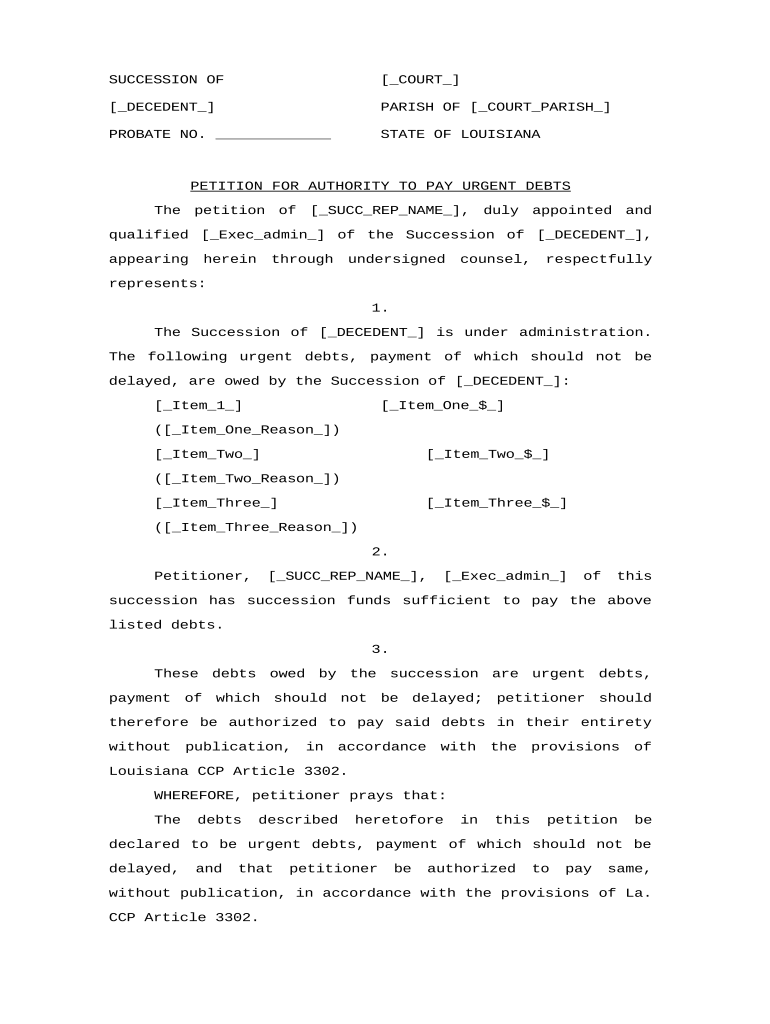
petition authority Preview on Page 1

Here's how it works

01. Edit your form online
Type text, add images, blackout confidential details, add comments, highlights and more.
02. Sign it in a few clicks
Draw your signature, type it, upload its image, or use your mobile device as a signature pad.
03. Share your form with others
Send it via email, link, or fax. You can also download it, export it or print it out.

How to use or fill out petition authority with our platform

Form edit decoration
9.5
Ease of Setup
DocHub User Ratings on G2
9.0
Ease of Use
DocHub User Ratings on G2
  1. Click ‘Get Form’ to open the petition authority document in the editor.
  2. Begin by filling in the court name and the decedent's full name in the designated fields. This information is crucial for identifying the case.
  3. Next, specify the parish where the proceedings are filed. Ensure accuracy as this affects jurisdiction.
  4. In the section for urgent debts, list each debt item along with its corresponding amount and reason. Be detailed to support your request for payment authorization.
  5. Complete the petitioner’s details, including their name and role (executor or administrator). This identifies who is making the request.
  6. Finally, review all entries for accuracy before submitting. Use our platform’s tools to ensure everything is correctly filled out.

Start using our platform today to efficiently complete your petition authority form online for free!

be ready to get more

Complete this form in 5 minutes or less

Get form

Got questions?

We have answers to the most popular questions from our customers. If you can't find an answer to your question, please contact us.
Contact us
Petitions can be physical documents signed with pen or created online with digital signatures. They function as tools to raise awareness about and address problems, concerns, and areas of opportunity. They can address specific, local community issues up to large, global causes.
petition, written instrument directed to some individual, official, legislative body, or court in order to redress a grievance or to request the granting of a favour. Petitions are also used to collect signatures to enable a candidate to get on a ballot or to put an issue before the electorate.
Petition rules Petition reason. Your petition must give a reason for why you are making the request. Request for action. Your petition must ask for something that the House of Representatives (the House) can do. Good language (moderate language) 250 word limit. No URLs or attachments. Rules for signatures. Other rules.
The person bringing the action is called the Petitioner. The person whom the action is against is called the Respondent. A petition is a written description of the circumstances of the case.
1. : a formal written request made to an official person or body (as a court or board) a petition for equitable relief. the creditor filed a petition for involuntary bankruptcy. : a document embodying a formal written request.

Security and compliance

At DocHub, your data security is our priority. We follow HIPAA, SOC2, GDPR, and other standards, so you can work on your documents with confidence.

Learn more
ccpa2
pci-dss
gdpr-compliance
hipaa
soc-compliance

People also ask

Rules for Petitions The petition must be in writing and be accompanied by the CBSC Petition Form (BSC-30). The form requires the following: Explain the problem and rationale for this petition. Explain how the issue has statewide significance.
Important. More generally, a petition is a formal request advocating for a cause and addressed to an authority. Many signatures are often sought in order to demonstrate support for the cause.

Related links