






Definition & Meaning
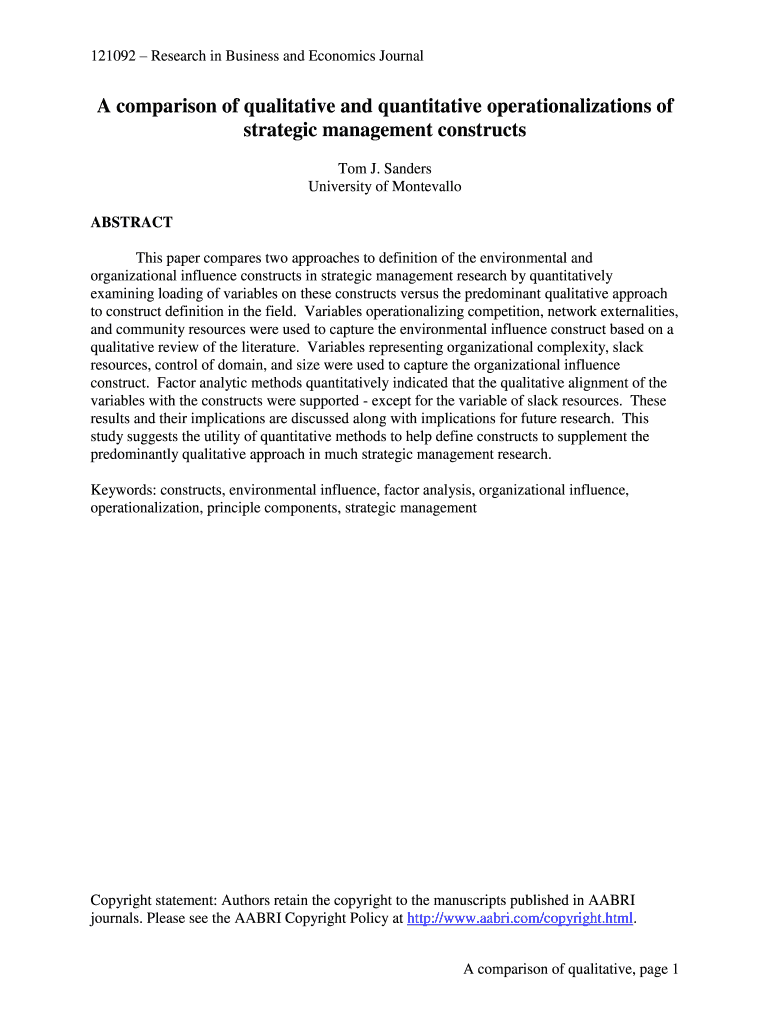
"A comparison of qualitative and quantitative operationalizations of" refers to an analytical framework used to evaluate and differentiate two methodological approaches in research. Qualitative operationalization focuses on describing and understanding phenomena through non-numerical data—such as interviews or observations—highlighting the depth and richness of contextual insights. Quantitative operationalization, on the other hand, emphasizes numerical data and statistical analysis, seeking to quantify relationships and test theories through measurable variables. This comparison is instrumental in strategic management and various research fields to enhance construct validity and data interpretation.
Key Elements of the Comparison
- Variables and Constructs: Qualitative research often employs open-ended questions and thematic analysis to explore constructs. In contrast, quantitative studies use statistical tools to measure specific variables.
- Data Collection Methods: Qualitative techniques include interviews and focus groups, while quantitative methods leverage surveys and experiments with predefined scales.
- Analysis Techniques: Thematic analysis is common in qualitative research, whereas quantitative studies use statistical methods such as regression analysis and factor analysis to interpret data.
- Outcomes and Interpretation: Qualitative results provide narrative insights, whereas quantitative outcomes offer statistical relationships and predictions.
How to Use the Comparison
When applying this comparison in research, consider the following steps:
- Identify Purpose: Determine whether the research objective is to explore a phenomenon (qualitative) or to test a hypothesis (quantitative).
- Select Appropriate Tools: Choose data collection methods aligned with the chosen approach—open-ended for qualitative and closed-ended for quantitative.
- Data Analysis: Use narrative techniques for qualitative data and statistical software for quantitative analysis.
- Interpret Findings: Combine insights for a comprehensive understanding, integrating both narrative context and numerical data.
Steps to Complete the Comparison
- Define Research Questions: Clearly articulate questions that can be addressed by each approach.
- Design Methodology: Develop a structured plan that outlines qualitative and quantitative methods.
- Data Collection: Implement the chosen methods, ensuring consistency and reliability in data gathering.
- Analysis and Synthesis: Analyze data separately before merging results for a holistic view.
- Report Findings: Present findings by highlighting unique insights from each approach and how they complement each other.
Who Typically Uses This Comparison
This comparison is widely used by:
- Researchers and Academics: To achieve a comprehensive analysis by using both breadth (quantitative) and depth (qualitative).
- Strategic Managers: To enhance decision-making processes through a dual lens of operational and contextual data.
- Policymakers: When formulating policies that require robust and multifaceted evidence.
- Market Analysts: To understand complex consumer behaviors and market trends through mixed-methods research.
Examples of Using the Comparison
- Strategic Management: Employing both methods to assess organizational influence and environmental factors, providing a fuller picture of strategic challenges.
- Healthcare Research: Utilizing qualitative interviews to explore patient experiences and quantitative measures to track treatment effectiveness.
- Educational Studies: Combining qualitative case studies with quantitative test scores to evaluate learning outcomes.
Important Terms Related
- Construct Validity: The appropriateness of inferences made based on observations or measurements, often enhanced by integrating both qualitative and quantitative data.
- Reliability and Validity: Reliability refers to the consistency of measurements, while validity refers to the accuracy of inferences.
- Triangulation: The use of multiple methods or data sources in qualitative research to develop a comprehensive understanding of phenomena.
Software Compatibility and Integration
- Data Analysis Tools: Platforms like SPSS for quantitative data and NVivo for qualitative analysis help streamline research processes.
- Document Workflow Management: Tools such as DocHub aid in managing and processing research documents, integrating across software like Google Workspace to handle document edits, storage, and sharing efficiently.
Business Types That Benefit Most
- Consulting Firms: Gaining insights for client projects through a comprehensive view.
- Educational Institutions: Employing innovative teaching and research methodologies.
- Nonprofit Organizations: Understanding community impact through a detailed approach.
- Startups and Corporations: Leveraging mixed-methods for product development and consumer insights.
By leveraging this structured comparison, researchers and professionals can effectively bridge the gap between conceptual understanding and empirical evidence, providing robust frameworks for analysis and decision-making.