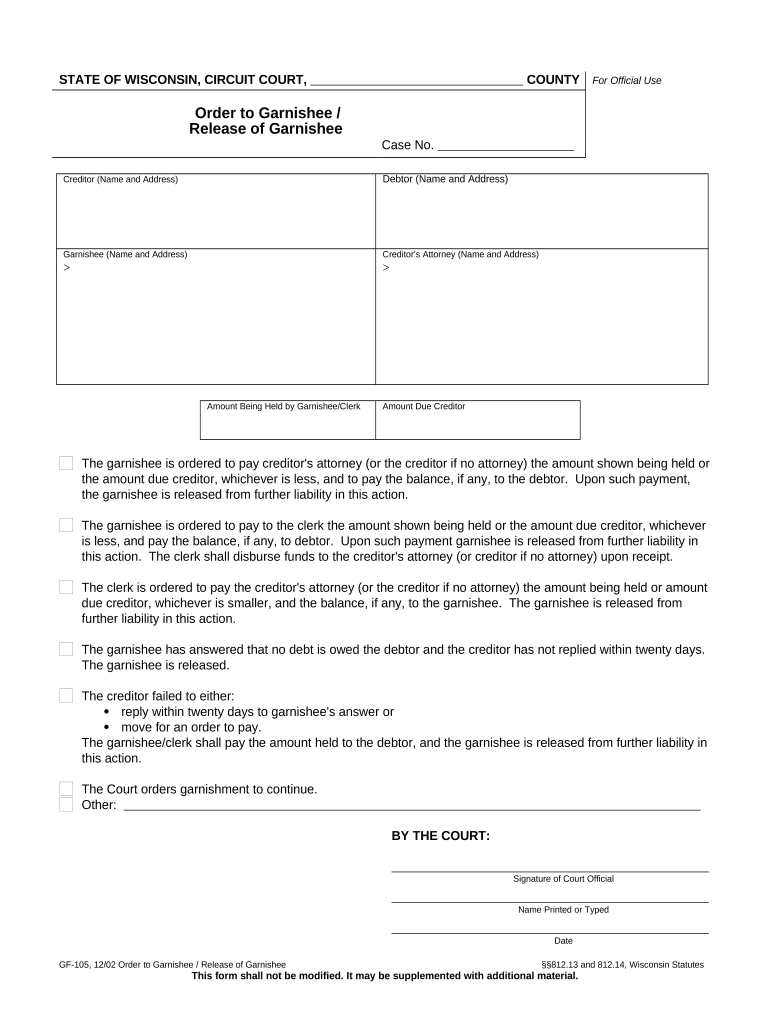
Order to Garnishee - Release of Garnishee - Wisconsin 2026

Get Form
wisconsin garnishment law Preview on Page 1

Here's how it works

01. Edit your wisconsin garnishment law online
Type text, add images, blackout confidential details, add comments, highlights and more.
02. Sign it in a few clicks
Draw your signature, type it, upload its image, or use your mobile device as a signature pad.
03. Share your form with others
Send wisconsin garnishment laws via email, link, or fax. You can also download it, export it or print it out.

How to use or fill out Order to Garnishee - Release of Garnishee - Wisconsin with DocHub

Form edit decoration
9.5
Ease of Setup
DocHub User Ratings on G2
9.0
Ease of Use
DocHub User Ratings on G2
  1. Click ‘Get Form’ to open the Order to Garnishee - Release of Garnishee in our editor.
  2. Begin by entering the case number at the top of the form. This is essential for identifying your specific garnishment case.
  3. Fill in the creditor's name and address in the designated fields. Ensure accuracy as this information is crucial for proper communication.
  4. Next, input the debtor's name and address. This identifies who is subject to garnishment.
  5. Enter the garnishee's name and address. The garnishee is typically the entity holding funds owed to the debtor.
  6. Provide details about the amount being held by the garnishee and the amount due to the creditor. This will determine payment distribution.
  7. Review all entries for accuracy before finalizing. Once satisfied, you can save or print your completed form directly from our platform.

Start using our platform today for free to streamline your document editing and signing process!

be ready to get more

Complete this form in 5 minutes or less

Get form

Got questions?

We have answers to the most popular questions from our customers. If you can't find an answer to your question, please contact us.
Contact us
If the garnishment of 20% of your disposable income would result in the income of your household being below the poverty line, the garnishment is limited to the amount of your households income in excess of the poverty line.
A writ of garnishment is a process by which the court orders the seizure or attachment of the property of a defendant or judgment debtor in the possession or control of a third party. The garnishee is the person or corporation in possession of the property of the defendant or judgment debtor.
812.33 Garnishee fees. (1) The creditor shall pay a $15 fee to the garnishee for each earnings garnishment or each stipulated extension of that earnings garnishment. This fee shall be included as a cost in the creditors claim in the earnings garnishment.
Wage Garnishment Limits In Wisconsin, collectors can only take 20% of your disposable income or whatever is left over after subtracting 30 times the federal minimum wage (30 x $7.25 = $217.50). Whichever of these amounts is smallest is the amount they can take.
Wisconsins wage garnishment laws impose stricter limits than federal law, limiting a garnishment to 20% of your disposable earnings in most cases. However, for a few types of debts, creditors can take more. Were looking for attorney matches in your area.

Security and compliance

At DocHub, your data security is our priority. We follow HIPAA, SOC2, GDPR, and other standards, so you can work on your documents with confidence.

Learn more
ccpa2
pci-dss
gdpr-compliance
hipaa
soc-compliance

People also ask

(1) The creditor shall pay a $15 fee to the garnishee for each earnings garnishment or each stipulated extension of that earnings garnishment. This fee shall be included as a cost in the creditors claim in the earnings garnishment.
Strategies to Stop Wage Garnishment in Wisconsin: A Practical Understand Your Rights: Verify the Validity of the Debt: Negotiate with Creditors: Request a Hearing: Explore Exemptions: Seek Legal Advice: Consider Chapter 128:
Garnishment fee means any service or legal processing fee, charged by a financial institution to an account holder, for processing a garnishment order or any associated withholding or release of funds.

Related links