Whats the difference between Form I-130 and i-130A?
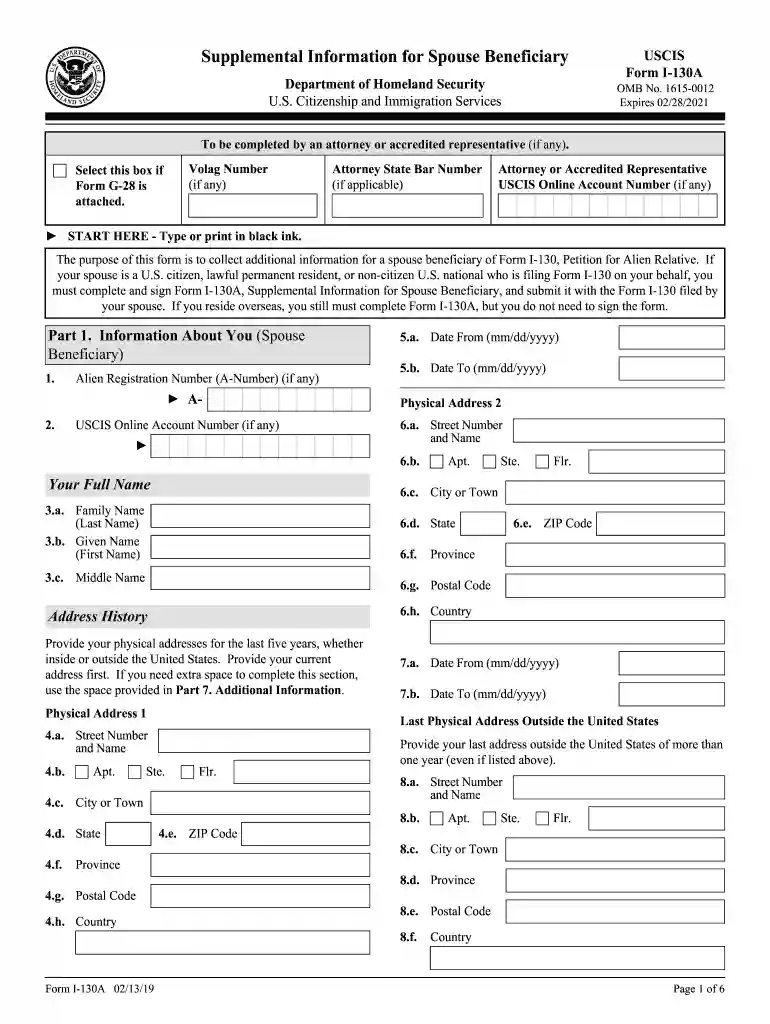
In the immigration procedure, Form I-130 and I-130A have different functions. Form I-130 is used to establish that you are indeed married to the individual you are sponsoring. On the contrary, the USCIS collects detailed information about the spouse beneficiary to verify the marital relationship using the Form I-130A.
What are common I-130 denial reasons?
Top 5 Reasons Your I-130 Family Petition Might Be Denied Insufficient Evidence of a Bona Fide Relationship. Criminal History of Petitioner or Beneficiary. Petitioner Is Not a U.S. Citizen or Lawful Permanent Resident. Prior Immigration Fraud or Misrepresentation in I-130 Petition. Jun 10, 2025
What is the difference between I-130 and i-130A?
Form I-130 establishes the relationship for immigration (e.g., U.S. citizen filing for a foreign spouse), while Form I-130A provides the spouse beneficiarys detailed personal and background history to USCIS, confirming the marriages legitimacy and is required in every marriage-based I-130 petition, filed together as a package. The I-130 is the main petition, and the I-130A is its essential supplemental form for spouses, detailing past residences, employment, and parents for the immigrant spouse. Form I-130: Petition for Alien Relative Purpose: Filed by a U.S. citizen or lawful permanent resident (the petitioner) to prove a qualifying family relationship (like spouse, parent, or child) with a foreign relative (the beneficiary). Who Files: The U.S. citizen or LPR sponsor. Form I-130A: Supplemental Information for Spouse Beneficiary Purpose: Gathers crucial biographical and background details from the foreign spouse to verify the authenticity of the marriage and prevent fraud. Who Files: The foreign spouse beneficiary (submitted by the I-130 petitioner). When: Required for all marriage-based I-130 petitions; not needed for other relatives (parents, children, siblings). Key Differences How They Work Together Roles: I-130 is the petition to establish the relationship; I-130A is the supplement to provide details about the beneficiary. Submission: They are filed together as one complete package, either by mail or uploaded as an attachment in the evidence section when filing the I-130 online. Requirement: The I-130A is mandatory for spousal petitions; failure to submit it can cause DocHub delays or requests for evidence (RFEs). AI can make mistakes, so double-check responsesForm I-130A - USCISThe purpose of this form is to collect additional information for a spouse beneficiary of Form I-130, Petition for Alien Relative.USCIS (.gov)*NEW* I-130A GUIDE Applies in 2026Sep 17, 2023 I am making an updated detailed guide for the form. I 138 in the first part of this video. I will mention some importaYouTube Kseniya International
How much is the fee for I-130A?
There is no fee for Form I-130A, as its a supplementary form for the main Form I-130 (Petition for Alien Relative); the fee applies only to the I-130 petition, which is currently $675 for paper filing or $625 for online filing, with potential discounts for online filers as part of recent fee rule changes, according to CitizenPath and Rebecca Kitson Law. Key Points: Form I-130A (Supplemental Information for Spouse Beneficiary): No fee. Its filed with Form I-130. Form I-130 (Petition for Alien Relative) Fee: Online Filing: $625 (as of recent changes). Paper Filing: $675 (as of recent changes). Where to find current fees: USCIS website for the official fee schedule. In Summary: You pay the I-130 fee, not the I-130A fee, when sponsoring a relative. Always check the official USCIS fee page for the most up-to-date costs before filing. AI can make mistakes, so double-check responsesI-130, Petition for Alien Relative - USCISDec 29, 2025 Filing Fee. You can find the filing fee for Form I-130 by visiting our Fee Schedule page.USCIS (.gov)USCIS Fee Chart - Rebecca Kitson LawRebecca Kitson Law
Who needs to fill out form I-130A?
Form I-130A, Supplemental Information for Spouse Beneficiary, must be filled out by the foreign-born spouse (the beneficiary) when a U.S. citizen or Lawful Permanent Resident (LPR) files Form I-130 to petition for them for a marriage-based green card. The beneficiary must complete the form with personal details, address history, and employment history for the last five years. If residing in the U.S., the spouse must sign it; if living abroad, they still complete it but dont sign, as the U.S. petitioner submits it. Who Needs to Complete It: The spouse who will receive the green card (the beneficiary). When Its Required: When a U.S. citizen or LPR sponsors their foreign-born spouse for immigration. Key Requirements: For Spouses in the U.S.: Must complete and sign Form I-130A. For Spouses Abroad: Must still complete Form I-130A but do not need to sign it. Submission: It must be submitted along with the main I-130 form filed by the U.S. citizen or LPR petitioner. Who Doesnt Need It: This form is only for marriage-based green card applications; its not for other family members like parents, children, or siblings. AI can make mistakes, so double-check responsesForm I-130A - USCISThe purpose of this form is to collect additional information for a spouse beneficiary of Form I-130, Petition for Alien Relative.USCIS (.gov)U.S. Immigration Form I-130A for Spouses Seeking a Green CardJul 25, 2025 Who needs to fill out the I-130A? The spouse seeking a marriage-based green card must complete the I-130A form and incBoundless Immigration