Dissociation questionnaire pdf 2026

Get Form
des ii online Preview on Page 1

Here's how it works

01. Edit your des ii online online
Type text, add images, blackout confidential details, add comments, highlights and more.

02. Sign it in a few clicks
Draw your signature, type it, upload its image, or use your mobile device as a signature pad.

03. Share your form with others
Send des ii fillable pdf via email, link, or fax. You can also download it, export it or print it out.

How to use or fill out dissociation questionnaire pdf with our platform

Form edit decoration
9.5
Ease of Setup
DocHub User Ratings on G2
9.0
Ease of Use
DocHub User Ratings on G2
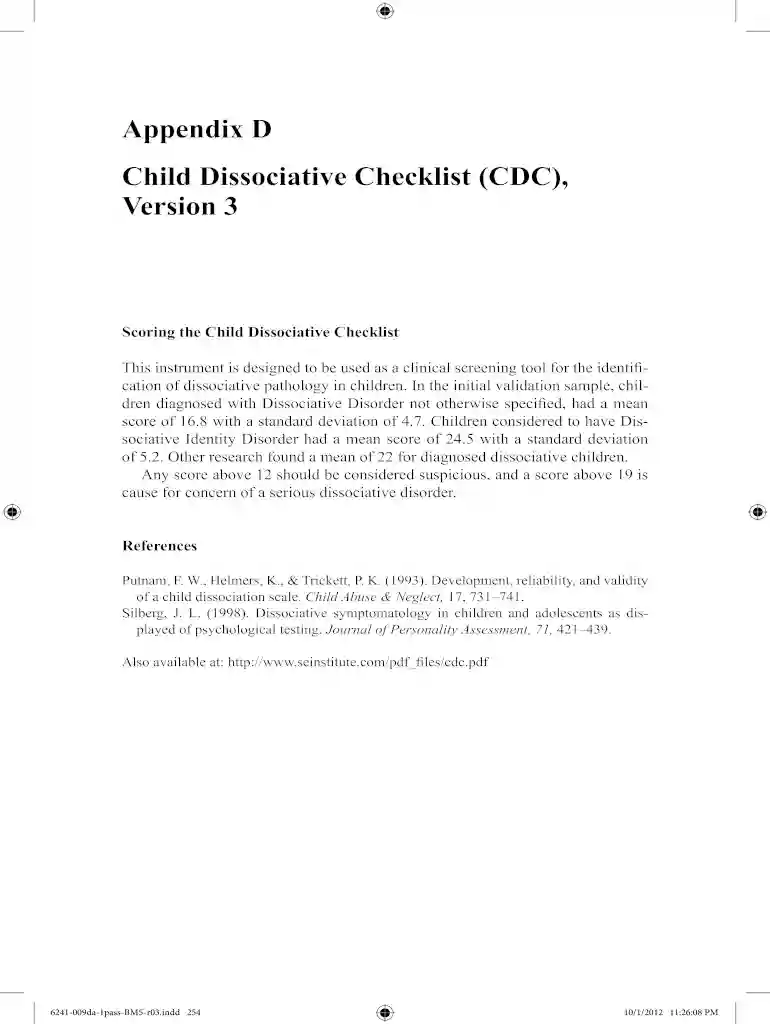
  1. Click ‘Get Form’ to open the Child Dissociative Checklist (CDC) in the editor.
  2. Begin by entering the date, age, and sex of the child at the top of the form. This information is crucial for accurate assessment.
  3. Review each behavior listed in the questionnaire carefully. For every item that describes your child NOW or WITHIN THE PAST 12 MONTHS, circle '2' if it is VERY TRUE, '1' if it is SOMEWHAT TRUE, and '0' if it is NOT TRUE.
  4. Continue through all 20 items, ensuring you provide thoughtful responses based on your observations. This will help in identifying any potential dissociative symptoms.
  5. Once completed, save your changes. You can easily export or share the filled-out form directly from our platform for further evaluation.

Start using our platform today to fill out your Child Dissociative Checklist effortlessly and for free!

See more dissociation questionnaire pdf versions

We've got more versions of the dissociation questionnaire pdf form. Select the right dissociation questionnaire pdf version from the list and start editing it straight away!
Versions Form popularity Fillable & printable
2012 4.8 Satisfied (206 Votes)
be ready to get more

Complete this form in 5 minutes or less

Get form

Got questions?

We have answers to the most popular questions from our customers. If you can't find an answer to your question, please contact us.
Contact us
This page offers some practical suggestions for helping you cope with dissociation, such as: Keep a journal. Try visualisation. Try grounding techniques. Think about practical strategies. Make a personal crisis plan. Talk to people with similar experiences. Look after your wellbeing. Dealing with stigma.
Many people may experience dissociation (dissociate) during their life. If you dissociate, you may feel disconnected from yourself and the world around you. For example, you may feel detached from your body or feel as though the world around you is unreal. Remember, everyones experience of dissociation is different.
The difference from active avoidance (on purpose avoiding thinking about or doing something) is that dissociation tends to happen without planning or even awareness. Many times, people who are dissociating are not even aware that it is happening, other people notice it.
Symptoms and signs of dissociative disorders depend on the type and severity, but may include: feeling disconnected from yourself. problems with handling intense emotions. sudden and unexpected shifts in mood for example, feeling very sad for no reason.
Furthermore, there are actually 5 types of dissociation: Depersonalization, derealization, amnesia, identity confusion, and identity alteration. Not all of them have to be present to constitute a dissociative disorder, but quite often they manifest in tandem and they can intensify if the disorder is not treated.

Security and compliance

At DocHub, your data security is our priority. We follow HIPAA, SOC2, GDPR, and other standards, so you can work on your documents with confidence.

Learn more
ccpa2
pci-dss
gdpr-compliance
hipaa
soc-compliance
be ready to get more

Complete this form in 5 minutes or less

Get form

People also ask

One of the arguments against dissociative identity disorder is that it is a disorder created by therapy -- it is iatrogenic; literally, its origin is in the treatment. So someone may go into hospital for a back operation during which the is ruptured.

dissociation scale