Increase your productivity with Welcome Letter for Tenants

Record management takes up to half of your office hours. With DocHub, you can reclaim your time and effort and increase your team's efficiency. Get Welcome Letter for Tenants category and explore all document templates relevant to your day-to-day workflows.

Effortlessly use Welcome Letter for Tenants:

  1. Open Welcome Letter for Tenants and apply Preview to obtain the suitable form.
  2. Click Get Form to begin working on it.
  3. Wait for your form to upload in our online editor and begin modifying it.
  4. Add new fillable fields, symbols, and pictures, change pages order, etc.
  5. Complete your form or prepare it for other contributors.
  6. Download or share the form by link, email attachment, or invite.

Improve your day-to-day document management with the Welcome Letter for Tenants. Get your free DocHub profile right now to explore all templates.
Video Guide on Welcome Letter for Tenants management

video background

Commonly Asked Questions about Welcome Letter for Tenants

How to write a welcome letter? Step 1-Begin with the letterhead/name/email address of the company for maximum attention. Step 2 Include the Date. Step 3-Greet the recipient. Step 4 Warm welcoming note along with brief information about the company.
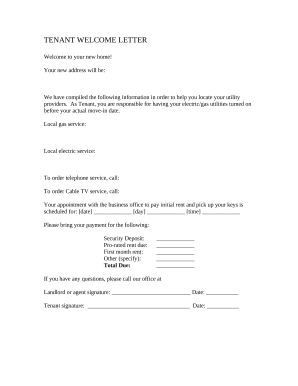
A welcome letter for tenants is a communication from a landlord or property manager to new tenants when they move into a rental property. It serves as an introduction between the two parties and provides tenants with the information they need to settle into their new rental smoothly.
A welcome letter is a way to set the tone for a new employees journey with a company. It is an opportunity to show excitement, introduce culture and values, and provide essential information about the employees role and responsibilities.
A welcome letter is a personalized document that your hiring manager will send to new colleagues within your business. It should include all the details that new employees need to feel prepared and excited about starting work.
The purpose of a non-binding letter of intent is to establish the framework for the lease negotiation process and incentivize good-faith negotiations. It allows the parties to explore various terms and conditions without being bound by legal obligations until a final lease agreement is executed.
The document can refer to a list of apartment rules and regulations and include a checklist of the units move-in condition. A comprehensive letter can include some or all of the following: A welcome to the apartment and the neighborhood.
A welcome letter is not a lease. However, a welcome letter can be used as evidence in court to show that tenancy was created.
Your welcome letter should provide the following information: Your contact information. How to set up utilities. Reminder that renters insurance is required. Where to pick up keys. Details about move-in day. Move-in day checklist. How to pay rent. How to report maintenance issues.