



Handle Summary Judgments easily online
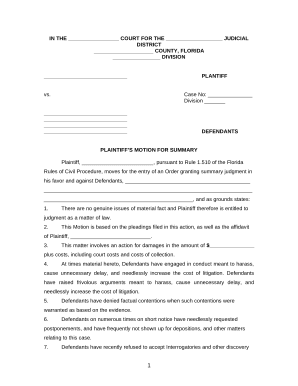
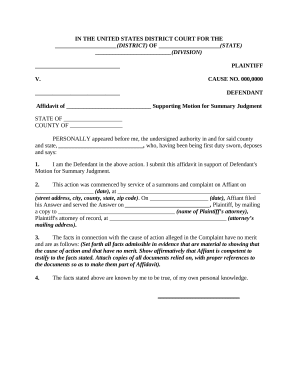
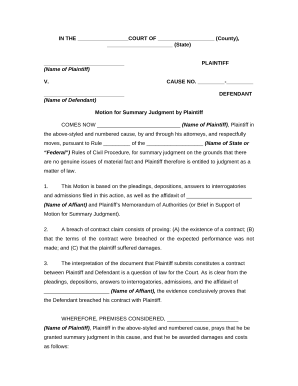
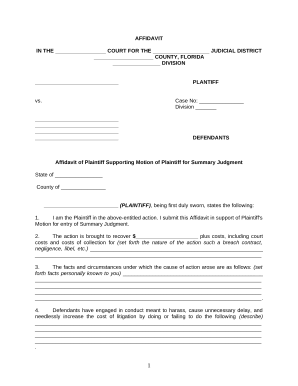
Document management can overpower you when you can’t find all of the forms you need. Fortunately, with DocHub's vast form categories, you can discover everything you need and quickly manage it without the need of changing between software. Get our Summary Judgments and start utilizing them.
How to use our Summary Judgments using these easy steps:
- Check Summary Judgments and select the form you need.
- Review the template and click on Get Form.
- Wait for it to open in the online editor.
- Change your form: add new information and pictures, and fillable fields or blackout some parts if required.
- Complete your form, save changes, and prepare it for delivering.
- When you are ready, download your form or share it with your contributors.
Try out DocHub and browse our Summary Judgments category without trouble. Get your free account today!
Video Guide on Summary Judgments management

Commonly Asked Questions about Summary Judgments
What is the difference between summary judgment and final judgment?
If the Court grants the full motion, the moving party obtains an appealable final judgment. On the other hand, if the judge grants summary judgment on only some claims, the order is not an appealable final judgment because some remaining claims/defenses in the case must be resolved.
What happens after summary judgment is granted?
Once the summary judgement is granted, the case ends there, and neither party will have to deal with the stresses of a full trial. At times, the winning party can ask for an award of costs or attorney fees from the other party unless those terms were already established in the summary judgment.
What happens after a summary judgement is denied?
When a motion for summary judgment is denied, the nonmoving party achieves a form of premium that enables a case to settle for an additional amount. Put simply, the settlement value of a case increases when a motion for summary judgment is denied. Thus, denials of summary judgment up the ante in the litigation game.
Is a summary judgement a settlement?
Summary judgment provides a good opportunity to settle your lawsuit. If summary judgment is denied, then the case will move forward to trial and the costs of litigation to both sides will likely increase substantially. If summary judgment is granted, then the entire case may be thrown out.
Why would you want a summary judgement?
In civil cases like this, a moving party asks the court to apply the law to an undisputed fact. Then, the court makes a ruling without proceeding to a full trial. Summary judgment streamlines the judicial process. It often saves both parties time and resources.
What is the summary judgement?
Understanding Summary Judgment There is a difference between a verdict and a summary judgment. A summary judgment is a decision made based on statements and evidence without going to trial. Its a final decision by a judge designed to resolve a lawsuit before trial.
What is a summary judgement in simple terms?
Summary judgment is a pretrial motion that promptly resolves legal actions where the parties have no genuine issues with any material fact. The court produces a judgment for one party against the opposing party without needing a full trial.
How it works How does summary judgment work?
In law, a summary judgment, also referred to as judgment as a matter of law or summary disposition, is a judgment entered by a court for one party and against another party summarily, i.e., without a full trial. Summary judgments may be issued on the merits of an entire case, or on discrete issues in that case. Summary judgment - Wikipedia wikipedia.org wiki Summaryjudgment wikipedia.org wiki Summaryjudgment
Effects What happens after a summary judgment is granted?
If the court granted summary judgment (not summary adjudication), a new-trial motion may be the best move for two reasons. First, a new-trial motion may get you exactly what you want a new trial! And, if successful, a two-month new-trial motion is much faster than a two-year appeal. Summary judgment granted and youre on the ropes: now what? plaintiffmagazine.com recent-issues item su plaintiffmagazine.com recent-issues item su
Purpose of a motion What is the purpose of a motion for summary judgment?
When bringing a summary judgment motion, a party is arguing that there can be no real dispute about material facts, and the moving party is entitled to win the case as a matter of law. What is a motion for summary judgment? - Bloomberg Law bloomberglaw.com insights litigation ho bloomberglaw.com insights litigation ho


