Get and manage Siding Contractor Agreement online

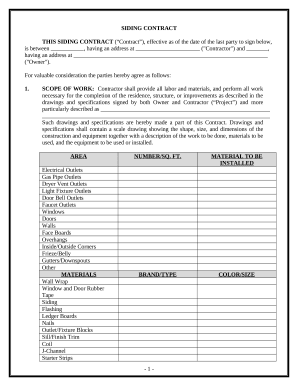
Speed up your document administration using our Siding Contractor Agreement online library with ready-made form templates that suit your requirements. Access the document, change it, fill it, and share it with your contributors without breaking a sweat. Begin working more efficiently together with your forms.

The best way to manage our Siding Contractor Agreement:

  1. Open our Siding Contractor Agreement and search for the form you require.
  2. Preview your document to ensure it’s what you want, and click on Get Form to start working on it.
  3. Change, add new text, or highlight important information with DocHub features.
  4. Prepare your form and preserve the changes.
  5. Download or share your document template with other people.

Discover all of the opportunities for your online file management using our Siding Contractor Agreement. Get a free free DocHub account right now!


Video Guide on Siding Contractor Agreement management

video background

Commonly Asked Questions about Siding Contractor Agreement

How to Write a Contractor Agreement Outline Services Provided. The contractor agreement should list all services the contractor will provide. Document Duration of the Work. Specify the duration of the working relationship. Outline Payment Terms. Outline Confidentiality Agreement. Consult with a Lawyer.
You can always negotiate with your contractor on the price of a successful project before signing a contract. Discuss your budget with your siding contractor. Agree that any unexpected project expenses will be presented in writing to help you remain within your budget.
On average, you can expect to pay $2$4 per square foot for siding repairs. Vinyl siding installation costs range from $2.15$5.25 per square foot. Typically, exterior painting costs anywhere from $1$4 per square foot.
When listing your pricing component, make sure you include: The total cost of siding materials. You can determine this by multiplying the materials cost per square foot by the homes total square footage. The total cost of additional materials. The cost of labor. Taxes. Overhead and profit margin.
Start with all square and rectangular walls, measuring height and width. Siding is ordered in squares. One square equals 100 square feet, so multiply height x width, then divide by 100 for total squares. If you are using different materials on different walls, you will want to keep these separate.
An independent contractor agreement is a contract that lays out the terms of the independent contractors work. It covers the contractual obligations, scope, and deadlines of the work to be performed.
1. The total cost of siding materials. You can determine this by multiplying the materials cost per square foot by the homes total square footage. So, if the project requires vinyl siding at around $3 per square foot for a 1,000-square-foot home, you can charge the homeowner $3,000 for material costs alone.
The average labor cost to siding is $1.50 to $4.50 per square foot on top of material costs. These rates vary depending on where you live and how large or complex your job is. Some contractors charge an hourly rate instead, typically between $40 and $90 per hour.