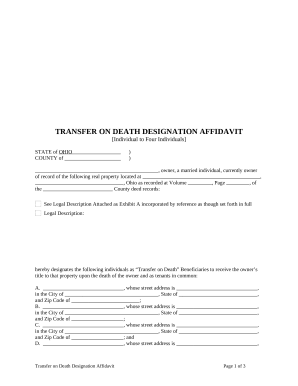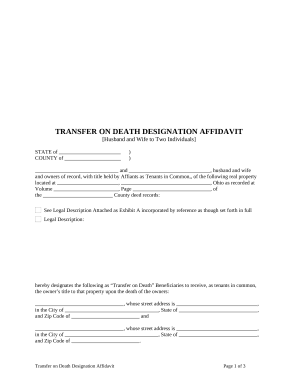
Improve your production with Real Estate TOD Forms

Form management consumes to half of your office hours. With DocHub, it is simple to reclaim your time and effort and boost your team's efficiency. Access Real Estate TOD Forms collection and check out all templates related to your everyday workflows.

The best way to use Real Estate TOD Forms:

  1. Open Real Estate TOD Forms and apply Preview to find the appropriate form.
  2. Click on Get Form to start working on it.
  3. Wait for your form to upload in our online editor and begin editing it.
  4. Add new fillable fields, icons, and pictures, adjust pages, etc.
  5. Fill out your form or set it for other contributors.
  6. Download or share the form by link, email attachment, or invite.

Accelerate your everyday document management with our Real Estate TOD Forms. Get your free DocHub account right now to discover all forms.


Video Guide on Real Estate TOD Forms management

video background

Commonly Asked Questions about Real Estate TOD Forms

A transfer on death, or TOD, is a designation that allows assets to pass directly to a beneficiary after they die. The account owner specifies the percentage of assets each beneficiary receives, allowing their executor to distribute without first passing through probate.
Although a transfer on death deed appears to have simplicity, there are many shortcomings. The first of which is that, if the named beneficiary dies before the property owner does, the deed becomes invalid. The property could then fall into probate upon the owners death.
A Transfer on Death Deed can be a great way to ensure your loved ones or Beneficiaries get the inheritance you intend. It streamlines the process, allowing for a simple transfer of property ownership without the headache, cost and time that probate requires.
Transfer-on-death (TOD) refers to named beneficiaries that receive assets at the death of the property owner without the need for probate, facilitating the executors disposition of the property owners assets after their death.
A Transfer on Death (TOD) deed must meet specific requirements to be effective and legally binding. The deed must include language that the transfer to the designated beneficiary occurs at the transferors death. All deeds require a notary, but this particular deed requires two witnesses (like a Will).
However, there are many cons of TOD deeds: TOD Deeds do not always avoid probate. If a named beneficiary becomes disabled prior to the death of the owner, a disabled beneficiary could be knocked off of public benefits, such as SSI and Medicaid. Are Transfer on Death (TOD) Deeds a Good Alternative to Estate Planning? farrlawfirm.com are-transfer-on-death-dee farrlawfirm.com are-transfer-on-death-dee
The Revocable Transfer on Death Deed, also called TOD Deed or beneficiary deed, is a simple way to leave a residence to your beneficiaries without the need for probate.