


Create your Real Estate TOD Form from scratch

Start Building Now
Title decoration

Here's how it works

01. Start with a blank Real Estate TOD Form
Open the blank document in the editor, set the document view, and add extra pages if applicable.
02. Add and configure fillable fields
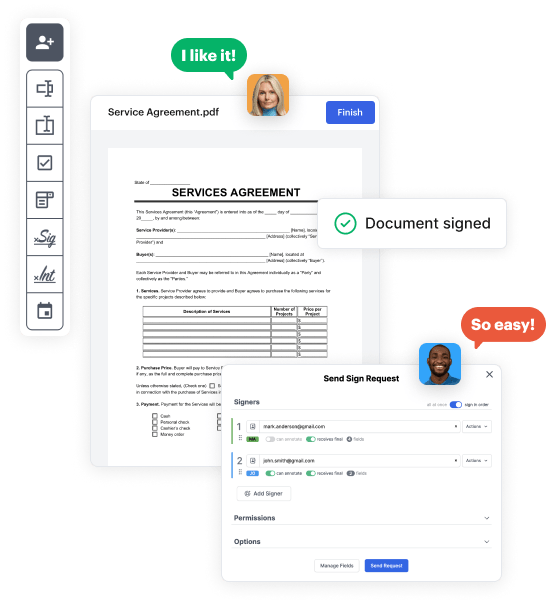
Use the top toolbar to insert fields like text and signature boxes, radio buttons, checkboxes, and more. Assign users to fields.
03. Distribute your form
Share your Real Estate TOD Form in seconds via email or a link. You can also download it, export it, or print it out.

A simple tutorial on how to create a polished Real Estate TOD Form

Form edit decoration

Step 1: Sign in to DocHub to begin creating your Real Estate TOD Form.

First, sign in to your DocHub account. If you don't have one, you can easily register for free.

Step 2: Go to the dashboard.

Once logged in, go to your dashboard. This is your central hub for all document-focused tasks.

Step 3: Initiate new document creation.

In your dashboard, hit New Document in the upper left corner. Pick Create Blank Document to put together the Real Estate TOD Form from the ground up.

Step 4: Add template elements.

Add numerous fields like text boxes, photos, signature fields, and other elements to your template and designate these fields to intended recipients as necessary.

Step 5: Configure your form.

Customize your form by incorporating instructions or any other vital information using the text feature.

Step 6: Review and modify the document.

Thoroughly go over your created Real Estate TOD Form for any mistakes or required adjustments. Leverage DocHub's editing capabilities to polish your form.

Step 7: Send out or export the form.

After completing, save your file. You can opt to save it within DocHub, transfer it to various storage platforms, or forward it via a link or email.


be ready to get more

Build your Real Estate TOD Form in minutes

Start creating now

Got questions?

We have answers to the most popular questions from our customers. If you can't find an answer to your question, please contact us.
Contact us
Filling Out and Recording a TOD deed Locate the Current Deed for the Property. Read the Common Questions Listed on Page 3-4 of the TOD Deed. Fill Out the TOD Deed (Do Not Sign) Sign in Front of a Notary; Have Two Witnesses Sign. Record the Deed at the Recorders Office within 60 Days of Notarizing It.
Transfer on Death (TOD) As the sole owner of a motor vehicle, watercraft, or outboard motor, an individual may designate a beneficiary or beneficiaries to an Ohio title with a signed and docHubd Affidavit to Designate a Beneficiary (form BMV 3811) submitted to a County Clerk of Courts Title Office.
A transfer on death deed (TODD) allows property owners in Ohio, and certain other states, to pass real estate directly to a designated beneficiary upon their death. This estate planning tool can help you avoid probate, and thereby save on time and money. To help protect your assets, talk to a financial advisor.
You can also get it from the County Auditors office. The County Recorders reference number, or volume and deed book number, stamped on your deed. If possible, have a lawyer review the form. Its important to complete the form properly to make sure that your property transfers the way you want it to.
If a transfer on death beneficiary does not survive the deceased owner or is not in existence on the date of the deceased owners death, and the deceased owner has designated one or more persons as contingent transfer on death beneficiaries as provided in division (B)(2) of this section, the designated contingent
be ready to get more

Build your Real Estate TOD Form in minutes

Start creating now

Related Q&A to Real Estate TOD Form

How to Complete a Texas Transfer-on-Death Deed Fill out the deed. Sign the deed in front of a notary public. Give the deed to the beneficiary. Upon your death, the beneficiary must provide proof of your death and file the deed with the county clerks office in the county where the property is located.
Although a transfer on death deed appears to have simplicity, there are many shortcomings. The first of which is that, if the named beneficiary dies before the property owner does, the deed becomes invalid. The property could then fall into probate upon the owners death.
Disadvantages of transfer on death deeds Creditors may come after the new owner(s) of the property. Beneficiaries may get equal shares of the asset. Not available in many states. Unintentional disinheritance. Raises the risk that estate planning documents dont match.

Additional resources on building your forms