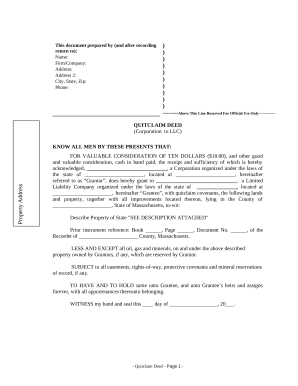
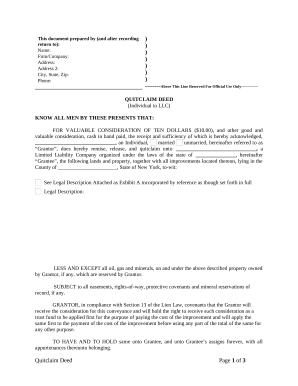
Improve your document operations with LLC Real Estate Transfer

Your workflows always benefit when you are able to obtain all of the forms and documents you will need on hand. DocHub offers a a huge collection of documents to alleviate your day-to-day pains. Get hold of LLC Real Estate Transfer category and quickly find your form.

Start working with LLC Real Estate Transfer in several clicks:

  1. Browse LLC Real Estate Transfer and locate the form you need.
  2. Click Get Form to open it in the editor.
  3. Start editing your form: add more fillable fields, highlight paragraphs, or blackout sensitive data.
  4. The application saves your modifications automatically, and once you are all set, you can download or share your form with other contributors.

Enjoy smooth form management with DocHub. Discover our LLC Real Estate Transfer online library and find your form today!


Video Guide on LLC Real Estate Transfer management

video background

Commonly Asked Questions about LLC Real Estate Transfer

Con: You may pay additional taxes For example, some states have a title transfer fee. That means youd pay when moving ownership from yourself to your new LLC. Also, other states require you to pay franchise tax, which will either be a percentage of the net worth of the LLC or a flat fee.
If the property has appreciated in value, a capital gains tax might apply. However, if the LLC is a single-member entity classified as a disregarded entity for tax purposes, the transfer generally has no immediate tax consequences.
Protects From Personal Liability You may own the LLC, but the LLC does not own you or your personal assets. When LLCs own a property, the owner of those LLCs are removed from any liability.
None. However, if you elect to treat your LLC as an S-Corp you might run into another level of unnecessary taxation. Heres why- rental properties are considered passive income even if you actively or materially participate in the rental activity.
Benefits of Forming a California LLC for Rental Property Separation of Personal Assets from Real Estate Holdings. Liability Limitation. Protections Against Liens Against Identically Titled Properties. Personal Liability Protection Among Members. Trusts Generally Do Not Provide Asset Protection or Limited Liability.
Yes, but it is limited and the treatment depends on how the LLC is taxed, says Crystal Stranger, Partner and Chief Operating Officer at Cleer Tax Bookkeeping. If [the LLC is taxed as] a sole proprietorship, [mortgage interest can be deducted on Schedule E of Form 1040, she explains.
Transferring your property into an LLC can activate the due-on-sale clause of your mortgage, requiring the balance to be paid in full.
The 2% rule is a rule of thumb that determines how much rental income a property should theoretically be able to generate. Following the 2% rule, an investor can expect to realize a positive cash flow from a rental property if the monthly rent is at least 2% of the purchase price.