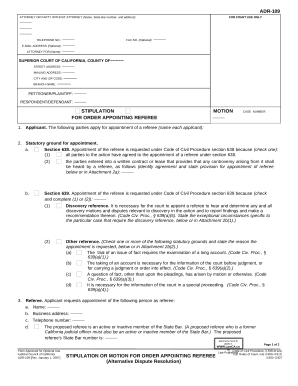
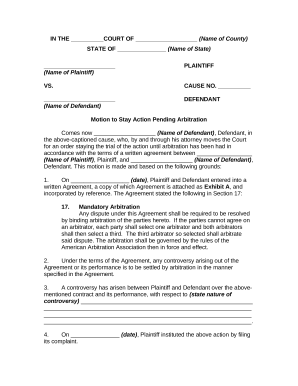
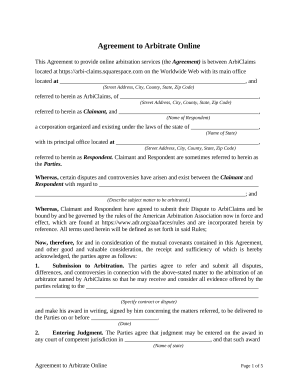
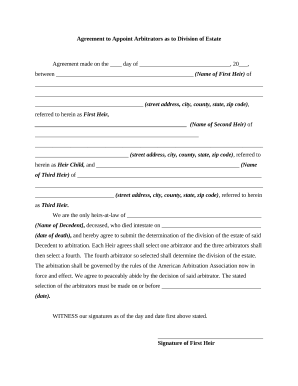
Transform your form management with Legal Forms for Arbitration

Your workflows always benefit when you can easily find all of the forms and documents you will need at your fingertips. DocHub gives a a huge library of forms to alleviate your everyday pains. Get hold of Legal Forms for Arbitration category and quickly find your form.

Start working with Legal Forms for Arbitration in several clicks:

  1. Open Legal Forms for Arbitration and locate the form you require.
  2. Click on Get Form to open it in the editor.
  3. Begin editing your document: add more fillable fields, highlight sentences, or blackout sensitive data.
  4. The app saves your changes automatically, and once you are all set, you are able to download or distribute your file with other contributors.

Enjoy fast and easy file administration with DocHub. Explore our Legal Forms for Arbitration collection and find your form right now!


Video Guide on Legal Forms for Arbitration management

video background

Commonly Asked Questions about Legal Forms for Arbitration

The Scope of the Clause. This section of the clause is critical; it sets the boundaries for which disputes the tribunal is authorised to determine. Choice of Rules. The Number of Arbitrators. Appointing Authority. Choice of Venue. The language of the proceedings. Finality. Exclusion of the right of appeal.
By signing a contract with an arbitration clause, parties agree to be bound by the decision of the arbitrator. For example, Company A contracts to purchase inventory parts from Company B, and the contract includes an arbitration clause. The parts are later found to be faulty, causing Company A to lose revenue.
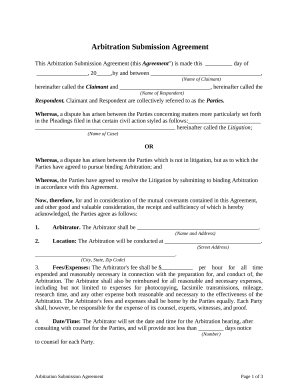
Arbitration is a procedure in which a dispute is submitted, by agreement of the parties, to one or more arbitrators who make a binding decision on the dispute. In choosing arbitration, the parties opt for a private dispute resolution procedure instead of going to court.
Arbitration agreements are common in consumer contracts and employment contracts, but they can be proposed additions to any contract negotiation in which one or both parties would like to head off the possibility of a future lawsuit.
Arbitration agreements require that persons who signed them resolve any disputes by binding arbitration, rather than in court before a judge and/or jury. What is binding arbitration? Binding arbitration involves the submission of a dispute to a neutral party who hears the case and makes a decision.
Judicial Arbitration is like a trial. But it is less formal and there is no jury. Each side presents its case to a neutral person, also called arbitrator. The arbitrator is either a lawyer or a retired judge, and does not take sides or give advice. For more information, see the frequently asked questions below.
Arbitration is similar to going to court, but faster, cheaper and less complex than litigation. If the case settles, an arbitration will last around one year. If the case goes to hearing, an arbitration typically takes 16 months. There are typically seven stages of the arbitration process: Claimant Files a Claim.
Arbitration has four types of functions: resolving contractual disputes between management and labor, addressing interests of different parties in bargaining situations such as public sector labor relations, settling litigated claims through court-annexed programs, and resolving community disputes.
Arbitration is similar to going to court, but more efficient, cost effective, and less complex than litigation. It is a formal process where parties select a neutral third party, called an arbitrator, to resolve a dispute.
The brief should include identification of the parties, a concise description of the facts, and applicable case law and statutes. The briefs should be submitted to the arbitrator at least 2 days prior to the arbitration hearing.