Improve your form managing with US Civil Actions Documents

Your workflows always benefit when you can get all the forms and files you will need at your fingertips. DocHub provides a vast array of form templates to alleviate your day-to-day pains. Get hold of US Civil Actions Documents category and quickly browse for your document.

Start working with US Civil Actions Documents in several clicks:

  1. Gain access to US Civil Actions Documents and discover the form you need.
  2. Click Get Form to open it in our editor.
  3. Begin changing your form: add more fillable fields, highlight sentences, or blackout sensitive data.
  4. The app saves your changes automatically, and once you are all set, you can download or share your form with other contributors.

Enjoy seamless form administration with DocHub. Check out our US Civil Actions Documents online library and get your form right now!


Video Guide on US Civil Actions Documents management

video background

Commonly Asked Questions about US Civil Actions Documents

Standard of proof In most civil cases, the judge or jury has to make a decision about which side wins based on a standard called preponderance of the evidence. This means that, if you win, your side of the story is more likely than not. It does not mean that one side brought in more evidence than the other side.
In California, there are three main standards of evidence used: preponderance of the evidence, clear and convincing evidence, and beyond a reasonable doubt. The preponderance of the evidence is the lowest standard of proof in a civil case.
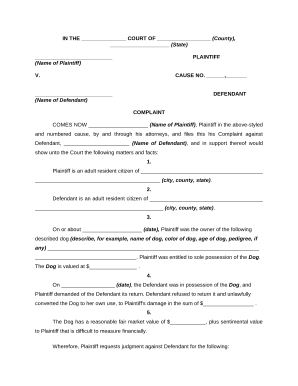
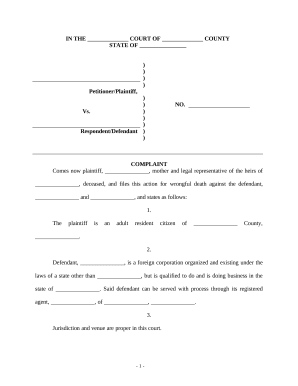
The complaint is the document that sets out the Plaintiffs charges against the Defendant.
The civil standard of proof is proof on a balance of probabilities. The criminal standard is proof beyond a reasonable doubt.
In 1970, the Court held in In re Winship that the due process clauses of the Fifth and Fourteenth Amendments [protect] the accused against conviction except upon proof beyond a reasonable doubt of every fact necessary to constitute the crime with which he is charged.
Beyond a Reasonable Doubt This is the standard the U.S. Constitution requires the government to meet in order to prove a defendant guilty of a crime. (In re Winship, 397 U.S. 358, 364 (1970).) Courts over the years have debated the extent to which the government has to prove its case to meet this high standard.
In civil cases, the plaintiff has the burden of proving their case by a preponderance of the evidence, which means the plaintiff merely needs to show that the fact in dispute is more likely than not.
Federal case files are maintained electronically and are available through the internet-based Public Access to Court Electronic Records (PACER) service. PACER allows anyone with an account to search and locate appellate, district, and bankruptcy court case and docket information. Register for a PACER account.