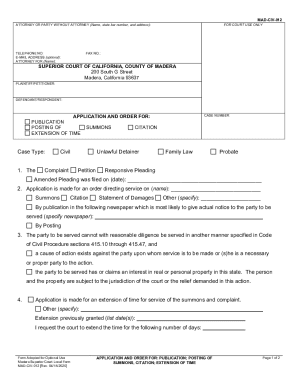
Manage Legal Contracts for Timber Sale quickly online

Document management can stress you when you can’t find all the forms you require. Luckily, with DocHub's vast form categories, you can discover everything you need and easily deal with it without switching among apps. Get our Legal Contracts for Timber Sale and start utilizing them.

How to use our Legal Contracts for Timber Sale using these easy steps:

  1. Check Legal Contracts for Timber Sale and select the form you require.
  2. Preview the template and click on Get Form.
  3. Wait for it to upload in our online editor.
  4. Adjust your form: include new information and pictures, and fillable fields or blackout some parts if necessary.
  5. Complete your form, conserve changes, and prepare it for delivering.
  6. When ready, download your form or share it with your contributors.

Try out DocHub and browse our Legal Contracts for Timber Sale category without trouble. Get your free profile today!


Video Guide on Legal Contracts for Timber Sale management

video background

Commonly Asked Questions about Legal Contracts for Timber Sale

The timber yield tax is a property tax based on the value of your standing timber. Other taxes, including sales tax and state and federal income tax, may apply to your operation.
How to report sale of lumber using Capital Gains- Schedule D: You may receive income by cutting timber and opting to treat that cutting as a sale, or by disposing of standing timber, which is known as stumpage. In this case the income is treated as a Capital Gain and is reported by the taxpayer on their Schedule D.
There are three common types of payments involved in a timber sale contract: lump sum, per unit, and blended price. The lump sum payment is the simplest type. The landowner and timber buyer negotiate upfront, or by means of a sealed bid, a set price for the timber that will be harvested. An Introduction to Timber Sale Contracts | Land-Grant Press Land-Grant Press Publications Land-Grant Press Publications
For investors, income on the sale of standing timber is a capital gain. Depending on the holding period, it can be long-term or short-term, but it is usually included in the net investment income for net investment income tax.
When you sell timber, the profit or loss you make is taxed as a capital gain or loss. Capital gains and losses are classified as either short-term or long-term based on how long you held the asset before selling it. The holding period for timber depends on how you acquired it. How to Report Sale of Timber on Tax Return - Corvee Corvee blog how-to-report-sale-of-timber Corvee blog how-to-report-sale-of-timber
Type of Forest Activity Generally, the maximum long- term capital gains rate for timber is 15 percent (for taxpayers in the 10 or 15 percent ordinary income tax brackets, the maximum long-term capital gains rate is 5 percent).
Basic Rule - The gain or loss on the sale or other disposal of timber is determined by reducing the amount received for the timber by the cost or other basis of the timber and any expenses incurred in making the sale or other disposal. Gain or Loss - National Timber Tax Website National Timber Tax Website getstarted sales basicrule National Timber Tax Website getstarted sales basicrule
How to report sale of lumber using Capital Gains- Schedule D: You may receive income by cutting timber and opting to treat that cutting as a sale, or by disposing of standing timber, which is known as stumpage. In this case the income is treated as a Capital Gain and is reported by the taxpayer on their Schedule D. How do I report Form 1099-S (Sale of Timber)? - TaxSlayer Support TaxSlayer Support en-us articles 360015 TaxSlayer Support en-us articles 360015