Massachusetts Forest Products Timber Sale Contract - Massachusetts 2026

Get Form
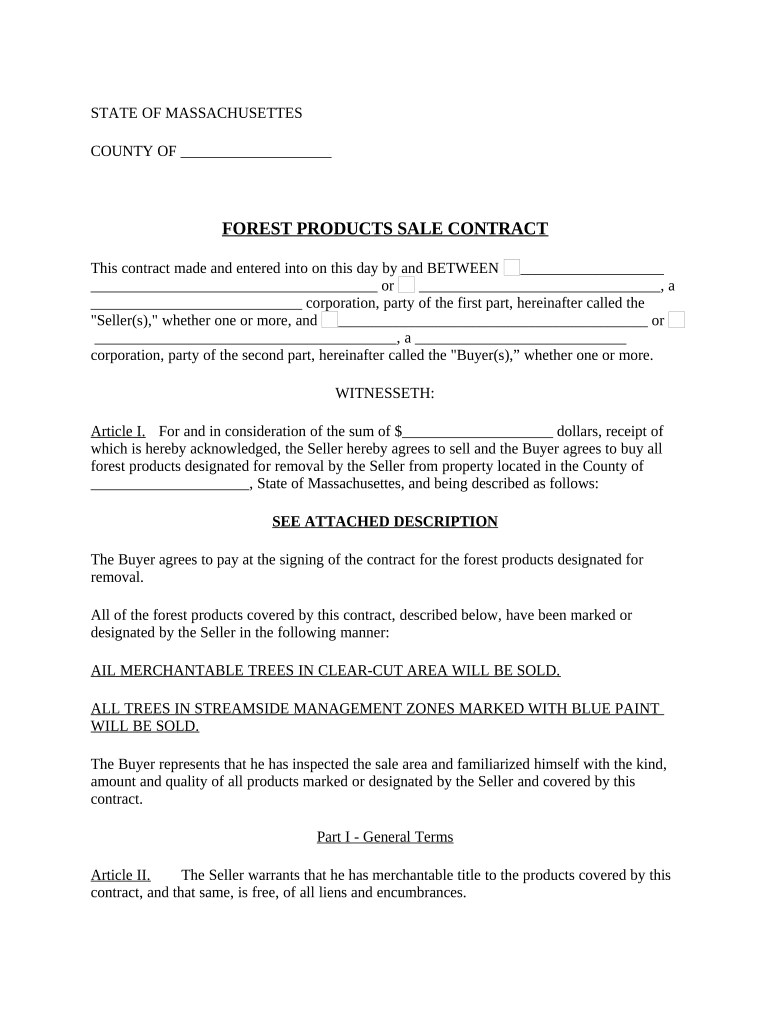
Massachusetts Forest Products Timber Sale Contract - Massachusetts Preview on Page 1

Here's how it works

01. Edit your form online
Type text, add images, blackout confidential details, add comments, highlights and more.
02. Sign it in a few clicks
Draw your signature, type it, upload its image, or use your mobile device as a signature pad.
03. Share your form with others
Send it via email, link, or fax. You can also download it, export it or print it out.

How to use or fill out Massachusetts Forest Products Timber Sale Contract - Massachusetts with our platform

Form edit decoration
9.5
Ease of Setup
DocHub User Ratings on G2
9.0
Ease of Use
DocHub User Ratings on G2
  1. Click ‘Get Form’ to open the Massachusetts Forest Products Timber Sale Contract in the editor.
  2. Begin by filling in the names of the Seller(s) and Buyer(s) at the top of the contract. Ensure that you specify whether they are individuals or corporations.
  3. In Article I, enter the sale amount and provide a detailed description of the property from which forest products will be removed. Attach any necessary documentation as indicated.
  4. Complete Part I by detailing general terms, including payment conditions and responsibilities regarding ingress and egress for timber removal.
  5. In Part II, outline performance requirements such as road maintenance and fire prevention measures. Fill in any specified rates for damaged trees as needed.
  6. Finalize by signing and dating the contract at the bottom, ensuring all parties have witnessed signatures where required.

Start using our platform today to easily complete your Massachusetts Forest Products Timber Sale Contract online for free!

be ready to get more

Complete this form in 5 minutes or less

Get form

Got questions?

We have answers to the most popular questions from our customers. If you can't find an answer to your question, please contact us.
Contact us
The Forest Services heavily subsidized timber sale program has long been criticized for spending more money to get timber ready for selling than it receives in sales. According to the General Accounting Office, the Forest Services timber sale program lost $1 billion between 1995 and 1997.
The FCPA protects the benefits of forests through a permitting process. Applicable to timber harvesting on both public and private forestland, the FCPA regulates any commercial timber cutting of wood products greater than 25 thousand board feet or 50 cords on any parcel of land at any one time.
You can advertise your timber through local timber markets, mills, or logging companies. You can also docHub out to forestry organizations and associations for recommendations on reputable buyers. Its important to get multiple bids to compare prices and choose the best offer.
Timberland. A minimum of 10-20 acres is typically needed to contract a logging company to harvest your timber. Modern, efficient logging operations require high capital investments in equipment and harvesting low volumes on small acreages is usually not financially feasible.
Shrinking and swelling occur as the wood changes moisture content in response to daily as well as seasonal changes in the relative humidity of the atmosphere, i.e., when the air is humid, wood adsorbs moisture and swells; when the air is dry, wood loses moisture and shrinks.

Security and compliance

At DocHub, your data security is our priority. We follow HIPAA, SOC2, GDPR, and other standards, so you can work on your documents with confidence.

Learn more
ccpa2
pci-dss
gdpr-compliance
hipaa
soc-compliance

People also ask

A timber sale contract is the most important document involved in conducting a timber sale. A well-prepared contract ensures the understanding of all parties. This Forestry Fact describes and clarifies the attached Sample Timber Sale Contract. The sample contract suggests key elements for inclusion in your agreement.
Timber and wood products are recognised as among the most profitable product categories for many builders merchants, representing up to a quarter of a general merchants turnover.
A typical timber sale contract usually contains the following: a description of the timber to be sold (estimated volume, number of trees and species), which timber will and will not be cut, the selling price (either lump sum or unit price), terms of payment, the location and boundaries of the sale, and time allowed to

Related links