Boost your efficiency with Church Employment Contracts

Record administration consumes to half of your business hours. With DocHub, it is easy to reclaim your time and effort and increase your team's productivity. Access Church Employment Contracts category and check out all form templates related to your everyday workflows.

Easily use Church Employment Contracts:

  1. Open Church Employment Contracts and apply Preview to get the relevant form.
  2. Click Get Form to start working on it.
  3. Wait for your form to upload in our online editor and start editing it.
  4. Add new fillable fields, symbols, and images, adjust pages order, etc.
  5. Complete your form or prepare it for other contributors.
  6. Download or share the form by link, email attachment, or invite.

Boost your everyday file administration using our Church Employment Contracts. Get your free DocHub profile right now to discover all templates.


Video Guide on Church Employment Contracts management

video background

Commonly Asked Questions about Church Employment Contracts

Paulalong with the rest of the Biblesimultaneously affirms that ministers deserve pay and yet that ministers ought to serve free of charge. Consider when Jesus sends out the disciples to proclaim the gospel. He tells them first, You received without paying; give without pay (Matt. 10:8).
How Much Do Pastor Jobs Pay per Year? $45,000 is the 25th percentile. Salaries below this are outliers. $69,500 is the 75th percentile.
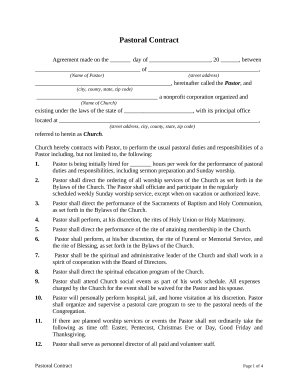
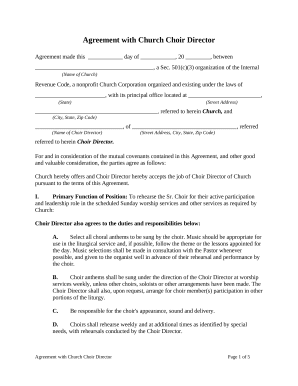
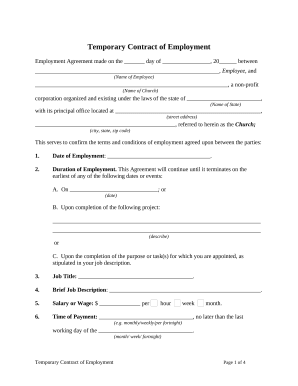
The relationship between a minister and church is contractual in nature. The contract may be expressed in a signed document, or it may be implied. Either way, there are important legal consequences resulting from the contract. The relationship between a minister and church is based on contract.
Pastoral Compensation This is a primary role of the church board to take care of the compensation of the pastor. A starting point for any church board in the area of compensation is to talk about and cultivate a spirit of generosity. This comes naturally for some boards.
Had he failed to model the Christian life and lead the church toward maturity in Christ (I Timothy 3:17; Hebrews 13:17)? Had he committed open sins worthy of public rebuke (1 Timothy 5:1920)? If any of these issues were the case, then removal would be justified, although not in a scheming way.