




01. Edit your form online
Type text, add images, blackout confidential details, add comments, highlights and more.

Type text, add images, blackout confidential details, add comments, highlights and more.

Draw your signature, type it, upload its image, or use your mobile device as a signature pad.

Send it via email, link, or fax. You can also download it, export it or print it out.
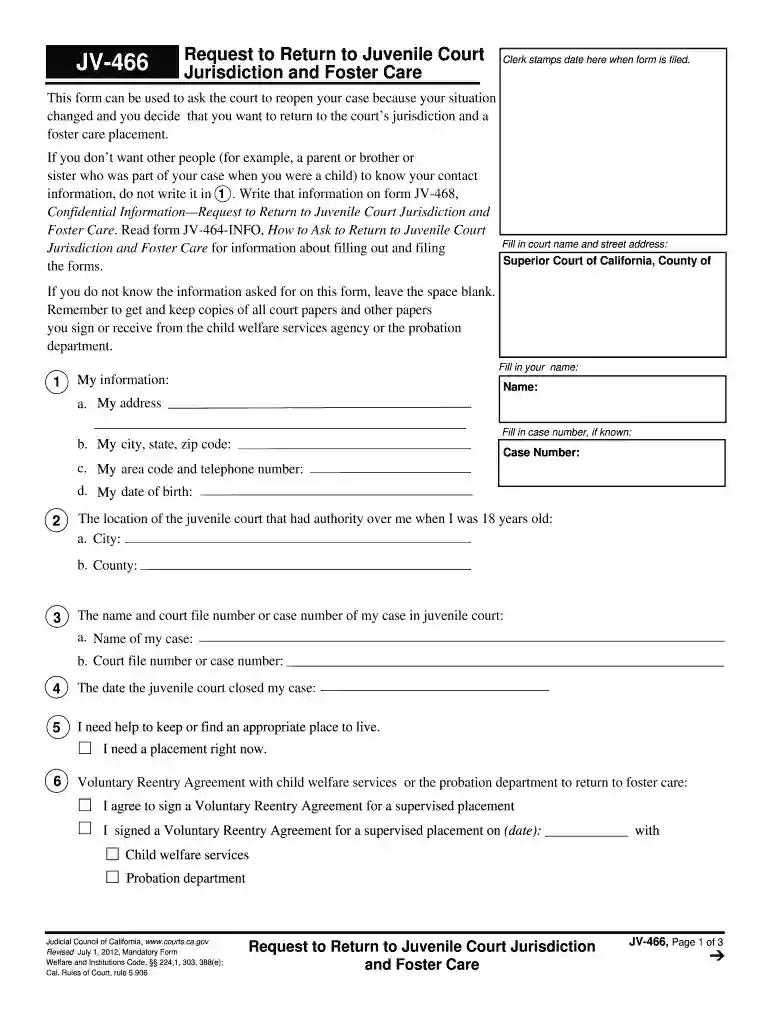
The JV form is a legal document used to request the reopening of a closed juvenile court case in the United States. It is primarily utilized by individuals who wish to return under the court's jurisdiction to seek foster care placement, usually due to new circumstances or changes in their living situation. The form requires detailed information about the applicant, their personal history, the context of the original court case, and the reasons for seeking reentry into foster care. Confidentiality issues and conditions for reentry are also addressed within the form.
To use the JV form effectively, individuals need to gather all relevant information before starting the application. This includes personal identification details, specifics of the previous juvenile court case, any changes in circumstances that warrant the reopening of the case, and information about intended foster care placement. The form must be filled out accurately, ensuring that all sections are completed and that any supporting documentation is included. Once filled, the form is submitted to the appropriate juvenile court for consideration.
The JV form is commonly used by former foster care youth or their representatives seeking to reestablish court oversight due to significant changes in personal circumstances. Social workers or legal guardians may also use this form on behalf of the individual to facilitate the process of returning to foster care systems where additional support may be provided.


Understanding key terms in the JV form is crucial:
The legality of using the JV form is grounded in its function to ensure that individuals who might need additional state intervention can legally request to reopen their cases. This form helps re-institute court oversight to assess the new circumstances and decide on the necessity of foster care reentry, ensuring that affected individuals receive the care and protection needed under law. Legal guardians typically guide applicants through this process to comply with legislative requirements.
Critical sections of the JV form include:
Different states may have unique requirements related to the submission and handling of the JV form. Some states could have specific eligibility criteria or supporting document requirements due to varying juvenile laws and foster care systems. It is crucial for applicants to verify any state-specific rules that might impact the processing of their form. Understanding these nuances can help in avoiding delays and ensuring compliance with all regulatory stipulations.
We've got more versions of the jv 466 2012 form form. Select the right jv 466 2012 form version from the list and start editing it straight away!
At DocHub, your data security is our priority. We follow HIPAA, SOC2, GDPR, and other standards, so you can work on your documents with confidence.
See form info Download JV-466 *. Request to Return to Juvenile Court Jurisdiction and Foster Care. Effective: January 1, 2019 See form info Download JV-
Dec 31, 2019 Title of each class. Trading Symbol(s). Name of each exchange on which registered. Common stock, par value $0.06 per share.


