Handle Gift in kind Donation Forms easily online

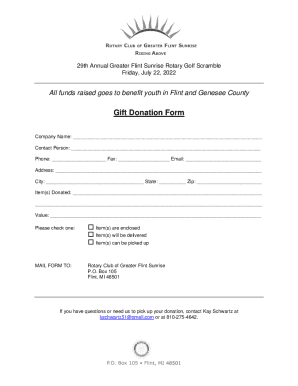
Document management can overwhelm you when you can’t find all the forms you need. Luckily, with DocHub's vast form collection, you can discover everything you need and swiftly take care of it without switching between software. Get our Gift in kind Donation Forms and begin utilizing them.

How to use our Gift in kind Donation Forms using these simple steps:

  1. Check Gift in kind Donation Forms and choose the form you need.
  2. Preview the template and click on Get Form.
  3. Wait for it to upload in our online editor.
  4. Adjust your form: add new information and images, and fillable fields or blackout certain parts if required.
  5. Fill out your form, save alterations, and prepare it for delivering.
  6. When all set, download your form or share it with other contributors.

Try out DocHub and browse our Gift in kind Donation Forms category with ease. Get your free account today!


Video Guide on Gift in kind Donation Forms management

video background

Commonly Asked Questions about Gift in kind Donation Forms

Here is a simple example of an acknowledgment statement to an in-kind donation: Thank you for your contribution of [detailed description of goods/services] that [name nonprofit] received on [date of receipt]. No goods or services were provided in exchange for your contribution.
In-kind donations of property are typically tax deductible, but the IRS will not allow taxpayers to deduct contributions of $250 or more unless they obtain a written acknowledgment from the recipient charitable organization.
You can calculate the value of that staff by dividing their combined annual salary by 2,080 (the number of hours in a 52-week work year) to obtain the hourly rate, then multiplying by the number of hours of service. The result is the value of their in-kind contribution.
To determine the amount of revenue, the organization must value the in-kind donation at its fair market value on the date the donation was received. By law, however, the charity itself cannot make value determinations on donated goods.
Recording In-Kind Donations of Goods: Record the same fair market value to either an expense account (if the items will be used immediately) or an asset account (if the items will remain in inventory or are tangible assets, like furniture or equipment). Accounting for In-Kind Donations to Nonprofits | The Charity CFO thecharitycfo.com accounting-for-in-kind-donat thecharitycfo.com accounting-for-in-kind-donat
ing to the Internal Revenue Service (IRS), a taxpayer can deduct the fair market value of clothing, household goods, used furniture, shoes, books and so forth. Fair market value is the price a willing buyer would pay for them. Value usually depends on the condition of the item.
One of the biggest reasons to account for in-kind donations is because it helps you reflect the true impact your organization creates in the community. For the purposes of GAAP, donations of goods and services are valid revenue.
An in-kind donation is the transfer of any other type of asset. In-kind gifts are contributions of goods or services, other than cash grants. Examples of in-kind gifts include: Goods, like computers, software, furniture, and office equipment, for use by your organization or for special event auctions.
Generally, a donor may deduct an in-kind (or, non-cash) donation as a charitable contribution. And a donor must obtain a written acknowledgment from the charity to substantiate the gift, although the acknowledgment will generally not assign a dollar value to the donation. Can My Donor Take a Tax Deduction for In-Kind Donations? charitableallies.org in-kind-donations charitableallies.org in-kind-donations