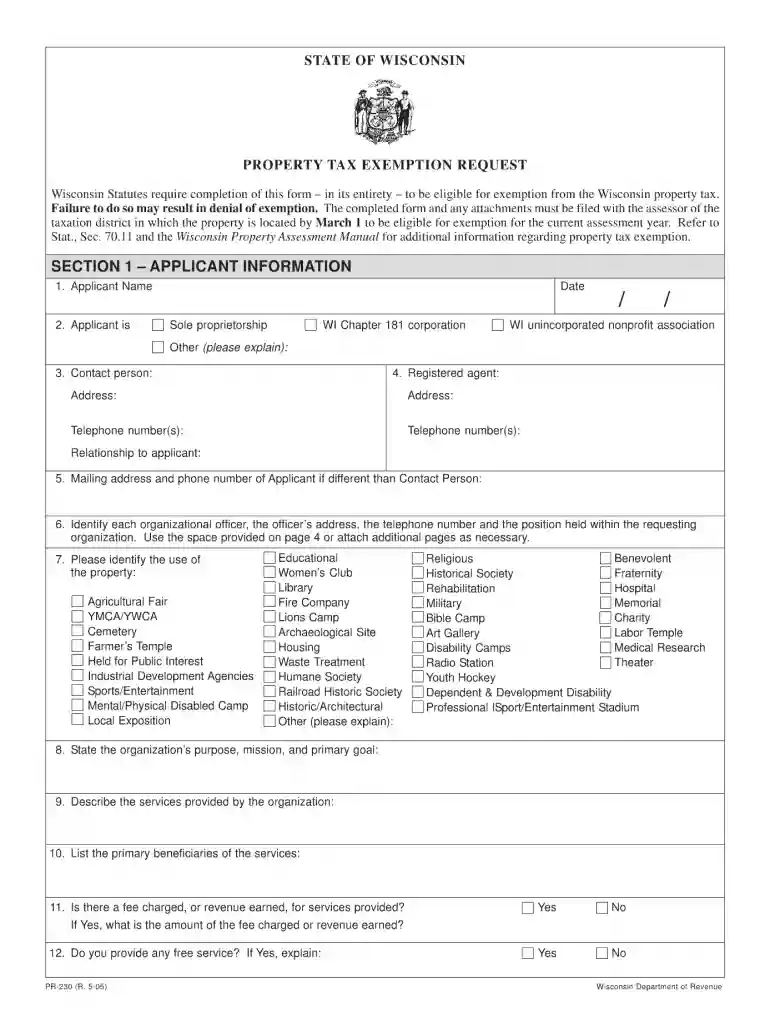
Pr 230 wisconsin 2005 form-2026

Get Form
pr 230 wisconsin 2005 form Preview on Page 1

Here's how it works

01. Edit your form online
Type text, add images, blackout confidential details, add comments, highlights and more.

02. Sign it in a few clicks
Draw your signature, type it, upload its image, or use your mobile device as a signature pad.

03. Share your form with others
Send it via email, link, or fax. You can also download it, export it or print it out.

How to use or fill out pr 230 wisconsin 2005 form with DocHub

Form edit decoration
9.5
Ease of Setup
DocHub User Ratings on G2
9.0
Ease of Use
DocHub User Ratings on G2
  1. Click ‘Get Form’ to open the pr 230 Wisconsin 2005 form in our editor.
  2. Begin with Section 1, where you will enter your applicant information. Fill in your name, date, and specify your organization type (e.g., sole proprietorship or corporation).
  3. Continue by providing contact details for the person responsible for the application, including their address and phone number.
  4. In Section 2, detail the subject property for which you are requesting an exemption. Include the address, tax parcel number, and a legal description of the property.
  5. Proceed to Section 3 to identify any tenants or entities using the property. Provide their names, addresses, and how they utilize the space.
  6. Finally, attach all required documents as outlined in Section 4. Ensure that you have proof of non-profit status and any other relevant documentation ready for submission.

Start filling out your pr 230 Wisconsin 2005 form today on our platform for free!

See more pr 230 wisconsin 2005 form versions

We've got more versions of the pr 230 wisconsin 2005 form form. Select the right pr 230 wisconsin 2005 form version from the list and start editing it straight away!
Versions Form popularity Fillable & printable
2020 4.8 Satisfied (85 Votes)
2017 4.3 Satisfied (32 Votes)
2016 4.4 Satisfied (45 Votes)
2014 4 Satisfied (45 Votes)
2005 4 Satisfied (50 Votes)
2001 4 Satisfied (45 Votes)
be ready to get more

Complete this form in 5 minutes or less

Get form

Got questions?

We have answers to the most popular questions from our customers. If you can't find an answer to your question, please contact us.
Contact us
The Wisconsin Veterans Surviving Spouses Property Tax Credit provides eligible 100% Service Connected (Permanent and Total) veterans and unremarried, surviving spouses, a refundable property tax credit for their primary, in-state residence and up to one acre of land.
(1) The bona fide homestead, consisting of a tract of land or two or more tracts of land even if the land is classified and assessed at use value pursuant to Article VII, Section 18(C) of this constitution, with a residence on one tract and a field with or without timber on it, pasture, or garden on the other tract or
You must live in the home to qualify for the tax break. Some states exempt a certain percentage of a homes value from property taxes, while other states exempt a set dollar amount. If your state uses a percentage method, the exemption will be more valuable to homeowners with more valuable homes.
Businesses in Wisconsin are no longer subject to personal property tax as of January 1, 2024, due to the enactment of 2023 Wisconsin Act 12. However, some property previously subject to personal property tax may now be taxed as real property.
The Homestead Tax Credit (HTC) limits the increase in taxable assessment each year to a fixed percentage. Every county and municipality in Maryland is required to limit taxable assessment increases to no more than 10% per year, and the State also limits the taxable assessment for the State portion of the tax to 10%.

Security and compliance

At DocHub, your data security is our priority. We follow HIPAA, SOC2, GDPR, and other standards, so you can work on your documents with confidence.

Learn more
ccpa2
pci-dss
gdpr-compliance
hipaa
soc-compliance
be ready to get more

Complete this form in 5 minutes or less

Get form

People also ask

Eligibility requirements for a homestead exemption vary by state. One of the key requirements is occupancy status homestead exemptions are typically only available for primary residences. Some other factors that may impact eligibility include your age and income, as well as your marital, veteran or disability status.
The homeowner must be at least 65 or a qualifying veteran. If qualifying by age, any co-owner must be at least 60 years of age.

Related links