




01. Edit your competency checklist template online
Type text, add images, blackout confidential details, add comments, highlights and more.

Type text, add images, blackout confidential details, add comments, highlights and more.

Draw your signature, type it, upload its image, or use your mobile device as a signature pad.

Send skills checklist template via email, link, or fax. You can also download it, export it or print it out.
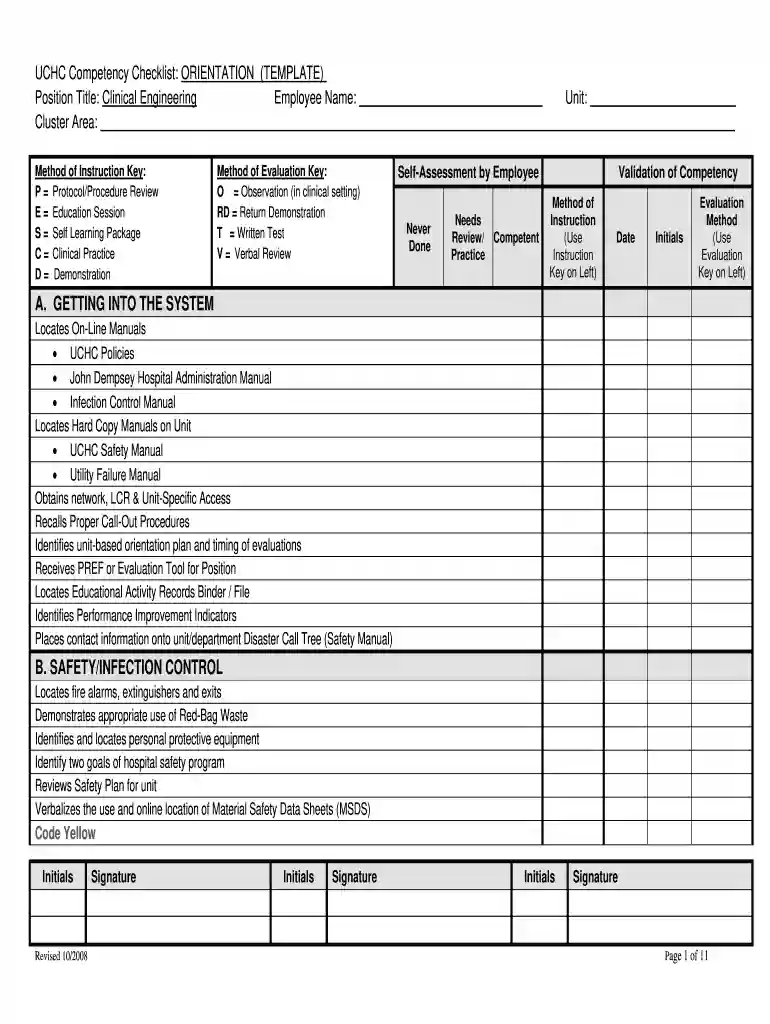
The competency checklist template 2008 form is a detailed tool utilized for evaluating the competencies of employees, particularly in healthcare settings. This form includes various categories relevant to job performance, such as safety protocols, technical skills, and compliance with institutional policies. It is critical for ensuring that employees meet the required standards in their roles, providing a framework for orientation and ongoing assessment.
The main purpose of the competency checklist is to systematically evaluate the skills and knowledge of employees. This checklist not only serves as a guideline for individual performance but also fosters accountability within organizations by ensuring that all employees adhere to established competency standards.
The competency checklist template contains various critical sections to thoroughly assess competencies. Each section corresponds to a vital aspect of job performance.
The checklist incorporates several methods for evaluation, enhancing the reliability of the assessments. These methods include:
This multi-faceted approach ensures a comprehensive evaluation of an employee's skills and competencies.
Utilizing the competency checklist template is a systematic process. Follow these steps to ensure effective implementation:
Employing a competency checklist template offers substantial benefits to both the organization and the employees. This includes:
Although the competency checklist template 2008 has a specific focus, various adaptations are used across different sectors. These might include:
When utilizing the competency checklist template, it is important to be aware of legal implications:
By leveraging the competency checklist template 2008 form effectively, organizations can enhance workforce performance, ensure compliance, and ultimately improve service delivery in healthcare settings.
We've got more versions of the competency checklist template form. Select the right competency checklist template version from the list and start editing it straight away!
Signing paperwork on a mobile device is fast, simple, and doesn’t require software installation if you have an account with DocHub. Log in from any browser, fill in your blank fields with your information, and click on Sign → Create your signature. You can draw your eSignature just as you usually do on paper, add its image to your competency checklist, or type in your name and stylize its look. No matter what option you choose, your document will be valid.
You can easily edit and complete your competency sign off sheet template on any iOS gadget. Open an internet browser of your choice, go to the DocHub site, authorize or create a new account, upload your file for editing, and make your required adjustments. Our service is mobile-friendly, so utilizing its features on your phone will be a no-brainer, even on the first try.
At DocHub, your data security is our priority. We follow HIPAA, SOC2, GDPR, and other standards, so you can work on your documents with confidence.
For jobs filed prior to December 31, 2014 ONLY (See Buildings Bulletin 2014-017). TR1 2008 Form - Rev. 10/13 - OLD Form TR1 2008 Instructions - OLD InstructionsRead more
CULTURAL COMPETENCY The list of services that require prior authorization is available in narrative form, along with a more detailed list by CPT and HCPCSRead more
Date Submitted/Revised: 2008-2. Effective Year/Term Competency 2: Recognize how foundational influences affect professional practice and assessment of.Read more


