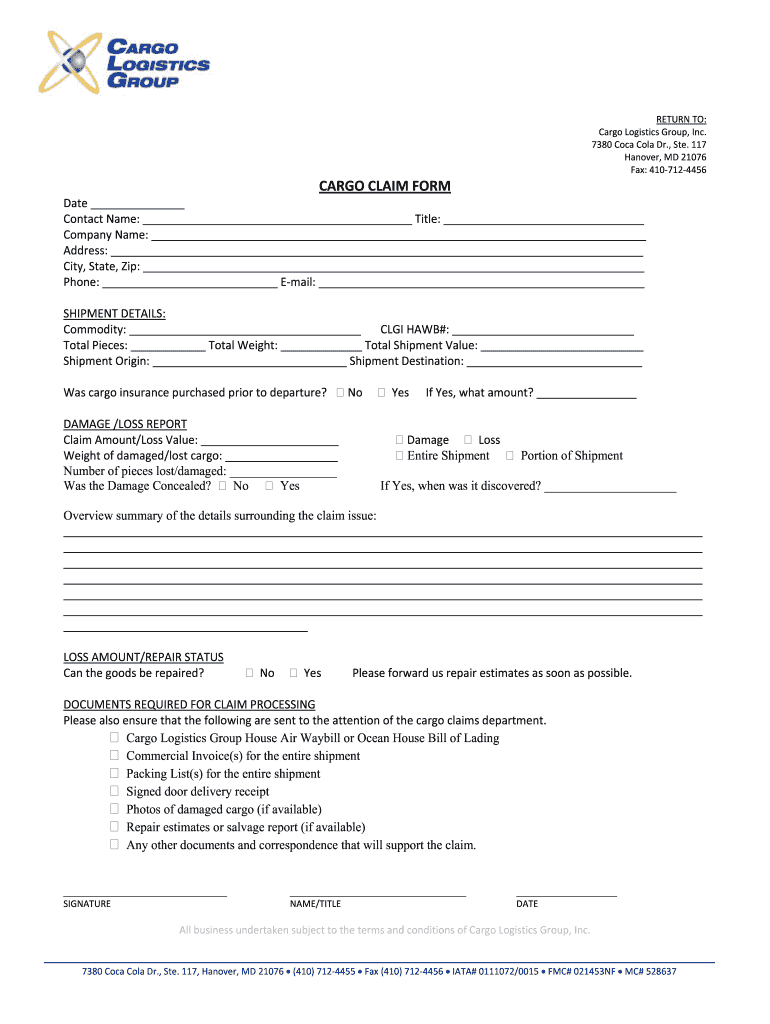
Iata cargo claim form 2026

Get Form
cargo claim form Preview on Page 1

Here's how it works

01. Edit your cargo claim form online
Type text, add images, blackout confidential details, add comments, highlights and more.
02. Sign it in a few clicks
Draw your signature, type it, upload its image, or use your mobile device as a signature pad.
03. Share your form with others
Send freight claim form template via email, link, or fax. You can also download it, export it or print it out.

How to use or fill out iata cargo claim form with DocHub

Form edit decoration
9.5
Ease of Setup
DocHub User Ratings on G2
9.0
Ease of Use
DocHub User Ratings on G2
  1. Click ‘Get Form’ to open the iata cargo claim form in our editor.
  2. Begin by entering the date at the top of the form. Next, fill in your contact name, title, and company name in the designated fields.
  3. Provide your address, city, state, zip code, phone number, and email address to ensure accurate communication regarding your claim.
  4. In the shipment details section, specify the commodity type, CLGI HAWB number, total pieces, total weight, and total shipment value.
  5. Indicate the shipment origin and destination. Confirm whether cargo insurance was purchased prior to departure by checking 'Yes' or 'No'.
  6. For damage/loss reporting, enter the claim amount/loss value and weight of damaged/lost cargo. Specify the number of pieces lost or damaged and indicate if damage was concealed.
  7. Provide an overview summary detailing the circumstances surrounding your claim issue in the provided space.
  8. Complete the loss amount/repair status section by indicating if goods can be repaired and attach any necessary repair estimates.
  9. Ensure all required documents are checked off before submitting your claim for processing.
  10. Finally, sign and date the form at the bottom to validate your submission.

Start using our platform today to fill out your iata cargo claim form quickly and efficiently!

See more iata cargo claim form versions

We've got more versions of the iata cargo claim form form. Select the right iata cargo claim form version from the list and start editing it straight away!
Versions Form popularity Fillable & printable
2019 4.4 Satisfied (56 Votes)
2009 4.9 Satisfied (40 Votes)
be ready to get more

Complete this form in 5 minutes or less

Get form

Got questions?

We have answers to the most popular questions from our customers. If you can't find an answer to your question, please contact us.
Contact us
The Cargo Accounts Settlement Systems (CASS), managed by the International Air Transport Association (IATA), is designed to streamline the billing and settlement process between airlines and freight forwarders.
There is no specific form required by law to be used for a claim; however, all freight claims must have four essentials elements: The freight shipment must be identified. The type of loss or damage to freight must be listed. The value of the freight claim. A demand for payment.
Here are the essential documents you should be prepared to submit: Bill of Lading (BOL) Commercial Invoice. Packing List. Damage Report or Survey. Photographs or Video Evidence. Claim Letter. Proof of Value.
The carrier has the burden of proof to show that damage was caused solely by the inherent vice of the goods and not by their own negligence, for example, failing to follow the shippers instructions for handling.
This is the basic list of documents that will be required when submitting your claim to a shipping line or air cargo carrier: Airway bill or bill of lading. Commercial invoice. Packing list. Survey report and photographs of damaged cargo. Claim value calculation. Salvage invoice/s or destruction certificate.

Security and compliance

At DocHub, your data security is our priority. We follow HIPAA, SOC2, GDPR, and other standards, so you can work on your documents with confidence.

Learn more
ccpa2
pci-dss
gdpr-compliance
hipaa
soc-compliance
be ready to get more

Complete this form in 5 minutes or less

Get form

People also ask

Your first step is the most important: When you spot damaged freight upon delivery, inform the driver immediately, clearly note the damages on the proof of delivery and take photographs of the damaged product. Failing to report damage immediately is the #1 reason claims are denied.
Table of Contents Understanding Cargo Claims. Step 1: Inspect Your Cargo Immediately. Step 2: Document the Damage or Loss. Step 3: Notify the Carrier or Freight Forwarder. Step 4: Preserve the Goods and Packaging. Step 5: Review Your Insurance Coverage. Step 6: Gather Necessary Documentation. Step 7: Calculate the Claim Amount.
The International Air Transport Association (IATA) is an international trade association of airlines. Airlines in IATA are responsible for safely and punctually delivering passengers and cargo from one location to another.

Related links