




01. Edit your pre delivery inspection checklist pdf online
Type text, add images, blackout confidential details, add comments, highlights and more.

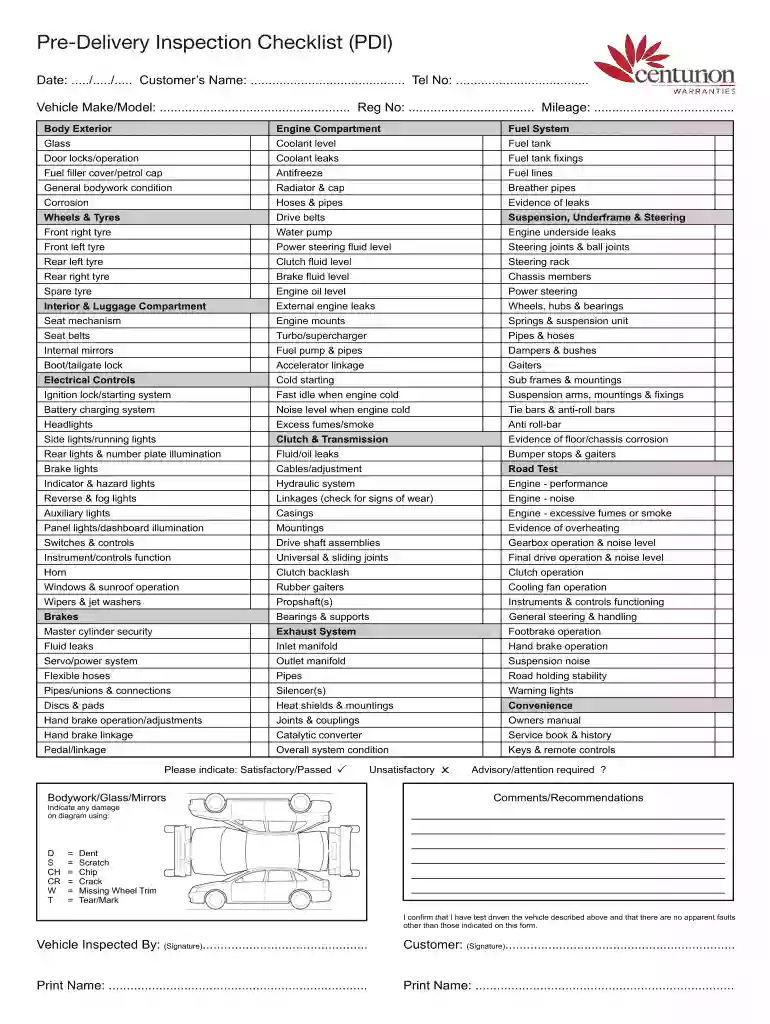
Type text, add images, blackout confidential details, add comments, highlights and more.

Draw your signature, type it, upload its image, or use your mobile device as a signature pad.

Send pdi checklist format via email, link, or fax. You can also download it, export it or print it out.
The Pre-Delivery Inspection Checklist (PDI) is a crucial document used in the automotive industry to assess the condition of a vehicle prior to its delivery to the customer. This checklist ensures that all vehicles meet quality standards and are free of defects, enhancing customer satisfaction and reducing future service costs. The PDI typically covers comprehensive evaluations including the vehicle's exterior, interior, mechanical components, and safety features.
A thorough PDI checklist consists of several key components designed to guide inspectors through a systematic evaluation of the vehicle. These components may include:
Utilizing a standardized format for the PDI checklist is critical. Various formats can be created, including:
These formats allow for easy sharing and editing while enabling quick access for relevant stakeholders.
When implementing a PDI checklist in a dealership, the following steps are vital for effectiveness:
Understanding the legal implications of the Pre-Delivery Inspection Checklist is important:
A typical use case for a PDI checklist involves the following sequence:
By following the PDI process closely and using the checklist effectively, dealerships can ensure a high-quality delivery experience for customers, improving satisfaction and reducing return service calls.
We've got more versions of the pre delivery inspection checklist pdf form. Select the right pre delivery inspection checklist pdf version from the list and start editing it straight away!
| Versions | Form popularity | Fillable & printable |
|---|---|---|
| 2015 | 4.6 Satisfied (35 Votes) |
At DocHub, your data security is our priority. We follow HIPAA, SOC2, GDPR, and other standards, so you can work on your documents with confidence.
Your RV must pass the dealers pre-delivery inspection (PDI), including all systems tests. □ Provide orientation of the RV, its systems, components andRead more
UNDER HOOD - Engine Off. ON INSIDE. Engine oil level. Operation of lights, turn signals, stop signals, courtesy. Steering gear housing fluid level.Read more
Apr 20, 2020 On the PDI Checklist, you find that certain items have been notated with an asterisk symbol (*), this lets you know that additional informationRead more


