Soc 341 2026

Get Form
soc 341a Preview on Page 1

Here's how it works

01. Edit your soc 341a online
Type text, add images, blackout confidential details, add comments, highlights and more.
02. Sign it in a few clicks
Draw your signature, type it, upload its image, or use your mobile device as a signature pad.
03. Share your form with others
Send soc 341 via email, link, or fax. You can also download it, export it or print it out.

How to use or fill out soc 341 with our platform

Form edit decoration
9.5
Ease of Setup
DocHub User Ratings on G2
9.0
Ease of Use
DocHub User Ratings on G2
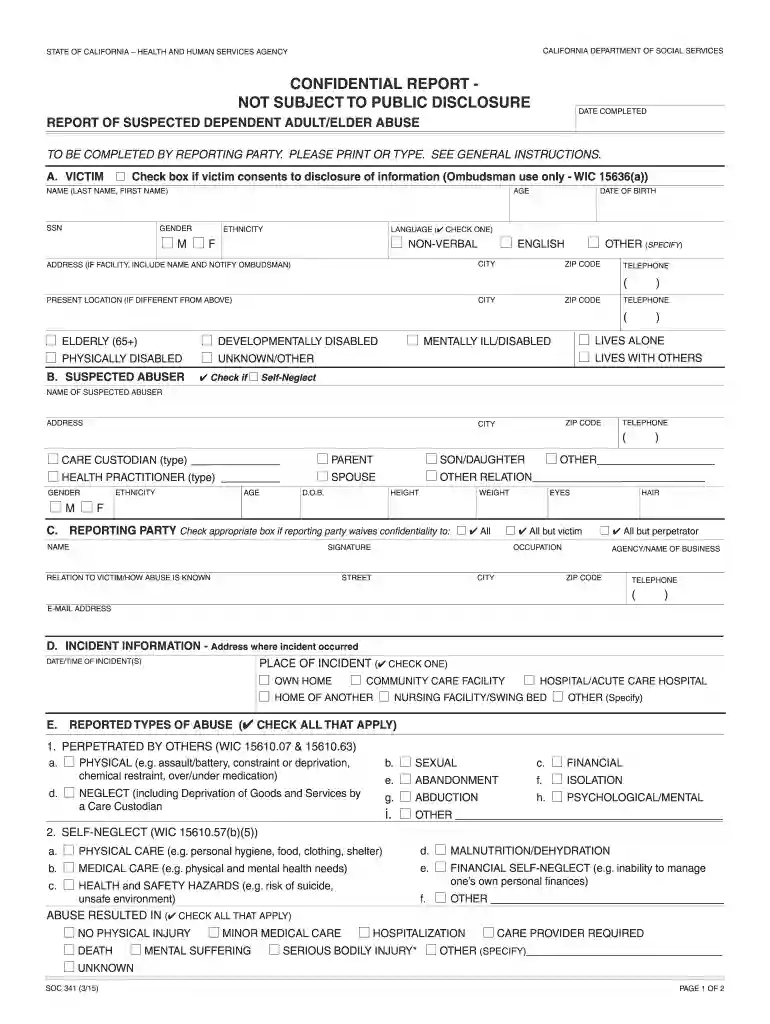
  1. Click ‘Get Form’ to open the SOC 341 in the editor.
  2. Begin with Section A, where you will input the victim's details. Fill in their name, age, gender, and ethnicity. Ensure accuracy as this information is crucial for proper reporting.
  3. In Section B, provide information about the suspected abuser. Include their name, address, and relationship to the victim. Check relevant boxes regarding their living situation and any known disabilities.
  4. Proceed to Section C to enter your details as the reporting party. Include your name, occupation, and contact information. If you wish to waive confidentiality, check the appropriate box.
  5. In Section D, document the incident details including date/time and location of abuse. Select all applicable types of abuse from the checklist provided.
  6. Finally, review all sections for completeness before saving or exporting your filled form directly from our platform for submission.

Start using our platform today to fill out your SOC 341 easily and efficiently!

See more soc 341 versions

We've got more versions of the soc 341 form. Select the right soc 341 version from the list and start editing it straight away!
Versions Form popularity Fillable & printable
2024 4.6 Satisfied (52 Votes)
2022 4.3 Satisfied (40 Votes)
2015 4.8 Satisfied (133 Votes)
2006 4.4 Satisfied (4589 Votes)
2003 4.4 Satisfied (562 Votes)
be ready to get more

Complete this form in 5 minutes or less

Get form

Got questions?

We have answers to the most popular questions from our customers. If you can't find an answer to your question, please contact us.
Contact us
In Florida, everyone is a mandatory reporter for suspected child abuse, neglect, or abandonment, but professionals (like teachers, healthcare workers, law enforcement) must provide their names, while others can report anonymously, though all reports should go to the Abuse Hotline. Reports for vulnerable adults (elderly/disabled) also require immediate action from mandated reporters, including professionals, with severe penalties for failing to report, especially for professionals who must self-identify. The key is reasonable cause to suspect abuse or neglect for children and vulnerable adults. Who Must Report? All Floridians: Anyone with reasonable cause to suspect child abuse/neglect must report. Professionally Mandated Reporters: Must provide their names; include doctors, nurses, hospital staff, educators, social workers, law enforcement, child care workers, and more. Vulnerable Adults: Also includes professionals (healthcare, law enforcement, etc.) who suspect abuse, neglect, or exploitation of an elderly or disabled adult. What to Report? Child Abuse/Neglect: Abuse, abandonment, neglect, or sexual abuse. Vulnerable Adult Abuse: Abuse, neglect, or exploitation. Child Sex Trafficking: Considered child abuse. Home Alone: Children left alone without appropriate supervision for their age/condition. How to Report? Florida Abuse Hotline: 1-800-96-ABUSE (1-800-962-2873). Methods: Phone, fax, online chat, or web-based report. Emergency: Call 911 for immediate danger. What to Provide (If Possible) Victim alleged perpetrator names, addresses, phone numbers, DOBs, Social Security numbers. Description of the abuse/neglect. Consequences of Failing to Report For Professionals: Failure to report known/suspected abuse/neglect can lead to criminal charges (e.g., a felony) and fines. Immunity: Reporters acting in good faith are immune from civil/criminal liability. For legal advice, consult a professional. 3-1 mandatory reporting of abuse checklist (june 2023) who needs to WHO NEEDS TO REPORT? In Florida, everyone is a mandatory reporter. However, there are two types of. reporters: Mandated ReporterFlorida Courts (.gov)Mandatory Reporting of Child Abuse and Neglect - FloridaChild Welfare.Gov (.gov)
An Adult Protective Services (APS) investigation is triggered by reports of abuse, neglect, or financial exploitation of a vulnerable adult (someone 18+ with mental/physical impairments) who cannot protect themselves, or by reports of self-neglect, where the adult cant meet basic needs like food, shelter, or healthcare. The core trigger is a report that creates reasonable cause to believe a vulnerable adult is in danger or being harmed due to these factors, often indicated by warning signs like unexplained injuries, sudden confusion, missing belongings, or caregivers displaying aggression. Key Triggers for APS Involvement: Abuse: Physical, sexual, or emotional harm caused by another person. Neglect: Harm to an adults health/welfare caused by another person (like a caregiver) or by the adult themselves (self-neglect). Financial Exploitation: Misuse of an adults funds, property, or personal dignity for profit or advantage. Self-Neglect: An impaired adult failing to provide for their own basic needs (food, water, shelter, medical care). When a Report is Made: Vulnerability: The adult must have a physical or mental impairment that prevents them from protecting themselves. Harm/Threatened Harm: There must be evidence or reasonable cause to believe harm (abuse, neglect, exploitation) is occurring or threatened. Examples of Situations Leading to Investigation: An elderly person with dementia has unexplained bruises and seems fearful of their caregiver. A disabled adults bank accounts are being drained by a relative, or they are missing essential medications. A hoarder situation with unsanitary conditions, spoiled food, and vermin infestation puts an impaired adult at risk. A caregiver is consistently angry, indifferent, or aggressive towards the vulnerable adult. If these criteria are met, APS will assign a specialist to investigate, contact the adult, assess the situation, and develop a plan to ensure safety while respecting the adults right to self-determination. AI can make mistakes, so double-check responsesAdult Protective Services (APS) - CDSS.ca.govWarning Signs. These are some possible warning signs that abuse might be occurring to an older or disabled adult or that the indivCalifornia Dept. of Social Services (.gov)APS Investigations and Services - DFPSAPS specialists investigate reports of alleged abuse, neglect, or financial exploitation to determine if the reported situation exTexas Department of Family and Protective Services (DFPS) (.gov)
Mandatory reporting is when the law requires you to report known or suspected cases of abuse and neglect. It mainly relates to children, but can also relate to adults if the person involved is living in a residential service, such as psychiatric, aged care, or other government-run facility.
A report is required when a mandated person is acting in an official or professional capacity and knows or suspects that a child under age 18 or a person under age 21 with a developmental disability or physical impairment has suffered or faces a threat of suffering any physical or mental wound, injury, disability, or
Conflicts between a mandated reporters duties and some privileged communication statutes are common but, in general, attorneyclient privileges and clergypenitent privileges are usually exempt from mandatory reporting.

Security and compliance

At DocHub, your data security is our priority. We follow HIPAA, SOC2, GDPR, and other standards, so you can work on your documents with confidence.

Learn more
ccpa2
pci-dss
gdpr-compliance
hipaa
soc-compliance

People also ask

SOC 341 (2/24) - Report of Suspected Dependant Adult-Elder Abuse.
A vulnerable adult report is a formal notification to Adult Protective Services (APS) or a similar agency about suspected abuse, neglect, exploitation, self-neglect, or abandonment of an adult (usually 18+) who cannot protect themselves due to physical, mental, or developmental disabilities, infirmities of aging, or other impairments. These reports trigger an investigation to ensure the adults safety and connect them with necessary services, with reporters often remaining anonymous and their information confidential. Who is a Vulnerable Adult? A vulnerable adult is generally defined as someone 18 or older who: Is impaired in their ability to provide for their own care or manage property. Has a disability (mental, emotional, sensory, physical, developmental) or brain damage that hinders their self-care. Is unable to protect themselves from harm. Types of Maltreatment Covered: Abuse: Physical, sexual, emotional/mental, isolation. Neglect: Failure to provide basic needs (food, shelter, care) by a caregiver or self-neglect. Exploitation: Misuse of funds, property, or resources. Abandonment: Willful desertion by a caregiver. When to Make a Report: If you suspect any of the above, even without proof. Immediately call 911: if the person is in immediate danger. Contact your local APS or human services agency for non-emergencies. What Happens After a Report? Screening: APS/relevant agency reviews the report. Investigation: If concerns are valid, a protective investigator assesses the situation. Intervention: Services are arranged to ensure safety and well-being, aiming for independence where possible. Key Points: Confidentiality: Your identity as a reporter is usually confidential. Mandatory Reporting: Some professionals (healthcare workers, educators) are legally required to report. AI can make mistakes, so double-check responsesAdult protection / Minnesota Department of Human ServicesMN.govReporting Abuse and Neglect of a Vulnerable AdultHow to Report. If you have a concern about possible abuse, neglect, exploitation or self-neglect of someone who might be a vulneraHealth and Human Services North Dakota (.gov)

soc 341 form