California custodian record search 2026

Get Form
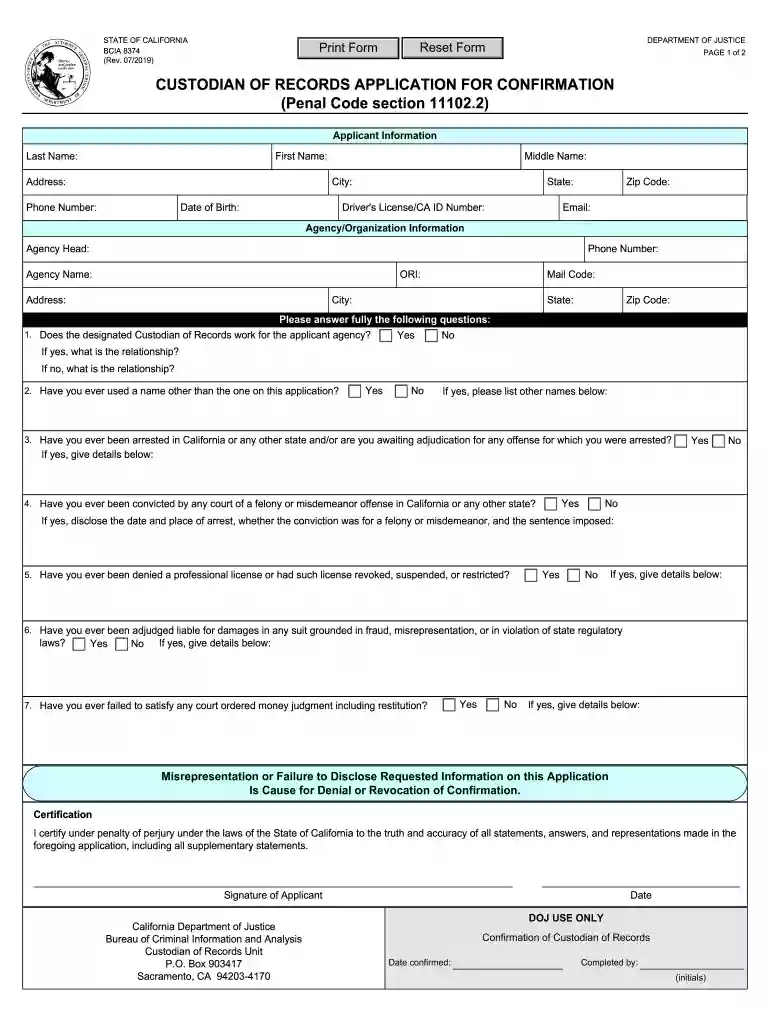
bcia 8374 Preview on Page 1

Here's how it works

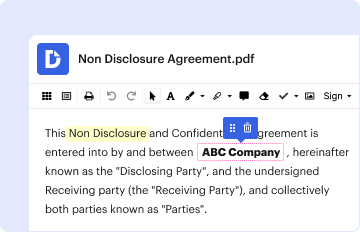
01. Edit your bcia 8374 online
Type text, add images, blackout confidential details, add comments, highlights and more.

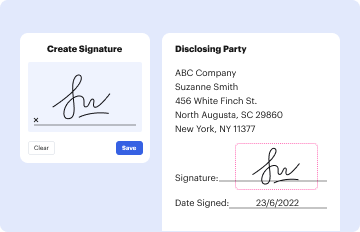
02. Sign it in a few clicks
Draw your signature, type it, upload its image, or use your mobile device as a signature pad.
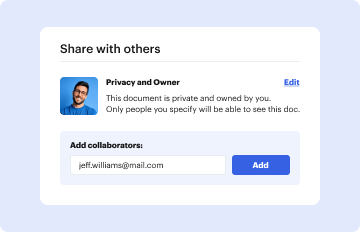
03. Share your form with others
Send custodian of records california via email, link, or fax. You can also download it, export it or print it out.

How to use or fill out California Custodian Record Search with our platform

Form edit decoration
9.5
Ease of Setup
DocHub User Ratings on G2
9.0
Ease of Use
DocHub User Ratings on G2
  1. Click ‘Get Form’ to open the California Custodian of Records Application for Confirmation in the editor.
  2. Begin by filling out the Applicant Information section. Enter your Last Name, First Name, Middle Name, Address, City, State, Zip Code, Phone Number, Date of Birth, and Email. Ensure all details are accurate for processing.
  3. Next, complete the Agency/Organization Information section. Provide the Agency Head's name and phone number, Agency Name, ORI (Originating Agency Identifier), and the agency's address including Mail Code.
  4. Answer all questions in the following sections thoroughly. For each question regarding past arrests or convictions, select 'Yes' or 'No' and provide additional details if applicable.
  5. Finally, review your application for accuracy. Sign and date the certification statement at the bottom before submitting it through our platform.

Start using our platform today to easily fill out your California Custodian Record Search form for free!

See more california custodian record search versions

We've got more versions of the california custodian record search form. Select the right california custodian record search version from the list and start editing it straight away!
Versions Form popularity Fillable & printable
2023 4.1 Satisfied (46 Votes)
2019 4.8 Satisfied (183 Votes)
2017 4.2 Satisfied (63 Votes)
2016 4.2 Satisfied (38 Votes)
2010 4.3 Satisfied (374 Votes)
be ready to get more

Complete this form in 5 minutes or less

Get form

Got questions?

We have answers to the most popular questions from our customers. If you can't find an answer to your question, please contact us.
Contact us
Yes. California makes temporary and final child custody orders publicly accessible. However, there are exceptions to this rule.
Q: Are Family Law Cases Public Records in California? A: Yes, family law cases are generally public records in California. This means that most documents filed in a family law case, such as divorce proceedings, child custody cases, and support orders, can be accessed by the public.
California Superior Court Records Searches by case/docket number are free; searches by party name require an account and fee payment.
To find a Family Law case online, visit the website of the Superior Court in the county where the case was filed. Navigate to the Family Law section to find the courts online case portal.
In general, custody orders are public records. That means anyone may view them. It may help to know some details of the court case, such as the date and location. The court may offer a way to request the information online.

Security and compliance

At DocHub, your data security is our priority. We follow HIPAA, SOC2, GDPR, and other standards, so you can work on your documents with confidence.

Learn more
ccpa2
pci-dss
gdpr-compliance
hipaa
soc-compliance
be ready to get more

Complete this form in 5 minutes or less

Get form

People also ask

A: Yes, family law cases are generally public records in California. This means that most documents filed in a family law case, such as divorce proceedings, child custody cases, and support orders, can be accessed by the public.
The Custodian of Records (COR) is responsible for the security, storage, dissemination, and destruction of the criminal offender record information (CORI) shared with an applicant agency and serves as the agencys primary contact with the Department of Justice (DOJ).
A term used in litigation or other disputes referring to a corporate (or other organizational) employee who exercises control over the organizations records in the ordinary course of business.

Related links