01. Edit your form online
Type text, add images, blackout confidential details, add comments, highlights and more.

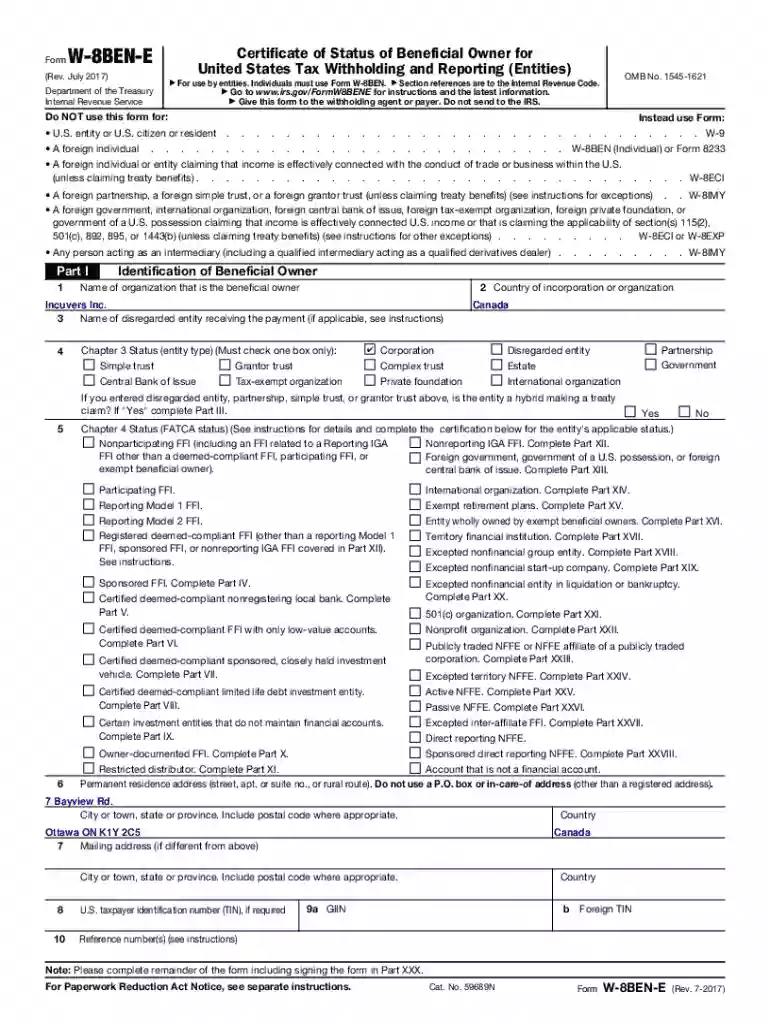
Type text, add images, blackout confidential details, add comments, highlights and more.

Draw your signature, type it, upload its image, or use your mobile device as a signature pad.

Send it via email, link, or fax. You can also download it, export it or print it out.
The Form W-8BEN-E (Rev July 2017) - Webflow serves as a certification document used by foreign entities to establish themselves as beneficial owners for purposes related to U.S. tax withholding and reporting. This form aids in ensuring compliance with the taxation rules applicable to foreign businesses that engage with U.S.-based payers. When this form is correctly executed, it can allow the entity to claim reduced withholding rates as per any applicable tax treaties.
Entities that qualify under tax treaties can claim relief from double taxation through this form. Ensuring proper completion will help in gaining these benefits efficiently.
To effectively use the Form W-8BEN-E, foreign entities must submit it to the withholding agent or payer, rather than directly to the IRS. This action certifies the entity's foreign status and entitlement to any applicable tax treaties concerning U.S. income. Importantly, the form must be completed with accuracy to ensure its acceptance.
Completing the Form W-8BEN-E (Rev July 2017) requires careful attention to every detail to ensure accurate representation of the entity's status. Below is a step-by-step guide:
The effectiveness of Form W-8BEN-E hinges on correctly identifying and completing various elements:
Understanding essential terminology associated with Form W-8BEN-E is vital for proper usage:
Refers to the entity that receives income and exercises control over it, qualifying for tax treaty benefits if applicable.
A U.S. person, including businesses and corporations, responsible for withholding taxes on income paid to foreign persons/entities.
The Foreign Account Tax Compliance Act, central to reporting and withholding obligations under Form W-8BEN-E.
The legal usage of this form extends predominantly to establishing the right to tax treaty benefits and confirming the foreign status of an entity in relation to U.S. tax laws. Proper completion is necessary to avoid legal and financial repercussions due to incorrect withholding.
Failure to provide a valid Form W-8BEN-E can result in the withholding agent applying the standard backup withholding rate for U.S. tax purposes, impacting financial operations.
Non-compliance with the completion or submission of Form W-8BEN-E may lead to significant penalties:
Practical scenarios further elucidate the form's usage:
A foreign corporation working with a U.S. company must submit this form to claim reduced tax withholding under a relevant treaty, ensuring smooth financial transactions.
Partnerships can effectively manage tax implications by correctly assigning partner interests as part of tax reporting, utilizing Form W-8BEN-E to reduce withholding tax complexities and optimize tax obligations.
Each of these elements is critical in maximizing the utility and compliance of Form W-8BEN-E (Rev July 2017) while engaging with U.S. payors and tax regulations.
At DocHub, your data security is our priority. We follow HIPAA, SOC2, GDPR, and other standards, so you can work on your documents with confidence.