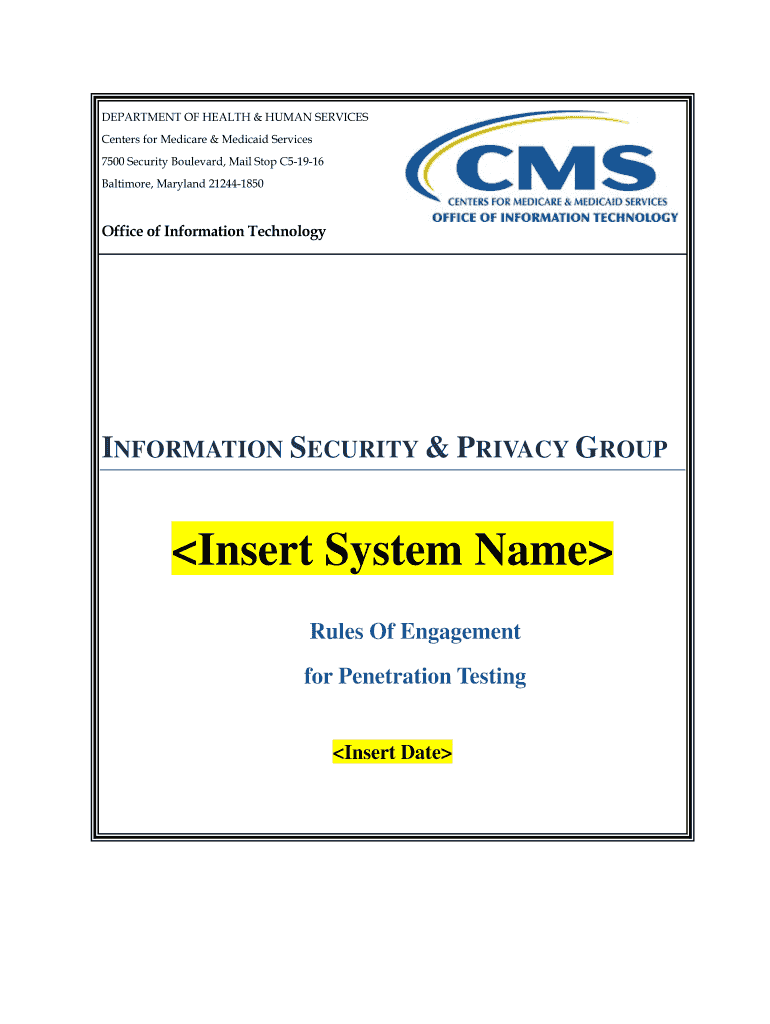
Rules of engagement penetration testing template 2026

Get Form
pentest rules of engagement template Preview on Page 1

Here's how it works

01. Edit your pentest rules of engagement template online
Type text, add images, blackout confidential details, add comments, highlights and more.
02. Sign it in a few clicks
Draw your signature, type it, upload its image, or use your mobile device as a signature pad.
03. Share your form with others
Send rules of engagement penetration testing template via email, link, or fax. You can also download it, export it or print it out.

How to use or fill out rules of engagement penetration testing template

Form edit decoration
9.5
Ease of Setup
DocHub User Ratings on G2
9.0
Ease of Use
DocHub User Ratings on G2
  1. Click ‘Get Form’ to open the rules of engagement penetration testing template in our editor.
  2. Begin with the 'Introduction' section, ensuring you understand the purpose and guidelines outlined for conducting vulnerability assessments and penetration tests.
  3. In the 'Scope' section, specify the systems and networks to be tested. Clearly identify authorized and unauthorized IP addresses, as well as any restrictions or exclusions.
  4. Fill out the 'Logistics' section by providing key personnel details, including names, roles, and contact information. This ensures clear communication during testing.
  5. Review the 'Testing Tools' section to list any specific tools that will be utilized during the assessment. Ensure these are pre-approved for use.
  6. Complete the 'Incident Handling and Response' section by outlining procedures for reporting vulnerabilities or incidents detected during testing.
  7. Finally, ensure all necessary signatures are obtained in the 'Signatures' section to authorize testing activities before submission.

Start using our platform today to streamline your document editing and form completion process for free!

be ready to get more

Complete this form in 5 minutes or less

Get form

Got questions?

We have answers to the most popular questions from our customers. If you can't find an answer to your question, please contact us.
Contact us
The Rules of Engagement, or ROE, clearly outline the details of your testing project. This includes what will be tested, when the testing will happen, and how it will be carried out. The ROE serves as a clear description of the testing process, making sure everyone involved understands what is happening.
The Testing Execution Standard (PTES) provides a comprehensive approach to conducting tests. It is divided into seven phases: Pre-Engagement Interactions, Intelligence Gathering, Threat Modeling, Vulnerability Analysis, Exploitation, Post-Exploitation, and Reporting.
Security professionals can gain an in-depth understanding of an organizations security posture by going through pre-engagement, reconnaissance, discovery, vulnerability analysis, exploitation, reporting, and remediation.
Which of the following rules of engagement provides the days and times that the test can occur? Temporal restrictions provide the constraints for which days and times the test can be performed.
Definitions: Detailed guidelines and constraints regarding the execution of information security testing. The ROE is established before the start of a security test, and gives the test team authority to conduct defined activities without the need for additional permissions.

Security and compliance

At DocHub, your data security is our priority. We follow HIPAA, SOC2, GDPR, and other standards, so you can work on your documents with confidence.

Learn more
ccpa2
pci-dss
gdpr-compliance
hipaa
soc-compliance
be ready to get more

Complete this form in 5 minutes or less

Get form