
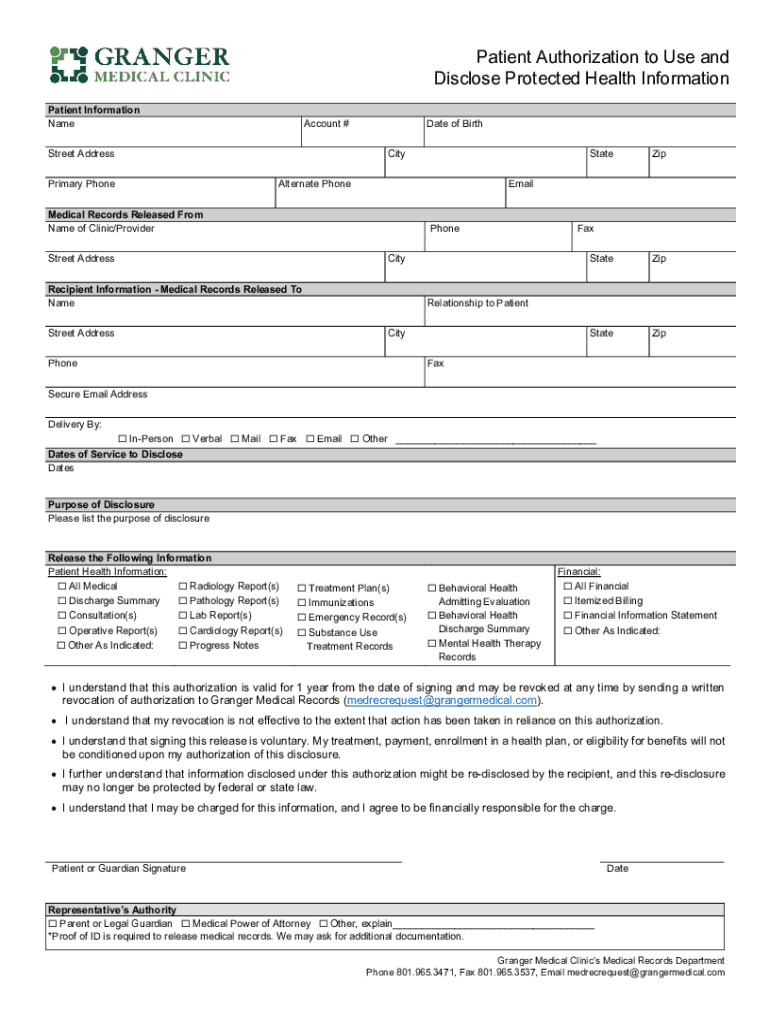







Definition and Meaning
The "Authorization for Use and Disclosure of Protected Health Information" form is a legal document that grants permission for healthcare providers to release a patient’s health information to specified entities. This is crucial for ensuring compliance with privacy laws such as HIPAA. The form includes specifics on which information can be disclosed, who can receive it, and for what purpose, safeguarding the patient's right to control the distribution of their personal health data.
How to Use the Form
To effectively use the form, individuals must first identify the healthcare provider or organization that will release the health information. Next, they should clearly fill in the details regarding the recipient and the type of information being authorized for release. When completing the form, ensure all required fields are filled out accurately to avoid delays in processing.
- Verify the recipient’s contact information.
- Specify the method of delivery, such as electronic or printed form.
- Confirm the specific period for which the authorization is valid.
Steps to Complete the Form
- Personal Information Section: Fill in the patient’s full name, date of birth, and contact information.
- Recipient Details: Provide the name and contact information of the party authorized to receive the information.
- Information to be Released: Clearly specify the medical records or information categories (e.g., lab results, medications).
- Purpose of Disclosure: State why the information is being released, such as for insurance claims or personal records.
- Authorization and Signature: Sign and date the form to validate the authorization. Ensure a witness or notary is present if required by state law.
Key Elements of the Form
- Patient Identification: Accurate identification details minimize the risk of releasing information to unauthorized parties.
- Recipient Information: Essential for directing the release to the correct person or organization.
- Information Scope: Precise details about what health data can be shared protect against unauthorized disclosure.
- Duration and Validity: Setting a timeline for the authorization ensures relevance and timeliness of data sharing.
Legal Use of the Form
The form must comply with healthcare privacy laws, notably HIPAA, ensuring the patient's private information is not disclosed improperly. Legal use demands that the form is:
- Completed voluntarily by the patient or their legal representative.
- Accompanied by proof of identity for verification purposes.
- Restricted to the specific type and amount of data consented for release.
Important Terms Related to the Form
- HIPAA: Healthcare privacy law regulating the use and disclosure of patient information.
- PHI (Protected Health Information): Refers to any information in a medical record that identifies the patient.
- Revocation: The patient’s right to cancel the authorization at any time before the information is released.
Examples of Form Usage
Real-world applications include a patient needing to provide their health records to a new healthcare provider for continuity of care, or to an insurance company for claims processing. In a legal context, a lawyer might request a patient's medical history to support a client’s personal injury claim.
State-Specific Rules
State laws may impose additional requirements, such as specifying the need for a witness when signing the form or restrictions on which medical information can be disclosed. It is crucial to check the specific state regulations where the patient resides to ensure compliance.
Form Submission Methods
- Online: Secure submission through a healthcare provider’s portal.
- Mail: Sending a completed form via certified mail to ensure tracking.
- In-Person: Direct submission at the healthcare provider’s office with receipt acknowledgment.
These methods ensure that the form reaches the intended recipient securely while maintaining a record of the submission method used.




