Tjjd form online 2026

Get Form
capps login tjjd Preview on Page 1

Here's how it works

01. Edit your capps login tjjd online
Type text, add images, blackout confidential details, add comments, highlights and more.

02. Sign it in a few clicks
Draw your signature, type it, upload its image, or use your mobile device as a signature pad.

03. Share your form with others
Send capps tjjd via email, link, or fax. You can also download it, export it or print it out.

How to use or fill out tjjd form online with our platform

Form edit decoration
9.5
Ease of Setup
DocHub User Ratings on G2
9.0
Ease of Use
DocHub User Ratings on G2
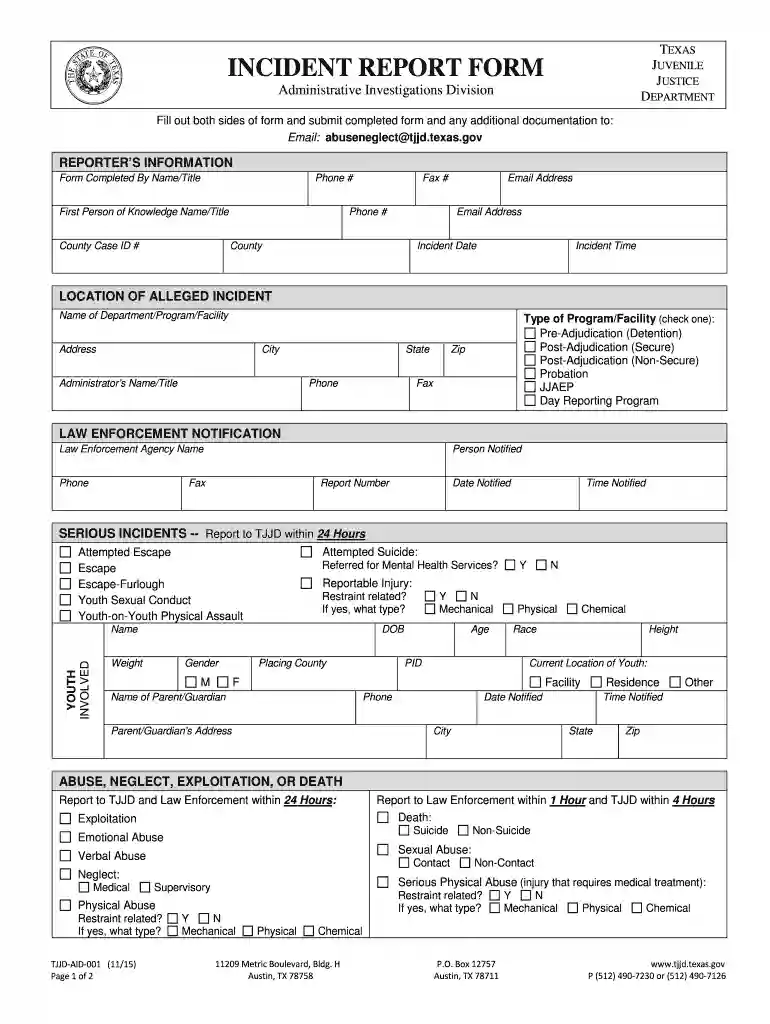
  1. Click ‘Get Form’ to open the tjjd form in the editor.
  2. Begin by filling out the REPORTER’S INFORMATION section. Enter your name, title, phone number, and email address. Ensure that you also provide details for the first person of knowledge.
  3. In the LOCATION OF ALLEGED INCIDENT section, specify the name of the department or facility, along with its address and contact information.
  4. Complete the LAW ENFORCEMENT NOTIFICATION section by providing details about the law enforcement agency notified, including their contact information and report number.
  5. Fill out the YOUTH INVOLVED section with accurate information regarding the youth's demographics and current location.
  6. In the ABUSE, NEGLECT, EXPLOITATION, OR DEATH section, check all applicable boxes and provide necessary details about any incidents.
  7. Finally, complete the DESCRIPTION OF INCIDENT section with a detailed narrative of what occurred. Remember to attest to the accuracy of your information before submitting.

Start using our platform today to fill out your tjjd form online for free!

See more tjjd form online versions

We've got more versions of the tjjd form online form. Select the right tjjd form online version from the list and start editing it straight away!
Versions Form popularity Fillable & printable
2015 4.9 Satisfied (46 Votes)
2012 4.2 Satisfied (40 Votes)
be ready to get more

Complete this form in 5 minutes or less

Get form

Got questions?

We have answers to the most popular questions from our customers. If you can't find an answer to your question, please contact us.
Contact us
In Texas the ages of juvenile justice jurisdiction are 10 through 16. The handling of juveniles is strictly regulated by state law, but juvenile probation is locally administered at the county level. For minor violations, the police may simply warn the child and parents.
Below, weve listed eight of the most common crimes that can send a minor to juvenile hall: #1 - Juvenile Theft. Theft, also known as larceny, is one of the most common crimes minors commit. #3 - Juvenile Weapon Possession. #4 - Child Alcohol Possession. #5 - Underage DUI. #6 - Assault. #7 - Sex Offenses. #8 - Vandalism.
A law enforcement officer may take a juvenile into custody if there is probable cause to believe that the juvenile violated a criminal law, engaged in delinquent conduct or conduct indicating a need for supervision, or violated a court-ordered condition of probation.
Texas Juvenile Justice Department. Texas Juvenile Justice Department formed in 2011, when the Texas Legislature combined the functions of the Texas Youth Commission (TYC) and the Texas Juvenile Probation Commission.
0:32 2:28 That come with the job. Now. Lets talk certification in Texas youll need to pass a certificationMoreThat come with the job. Now. Lets talk certification in Texas youll need to pass a certification exam. This exam ensures youve got the knowledge to handle the complexities of juvenile probation.

Security and compliance

At DocHub, your data security is our priority. We follow HIPAA, SOC2, GDPR, and other standards, so you can work on your documents with confidence.

Learn more
ccpa2
pci-dss
gdpr-compliance
hipaa
soc-compliance
be ready to get more

Complete this form in 5 minutes or less

Get form

People also ask

If a minor is detained in a juvenile hall, a detention hearing must be held within 48 hours of their arrest. At this hearing, a judge will determine if the minor can be released to the parents or other responsible adult or remain in custody.
In Texas, children who are between the ages of 10 and 17 have their case heard before a juvenile court judge. Juveniles have separate courts, separate detention facilities, and are adjudicated by a judge and sentenced because of delinquent conduct, not found guilty of a crime.

tjjd capps