
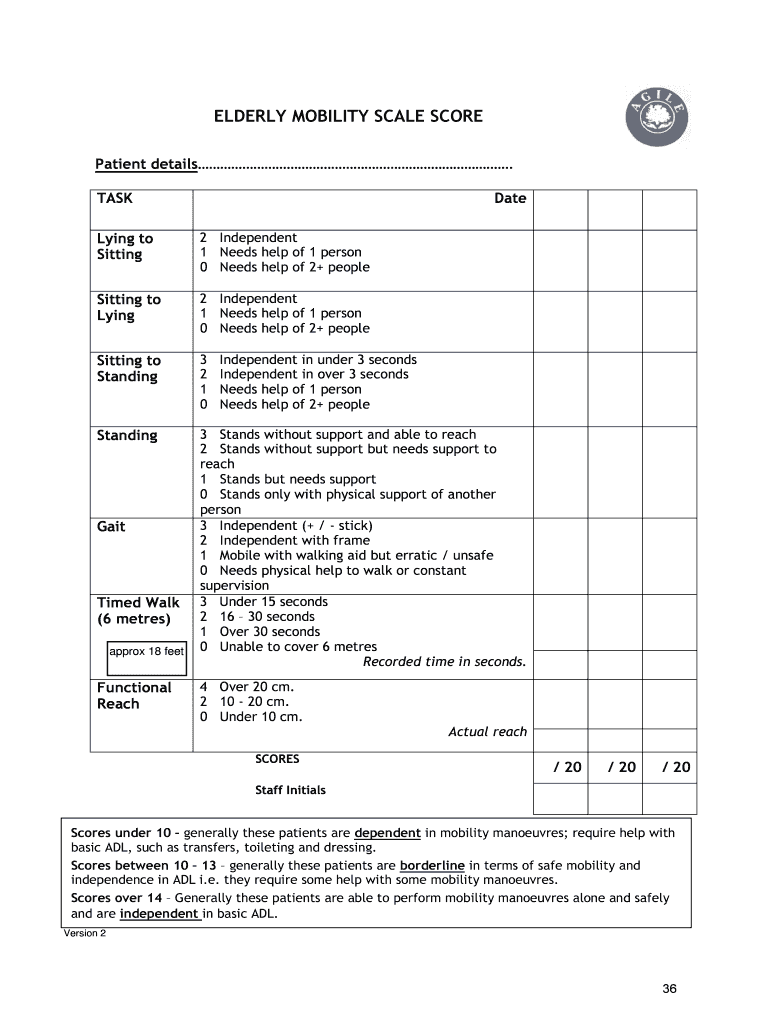







Definition and Meaning of the Elderly Mobility Scale
The elderly mobility scale is a clinical tool designed to assess the mobility capabilities of older adults. It evaluates various functional tasks such as transitioning between positions—lying down to sitting, sitting to standing—along with walking distances, reaching, and maintaining balance. This scale is crucial for healthcare professionals as it helps identify the level of assistance an elderly individual may require in daily activities.
Scoring is based on a standardized format, providing a numerical value that reflects a person's mobility independence. Scores categorize individuals into various levels: dependent, borderline, or independent mobility. Each category is predicated on specific criteria, making it a reliable gauge for assessing a patient's ability to perform everyday movements.
How to Use the Elderly Mobility Scale
Using the elderly mobility scale involves several steps aimed at accurately assessing an individual's physical abilities. Healthcare professionals typically guide this process.
-
Preparation: Begin by gathering all necessary materials, such as the elderly mobility scale PDF and blank scoring sheets.
-
Patient Assessment: Administer the evaluation in a safe environment, ensuring that the individual feels comfortable. Observations should include:
- Sitting to standing transitions.
- Walking distances of various lengths.
- Reaching for objects at different heights.
- Assessing balance during activities.
-
Scoring: Assign scores based on observed performance. Each task has defined scoring criteria, creating a precise profile of mobility capabilities.
-
Documentation: Record scores in the elderly mobility scale calculator, which aids in visualizing mobility progression over time.
-
Interpretation: Analyze the results with the patient to discuss potential interventions or therapies that could enhance mobility.
Through these steps, the elderly mobility scale enables healthcare professionals to document and support an elderly individual’s physical capabilities effectively.
Steps to Complete the Elderly Mobility Scale
Completing the elderly mobility scale requires a systematic approach to ensure thorough and accurate results. The following steps outline the entire process.
-
Identify Background Information: Gather relevant details about the individual, including age, medical history, and current physical status.
-
Select the Right Environment: Choose a space that is free of hazards. Ensure that it is spacious enough to accommodate various movement tasks safely.
-
Conduct Mobility Tasks: Carefully guide the individual through each prescribed task. Make sure to observe:
- Method of movement (e.g., use of assistive devices).
- Time taken to complete each task.
- Stability and balance while transitioning.
-
Score Each Task: Use the specific criteria associated with each mobility task to assign scores. Each task is typically rated on a scale, reflecting the individual’s performance.
-
Aggregate Scores: Total the scores to determine the overall mobility category that best fits the individual—dependent, borderline, or independent.
-
Feedback and Recommendations: Provide feedback to the individual about their mobility status and suggest steps or therapies to improve their mobility as needed.
By following these steps, practitioners ensure accurate assessments that are crucial for tailoring interventions for mobility improvement.
Key Elements of the Elderly Mobility Scale
Understanding the key elements of the elderly mobility scale is essential for proper implementation and interpretation. The following aspects are critical:
-
Scoring Criteria: Each mobility task has precise scoring guidelines that outline how to rate the performance of the individual effectively.
-
Mobility Levels:
- Dependent: Individuals who require significant assistance.
- Borderline: Those who may need occasional support but can perform tasks independently most of the time.
- Independent: Individuals completely capable of performing daily mobility tasks without assistance.
-
Functional Tasks: The scale encompasses a range of functional tasks, including:
- Transitions (lying-to-sitting, sitting-to-standing).
- Walking distances (short and long paths).
- Reaching actions (overhead and lateral).
-
Documentation: Recording scores accurately helps in tracking mobility changes over time, which is vital for ongoing health management.
These elements provide a comprehensive understanding of the elderly mobility scale and its foundational role in promoting elderly independence.
Important Terms Related to the Elderly Mobility Scale
Familiarity with specific terminology surrounding the elderly mobility scale is vital for both practitioners and users. Some key terms include:
-
Mobility Assessment Scale: A broader term that may encompass various tools used to evaluate mobility across populations, including the elderly mobility scale.
-
Functional Mobility Scale: This term often refers to the judgment of an individual's general functional mobility capabilities.
-
Scoring Interpretation: Understanding how to interpret the scores recorded on the elderly mobility scale, including what each score suggests regarding mobility and care needs.
-
Assistive Devices: Equipment that enhances mobility for individuals with physical limitations, such as walkers, canes, and wheelchairs.
-
Assessment Tools: Generic term for various instruments and scales used to measure physical ability, including the elderly mobility scale.
These terms enhance the efficiency and clarity of communication among healthcare professionals using the elderly mobility scale.




