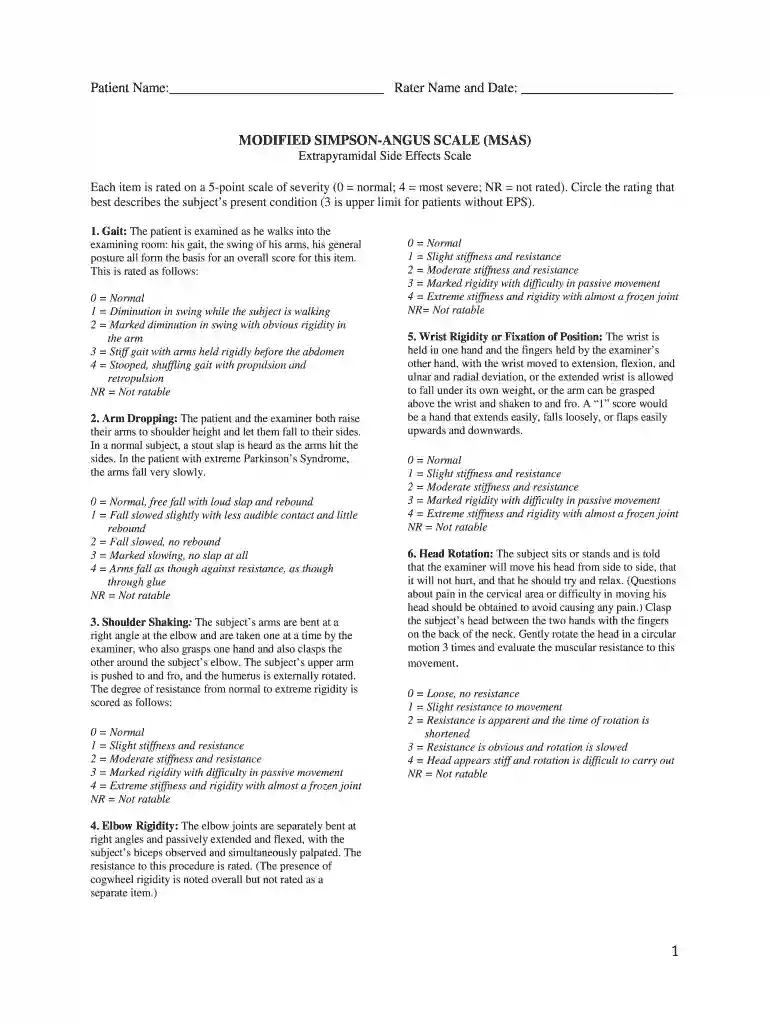
Modified simpson angus scale 2026

Get Form
simpson angus scale pdf Preview on Page 1

Here's how it works

01. Edit your simpson angus scale pdf online
Type text, add images, blackout confidential details, add comments, highlights and more.

02. Sign it in a few clicks
Draw your signature, type it, upload its image, or use your mobile device as a signature pad.

03. Share your form with others
Send simpson angus scale via email, link, or fax. You can also download it, export it or print it out.

Definition and Application of the Modified Simpson Angus Scale

The Modified Simpson-Angus Scale (MSAS) is a vital assessment tool designed for healthcare professionals to evaluate the presence and severity of extrapyramidal side effects in patients, particularly those who are undergoing treatment for psychiatric conditions, such as schizophrenia. It consists of ten specific items that reflect various physical symptoms associated with extrapyramidal symptoms, such as rigidity, tremors, and abnormal gait patterns. Each item is scored on a five-point scale, ranging from zero, indicating no symptoms, to four, reflecting severe symptoms. The cumulative score provides an overall indication of the patient’s condition, guiding clinicians in managing treatment effectively.

The MSAS is an essential instrument in both clinical and research settings. By quantifying the presence of these symptoms, doctors can adjust medications and monitor the efficacy of antipsychotic treatments. Healthcare providers should ensure proper training in administering and interpreting the scale to facilitate accurate assessments.

Steps to Complete the Modified Simpson Angus Scale

Completing the Modified Simpson-Angus Scale involves a systematic approach to accurately assess the patient's physical symptoms.

  1. Preparation:

    • Ensure that the patient is comfortable and is in a relaxed environment. This reduces anxiety, which can influence symptom presentation.
    • Familiarize yourself with the items on the scale prior to assessment to streamline the process.
  2. Perform the Examination:

    • Assess each item on the scale, which includes observing the patient for specific symptoms:
      • Gait: Evaluate the patient's walking pattern, checking for abnormalities.
      • Arm Dropping: Observe the ability to maintain arms in a raised position.
      • Rigidity: Conduct a passive range of motion to determine resistance in the muscles.
      • Tremors: Look for involuntary shaking when the patient is at rest or during movement.
  3. Rate Each Item:

    • Based on your observations, score each item from zero to four. Be consistent and objective in your assessments to maintain reliability.
    • Consider documenting your observations contemporaneously to ensure accuracy.
  4. Total the Score:

    • After completing the assessment, calculate the total score to understand the severity of the symptoms.
    • Use this score to discuss treatment options with the patient, considering adjustments to medication if necessary.

Key Elements of the Modified Simpson Angus Scale

The Modified Simpson-Angus Scale encompasses several critical components that ensure its effectiveness in measuring extrapyramidal symptoms.

  • Structure:

    • Composed of ten distinct items that focus on specific neurological and motor control aspects.
  • Scoring System:

    • The five-point scoring system allows for nuanced evaluation of symptom severity, thus facilitating personalized treatment strategies.
  • Assessment Scope:

    • Addresses a range of symptoms, including rigidity, tremors, and abnormal movement patterns, providing a comprehensive overview of the patient's motor health.
  • Monitoring and Follow-Up:

    • Regular administration of the scale helps track changes over time, which is essential for treatment efficacy evaluations.

Important Terms Related to the Modified Simpson Angus Scale

Understanding the terminology associated with the Modified Simpson-Angus Scale is critical for effective application and communication among healthcare professionals.

  • Extrapyramidal Symptoms:

    • These are drug-induced symptoms affecting motor control and can manifest as tardive dyskinesia, akathisia, and other movement disorders, often linked to antipsychotic medication.
  • Tardive Dyskinesia:

    • A condition characterized by repetitive, involuntary movements, often as a side effect of prolonged use of antipsychotic medications.
  • Akathisia:

    • A state of inner restlessness and uncontrollable need to be in constant motion, which can be highly uncomfortable for patients.
  • Neuroleptic Drugs:

    • A class of medication mainly used to manage psychosis, they can lead to extrapyramidal symptoms, which the MSAS aims to assess.

Who Typically Uses the Modified Simpson Angus Scale

Healthcare providers, particularly in psychiatric and neurologic practice, primarily utilize the Modified Simpson-Angus Scale.

  • Psychiatrists:

    • Regularly assess the effectiveness of treatment regimens in patients with schizophrenia and other mental health disorders.
  • Neurologists:

    • Utilize the scale to evaluate patients presenting with movement disorders, contributing to a diagnosis or treatment strategy.
  • Researchers:

    • Employ the MSAS in clinical trials targeting psychotropic medications to evaluate their side effect profiles.
  • Nurses and Allied Health Professionals:

    • Trained staff members often perform assessments and assist in the documentation of scores, playing a vital role in patient management.
decoration image ratings of Dochub

Examples of Using the Modified Simpson Angus Scale

Practical application of the Modified Simpson-Angus Scale is essential for assessing and managing patients effectively.

  • Clinical Case Study:

    • A patient on a long-term antipsychotic regimen is evaluated using the MSAS. Initially scoring highly on tremors and rigidity, the clinician can track changes over the following months to ensure timely adjustments to treatment.
  • Research Application:

    • In a clinical trial for a new antipsychotic medication, researchers assess participants using the MSAS to establish efficacy and side effects compared to a control group.
  • Monitoring Progress:

    • During regular follow-ups, healthcare providers use the MSAS to determine if dosage adjustments are necessary based on changes in the patient's symptom scores.
  • Patient Education:

    • Clinicians explain to patients how their movements will be assessed, helping them understand the importance of the evaluation in their overall treatment plan.
be ready to get more

Complete this form in 5 minutes or less

Get form

Got questions?

We have answers to the most popular questions from our customers. If you can't find an answer to your question, please contact us.
Contact us
The Extrapyramidal Symptom Rating Scale (ESRS) was developed to assess four types of drug-induced movement disorders (DIMD): Parkinsonism, akathisia, dystonia, and tardive dyskinesia (TD). Comprehensive ESRS definitions and basic instructions are given.
Simpson-Angus Scale (SAS) is a 10-item rating scale that has been used widely for assessment of NIP in both clinical practice and research settings [13]. It consists of one item measuring gait (hypokinesia), six items measuring rigidity and three items measuring glabella tap, tremor and salivation, respectively.
A total score of 0-40 is calculated (or scale score can be calculated by dividing the total by 10 to give a score between 0 and 4), with a raw score of 3 identifying normal symptoms, 6 indicating a level of disorder for which treatment should be reconsidered, 12 requiring attention, and a score of 18 almost
The Extrapyramidal Symptom Rating Scale (ESRS) (5) was developed to assess four types of drug-induced movement disorders: parkinsonism, akathisia, dystonia and tardive dyskinesia. It consists of four subscales and four clinical global impression severity scales for each type of movement disorder.
SimpsonAngus Scale (SAS): 10-item scale, with item scores ranging from 1 to 5, designed to assess the presence and severity of rigidity and bradykinesia. It is the most widely used scale for extrapyramidal symptoms in clinical assays.

Security and compliance

At DocHub, your data security is our priority. We follow HIPAA, SOC2, GDPR, and other standards, so you can work on your documents with confidence.

Learn more
ccpa2
pci-dss
gdpr-compliance
hipaa
soc-compliance
be ready to get more

Complete this form in 5 minutes or less

Get form