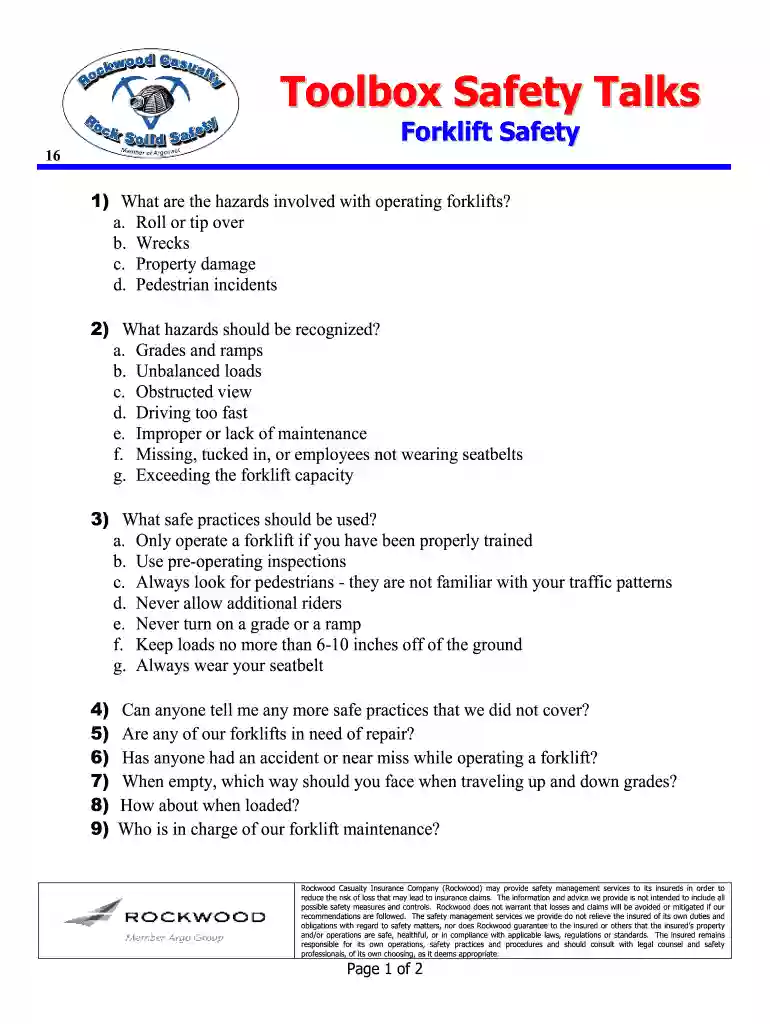
Forklift safety toolbox talk pdf 2026

Get Form
forklift toolbox talk pdf Preview on Page 1

Here's how it works

01. Edit your forklift toolbox talk pdf online
Type text, add images, blackout confidential details, add comments, highlights and more.

02. Sign it in a few clicks
Draw your signature, type it, upload its image, or use your mobile device as a signature pad.

03. Share your form with others
Send toolbox talk topics pdf via email, link, or fax. You can also download it, export it or print it out.

Definition and Meaning of Forklift Safety Toolbox Talk PDF

A forklift safety toolbox talk PDF serves as a critical document designed to promote safety awareness among workers operating forklifts. It is an essential resource that outlines key safety guidelines and protocols necessary to prevent accidents and injuries in the workplace. The document emphasizes the importance of adhering to safety standards specific to forklift operation, detailing the responsibilities of operators, as well as the potential hazards associated with forklift use.

This type of toolbox talk often covers several key areas:

  • Operational Safety: Guidelines for proper operation of forklifts, including load handling, visibility, and environment awareness.
  • Maintenance Procedures: Information on regular inspections and maintenance practices necessary to ensure that forklifts are functioning correctly and safely.
  • Training Requirements: Emphasis on the need for operators to undergo comprehensive training, highlighting both theoretical and practical components.

These elements combine to foster a workplace culture that prioritizes safety, reduces risks, and enhances overall operational efficiency.

How to Use the Forklift Safety Toolbox Talk PDF Effectively

Utilizing the forklift safety toolbox talk PDF effectively requires a structured approach to ensure that the information is not only conveyed but also understood and implemented by all employees involved in forklift operations. Here are steps to effectively use the document:

  1. Pre-Meeting Preparation:

    • Review the PDF thoroughly to ensure you are familiar with the content.
    • Identify key topics and any specific areas that may require attention based on previous incidents or safety audits.
  2. Conducting a Meeting:

    • Assemble all forklift operators and relevant personnel in a safe, distraction-free environment.
    • Present the key safety topics outlined in the PDF, ensuring to explain the significance of each section.
  3. Encouragement of Participation:

    • Foster an open dialogue by encouraging participants to share their insights and experiences related to forklift safety.
    • Use the PDF as a reference point to clarify any doubts or emphasize specific practices.
  4. Follow-Up Actions:

    • After the meeting, distribute the PDF to all attendees for review and reference.
    • Schedule periodic refresher sessions to ensure ongoing compliance and understanding of safety practices.

By following these steps, organizations can enhance the effectiveness of their safety meetings and reinforce the importance of adhering to forklift safety protocols.

Steps to Complete the Forklift Safety Toolbox Talk PDF

Completing a forklift safety toolbox talk PDF involves several essential steps designed to ensure thorough coverage of safety topics. The following steps outline the process:

  1. Download the Template: Obtain a standardized toolbox talk template that aligns with your facility's specific needs.

  2. Customizing the Content:

    • Modify the template to include relevant topics such as operational safety, hazard recognition, and maintenance protocols.
    • Ensure any state-specific regulations or company policies are incorporated into the talk.
  3. Incorporating Visual Aids:

    • Add diagrams or images related to forklift operations (e.g., proper load placement).
    • Use bullet points and tables to present information concisely and clearly.
  4. Review and Approval:

    • Have safety personnel or management review the completed talk to ensure all critical aspects are covered.
    • Adjust based on feedback to enhance clarity or relevance.
  5. Distributing the Document:

    • Make the final PDF accessible to all forklift operators and relevant staff.
    • Ensure it is stored in a location that is easy to access for future reference.

By adhering to these steps, organizations can produce comprehensive and effective toolbox talks that contribute to workplace safety.

Key Elements of the Forklift Safety Toolbox Talk PDF

A well-structured forklift safety toolbox talk PDF should encompass several key elements to ensure it meets the needs of users. The primary components include:

  • Topic Overview:

    • A brief introduction explaining the focus of the toolbox talk and its significance to safety.
  • Detailed Safety Guidelines:

    • Clear instructions on operating forklifts safely, including load limits and operating procedures.
  • Hazard Awareness:

    • Identification of potential hazards associated with forklift use, such as blind spots and uneven surfaces.
  • Operator Training Requirements:

    • Specifies the required qualifications for operators to ensure they understand safe practices and legal regulations.
  • Emergency Procedures:

    • Information on what to do in the event of an accident or emergency, including evacuation plans and reporting protocols.

These elements must be organized clearly to facilitate ease of use and ensure that all participants can readily engage with the material presented.

Importance of Forklift Safety Toolbox Talks PDF

The significance of forklift safety toolbox talks PDF cannot be overstated in promoting a culture of safety within organizations that utilize forklift operations. Some critical reasons for their importance include:

  • Accident Prevention: These talks serve as proactive measures to highlight safety protocols that help avoid accidents and injuries, thus protecting employees and equipment.

  • Compliance Assurance: Regularly utilizing toolbox talks helps ensure that organizations comply with Occupational Safety and Health Administration (OSHA) regulations, reducing the risk of penalties and enhancing workplace safety standards.

  • Enhanced Knowledge and Skills: Workers receive necessary updates and refresher training that keeps them informed about safety practices and operational changes, leading to improved skillsets.

  • Increased Communication: Developing a space for open discussions about safety encourages teamwork and communication among employees, fostering a culture of shared responsibility for safety.

By recognizing the importance of these toolbox talks, organizations can significantly improve their safety record and foster a more aware workforce.

Examples of Using Forklift Safety Toolbox Talks PDF in the Workplace

Implementing forklift safety toolbox talks PDF can manifest in several practical contexts in the workplace. Here are various examples:

  • Daily Safety Briefings:

    • Forklift operators can convene every morning for a brief meeting to discuss the day's tasks, referencing the safety toolbox talk PDF to highlight specific safety measures applicable to their work.
  • Training New Operators:

    • When onboarding new employees, companies can use the forklift safety toolbox talk PDF as part of the training curriculum, ensuring new operators understand crucial safety guidelines from the outset.
  • Incident Review Sessions:

    • Following any incidents or near misses, management can review the toolbox talk PDF with all operators, emphasizing the areas of concern and reinforcing the importance of safety compliance.
  • Safety Audits and Inspections:

    • Organizations may incorporate these toolbox talks as part of their safety audits, ensuring that employees are regularly reminded of best practices and that compliance is maintained.

These examples illustrate the versatility of toolbox talks in maintaining a high standard of safety within forklift operations.

See more forklift safety toolbox talk pdf versions

We've got more versions of the forklift safety toolbox talk pdf form. Select the right forklift safety toolbox talk pdf version from the list and start editing it straight away!
Versions Form popularity Fillable & printable
2020 4.6 Satisfied (40 Votes)
2008 4 Satisfied (41 Votes)
be ready to get more

Complete this form in 5 minutes or less

Get form

Got questions?

We have answers to the most popular questions from our customers. If you can't find an answer to your question, please contact us.
Contact us
The HALO rule was implemented to decrease fatalities and provide a standard to decrease all accidents. It consists of two zones: The Danger Zone is within three feet of the forklift. If a pedestrian is within three feet of a forklift, the operator is required to stop.
The 3-Meter Rule for Forklifts This rule emphasizes maintaining a safe 3-meter distance from other forklifts and pedestrians to avoid collisions and accidents, especially in busy or confined spaces.
A three metre safe exclusion zone around forklifts must be enforced whilst they are operating. This means Crew Members and all other personnel must maintain a safe working distance from forklifts. Getting too close to a forklift can result in catastrophic injuries.
Halo Rule: Maintains that one must always stay three feet away from forklifts. This creates a safety halo that consists of a two-ring zone the danger zone and the warning zone. Danger Zone: This is the zone within three feet of a forklift. If a pedestrian is within three feet, the operator must stop.
It simply states that when entering or exiting a truck, you should maintain three points of contact until you are either in your seat or standing firmly on the ground. This means one hand and two feet or two hands and one foot at all times.
be ready to get more

Complete this form in 5 minutes or less

Get form

People also ask

Always operate the vehicle ing to the manufacturers instructions. Always wear a seatbelt when the forklift has one. Never exceed the rated load and ensure it is stable and balanced. Do not raise or lower the load while traveling.
Lower the load so that its lowest point is 15 to 20 cm (6 to 8 inches) from the floor. While traveling, keep the load at a safe travel height. See Traveling Maneuvering.

forklift safety toolbox talk