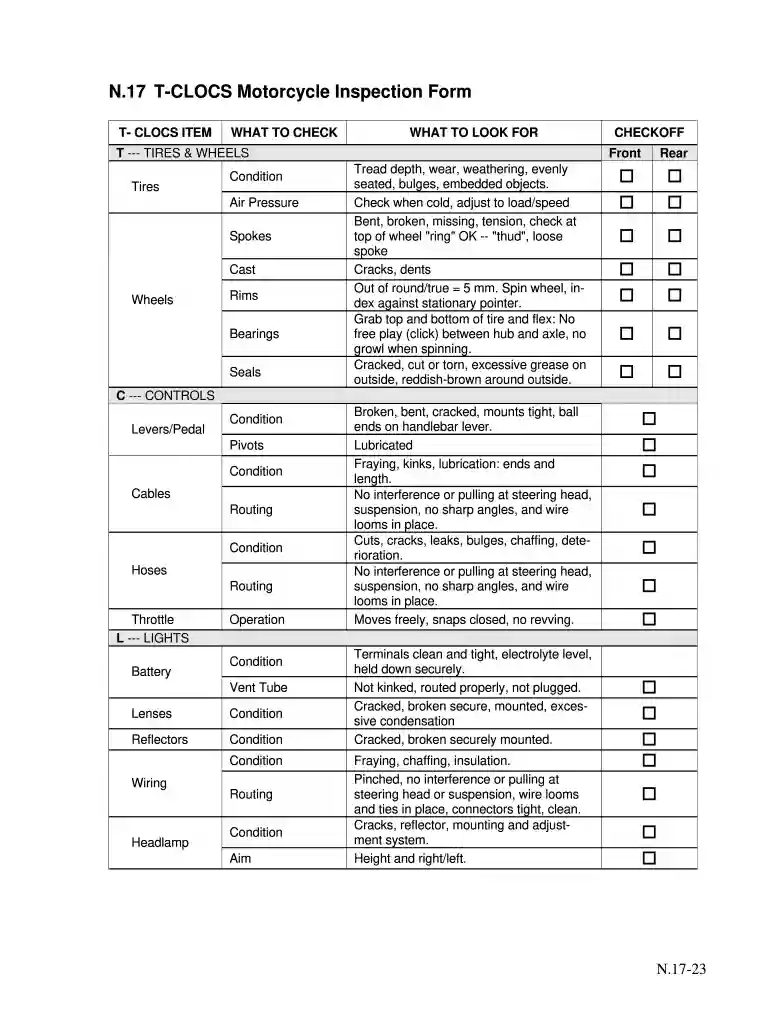
T clocs 2026

Get Form
tclocs Preview on Page 1

Here's how it works

01. Edit your tclocs online
Type text, add images, blackout confidential details, add comments, highlights and more.

02. Sign it in a few clicks
Draw your signature, type it, upload its image, or use your mobile device as a signature pad.

03. Share your form with others
Send t clocs via email, link, or fax. You can also download it, export it or print it out.

Definition and Meaning of T Clocs

The term "T-Clocs" refers to a comprehensive motorcycle inspection checklist developed by the Motorcycle Safety Foundation (MSF) to ensure riders perform thorough safety checks on their motorcycles before riding. T-Clocs stands for Tires, Controls, Lights, Oil, Chassis, and Stands, which represent the essential components that riders should evaluate.

When using the T-Clocs checklist, each of the six categories focuses on critical aspects of the motorcycle's functionality and safety. By following the T-Clocs protocol, riders can identify potential issues that could compromise their safety during operation. This systematic approach not only enhances rider safety but also prolongs the lifespan of the motorcycle.

For example, under the "Tires" category, riders should examine tread depth, look for any signs of damage, and check tire pressure. The "Controls" section ensures that all levers and systems, such as the clutch and brakes, are functioning correctly. Understanding the meaning and purpose of T-Clocs is vital for all motorcycle riders, as it serves as a foundational element of responsible riding practices.

Key Elements of the T Clocs

The T-Clocs inspection checklist encompasses six key elements, each representing a vital component that should be assessed for motorcycle safety and performance.

  • Tires: Check for adequate tread depth, inspect for visible wear or damage, and assess proper inflation levels.
  • Controls: Ensure that all control levers, including brakes, clutch, and throttle, are functioning smoothly and are easily accessible.
  • Lights: Test all lights, including headlights, taillights, and turn signals, to verify they are operational and compliant with local regulations.
  • Oil: Inspect oil levels and conditions, ensuring that the engine oil is at the appropriate level and not contaminated.
  • Chassis: Evaluate the overall structure, including the frame, suspension, and mounting points, for signs of wear or instability.
  • Stands: Ensure that the center and side stands function correctly, providing stability when the motorcycle is parked.

By meticulously examining each of these elements, riders can significantly reduce the risk of mechanical failures or safety hazards while riding.

Steps to Complete the T Clocs

Completing the T-Clocs inspection is a straightforward process that involves step-by-step evaluation of your motorcycle. Following these steps can help ensure thorough checking.

  1. Prepare the Motorcycle: Position your motorcycle on a stable surface, ideally on a flat area where you can freely access all sides.
  2. Inspect Tires: Check both front and rear tires for proper pressure using a tire pressure gauge, examine tread depth with the penny test, and visually look for any cracks or punctures.
  3. Evaluate Controls: Activate the controls such as the throttle, brake levers, and clutch, noting their responsiveness, and check for any stiffness or disfunction.
  4. Test Lights: Switch on the ignition and test all lights, confirming that both brake lights function and that indicators flash correctly without any outages.
  5. Check Oil Levels: Remove the oil dipstick or access the oil reservoir if applicable and check the oil level. Make sure to wipe the dipstick clean and check that the oil appears free from debris.
  6. Assess Chassis: Visually inspect the frame for cracks or rust, depress the suspension to ensure it rebounds smoothly, and check the condition of bolts and fittings.
  7. Examine Stands: Engage the side and center stands to ensure they operate smoothly; also check that the motorcycle stands upright without wobbling.

Once you have completed all steps, document your findings. If any discrepancies are found, take the necessary actions to address them before riding.

Examples of Using the T Clocs

Practical applications of the T-Clocs inspection checklist are vital in various situations. Here are some scenarios where riders would benefit from using this tool:

  • Pre-Ride Checks: Before embarking on a long ride, a thorough inspection using T-Clocs can help ensure that the motorcycle is in optimal condition. For instance, ensuring tire pressure is adequate may prevent tire blowouts during extended rides.
  • Post-Season Storage: After winter storage, a T-Clocs inspection can help identify any potential issues caused by inactivity, such as battery discharge or tire flat spotting.
  • New Riders: For those new to motorcycling or those borrowing a bike, using T-Clocs provides a structured way to ensure the motorcycle is safe and operable without relying solely on another person's assessment.

In each of these cases, practicing T-Clocs not only fosters a culture of safety among riders but also adds to the enjoyment of riding by minimizing mechanical failures on the road.

Who Typically Uses the T Clocs

The T-Clocs checklist is a valuable tool for various groups within the motorcycle community, encompassing both professional and recreational riders.

  • New Riders: Individuals who have just received their motorcycle license typically use T-Clocs as part of their routine to develop safe riding habits.
  • Experienced Riders: Seasoned motorcyclists incorporate T-Clocs checks to maintain their motorcycles and enhance their awareness of vehicle condition, especially before long trips.
  • Motorcycle Instructors and Schools: MSF instructors emphasize the importance of the T-Clocs teaching module, helping students understand the significance of routine safety checks as part of riding education.
  • Motorcycle Enthusiasts: Riders who participate in clubs or groups commonly share T-Clocs inspections during meet-ups, fostering safety within the riding community.

Ultimately, any motorcycle rider, regardless of experience level, can benefit from employing T-Clocs to prioritize safety and vehicle maintenance. By making T-Clocs standard practice, riders promote a culture of responsibility and pragmatism in motorcycle touring.


decoration image ratings of Dochub
be ready to get more

Complete this form in 5 minutes or less

Get form

Got questions?

We have answers to the most popular questions from our customers. If you can't find an answer to your question, please contact us.
Contact us
A motorcycle inspection examines various components of the vehicle to ensure your bike is roadworthy and safe to operate. While inspections may vary from place to place, you can expect a motorcycle inspection checklist to cover the fuel systems, brakes and more.
T-CLOC stands for Tires and Wheels, Controls and Cables, Lights and Electrics, Oil and Fuel, Chain/Driveshaft and Chassis.
FINE-C refers to an engine pre-start routine. It stands for Fuel, Ignition, Neutral, Engine cut-off switch, Choke and Clutch. Tap the card to flip 👆
FINE-C: Fuel, Ignition, Neutral, Engine cut-off switch, Choke and clutch. FINE-C is an ordered series of controls you should always engage when starting your motorcycle. With certain bikes, you may need to skip steps that dont apply.
C is for Choke: Read your owners manual for details of when you should use the choke on your bike. Generally you use it any time, and only, when starting a cold engine. Skip this step if the engine is still warm from a recent run; develop a feel for when you need the choke.
be ready to get more

Complete this form in 5 minutes or less

Get form

People also ask

FINE C stands for fuel valve, ignition, and neutral, engine cut off switch, choke and clutch.

t clocs fine c