LOCAL CIVIL AND CRIMINAL RULES - District of New Jersey - njd uscourts 2026

Get Form
nj writ execution Preview on Page 1

Here's how it works

01. Edit your nj writ execution online
Type text, add images, blackout confidential details, add comments, highlights and more.

02. Sign it in a few clicks
Draw your signature, type it, upload its image, or use your mobile device as a signature pad.

03. Share your form with others
Send njd uscourts via email, link, or fax. You can also download it, export it or print it out.

How to use or fill out LOCAL CIVIL AND CRIMINAL RULES - District of New Jersey - njd uscourts with our platform

Form edit decoration
9.5
Ease of Setup
DocHub User Ratings on G2
9.0
Ease of Use
DocHub User Ratings on G2
  1. Click ‘Get Form’ to open it in the editor.
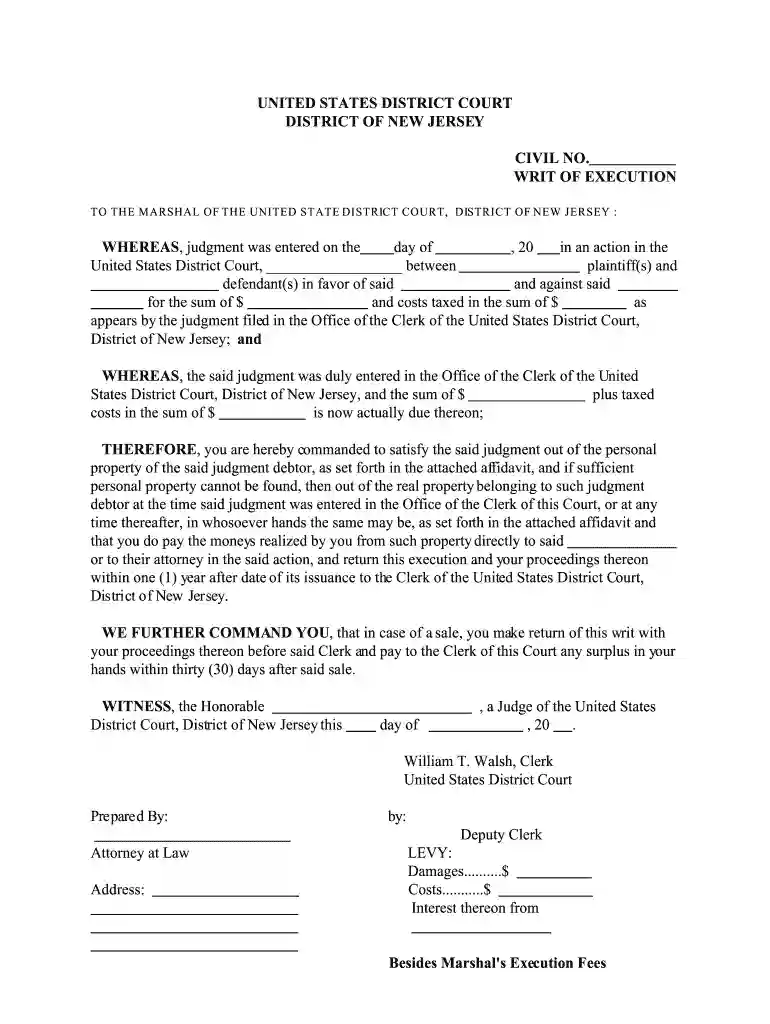
  2. Begin by entering the Civil No. at the top of the form, ensuring it matches your case number.
  3. Fill in the date judgment was entered and the names of the plaintiff(s) and defendant(s) in the designated fields.
  4. Specify the total amount due, including damages and costs, as indicated on your judgment.
  5. Complete the affidavit section by detailing non-exempt personal and real property of the judgment debtor, including descriptions and locations.
  6. Ensure all signatures are completed where required, including that of a notary public if necessary.
  7. Review all entries for accuracy before saving or printing your completed document.

Start using our platform today to streamline your document editing and ensure a smooth filing process!

See more LOCAL CIVIL AND CRIMINAL RULES - District of New Jersey - njd uscourts versions

We've got more versions of the LOCAL CIVIL AND CRIMINAL RULES - District of New Jersey - njd uscourts form. Select the right LOCAL CIVIL AND CRIMINAL RULES - District of New Jersey - njd uscourts version from the list and start editing it straight away!
Versions Form popularity Fillable & printable
2000 4.7 Satisfied (62 Votes)
be ready to get more

Complete this form in 5 minutes or less

Get form

Got questions?

We have answers to the most popular questions from our customers. If you can't find an answer to your question, please contact us.
Contact us
Local Rule 101.1(c) governs the admission of an attorney pro hac vice. The motion to appear pro hac vice shall be filed via CM/ECF by a member of the bar of this Court. Upon the granting of a motion to appear pro hac vice, the out-of-state attorney is required to make a payment of $250.00 on each admission.
To set aside a default judgment, the defendant must demonstrate that its failure to answer or otherwise appear and defend was due to excusable neglect under the circumstances and that it has a meritorious defense either to the cause of action itself or the quantum of damages assessed.
LOCAL CIVIL RULE 11.2 requires that the complaint (or other initial pleading of any party) contain a certification in accordance with 28 U.S.C. 1746 that states whether the matter is the subject of any other court, arbitration, or administrative proceeding and identifies any such other proceeding.
Motion Practice: Motions to Dismiss (NJ) It outlines who may file a motion to dismiss, the timing for filing, and the available defenses, such as lack of subject matter jurisdiction, personal jurisdiction, insufficient process or service of process, failure to state a claim, and failure to join a necessary party.
Rule 3:13-3(b) of the New Jersey Rules of Court directs, in relevant part, that the prosecutors discovery for a defendant named in an indictment is to be provided or made available within seven days of the return or unsealing of the indictment.

Security and compliance

At DocHub, your data security is our priority. We follow HIPAA, SOC2, GDPR, and other standards, so you can work on your documents with confidence.

Learn more
ccpa2
pci-dss
gdpr-compliance
hipaa
soc-compliance
be ready to get more

Complete this form in 5 minutes or less

Get form

People also ask

RULE 1:9. SUBPOENAS 1:9-1. For Attendance of Witnesses; Forms; Issuance; Notice in Lieu of Subpoena A subpoena may be issued by the clerk of the court or by an attorney or party in the name of the clerk or as provided by R. 7:7-8 (subpoenas in certain cases in the municipal court).

Related links