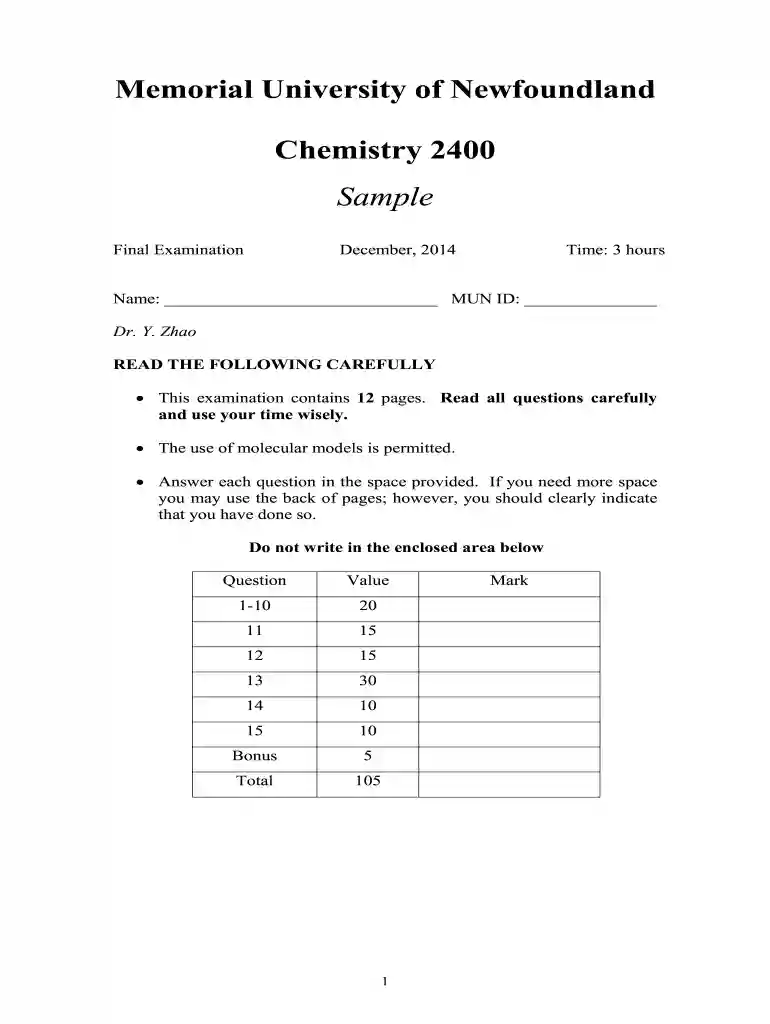
Chem 2400 mun-2025

Get Form
chem 2400 mun Preview on Page 1

Here's how it works

01. Edit your chem 2400 mun online
Type text, add images, blackout confidential details, add comments, highlights and more.

02. Sign it in a few clicks
Draw your signature, type it, upload its image, or use your mobile device as a signature pad.

03. Share your form with others
Send it via email, link, or fax. You can also download it, export it or print it out.

How to use or fill out chem 2400 mun with our platform

Form edit decoration
9.5
Ease of Setup
DocHub User Ratings on G2
9.0
Ease of Use
DocHub User Ratings on G2
  1. Click ‘Get Form’ to open the chem 2400 mun document in the editor.
  2. Begin by entering your name and MUN ID in the designated fields at the top of the form. This ensures your submission is properly identified.
  3. Carefully read through each question, starting with Part A, which consists of multiple-choice questions. Select your answers by clicking on the appropriate option.
  4. For Part B, where you need to provide detailed responses, utilize the text boxes provided. If additional space is required, indicate that you are continuing on a separate page.
  5. Review your answers thoroughly before finalizing. Use our platform's features to save your progress and make any necessary edits.

Start using our platform today for free to complete your chem 2400 mun efficiently!

be ready to get more

Complete this form in 5 minutes or less

Get form

Got questions?

We have answers to the most popular questions from our customers. If you can't find an answer to your question, please contact us.
Contact us
Course Description: This course aims to provide students with some fundamental concepts in analytical chemistry. These include treatment of analytical data, chemical equilibria and quantitative analysis using titrimetric and electrochemical methods.
While organic chemistry can be very difficult, you can make it easier with some basic strategies such as knowing the types of reactions and how they occur and using a 3D modeling kit to work out the chemical structures.
Currently, the fail rate for organic chemistry across the nation is over 50%, with the course being described as the ultimate - out course. 1 It has a notorious reputation, and many professors have difficulty achieving high success rates in their classes.
This course is the first semester of a one-year course in organic chemistry. Major themes include, but are not limited to, bonding, molecular structure, isomerism, conformational analysis, nomenclature, reaction mechanisms, and synthesis.
CHEM 121: An Introduction To Organic Chemistry and Biochemistry - Modern Campus Catalog
be ready to get more

Complete this form in 5 minutes or less

Get form

People also ask

Understanding these reasons that students struggle with organic chemistry - the uniqueness of the class, the requirement of the visual cortex in processing shapes and structures, the compounding material of the class, and student mentality - provides the prelude for discovering how we can better prepare students for
It requires an understanding of a variety of functional groups, reaction mechanisms, bonds, and polarity. While these can be mastered, there can be a steep learning curve. Studying the various reactions and theory in organic chemistry requires rote learning and memorization.

Related links