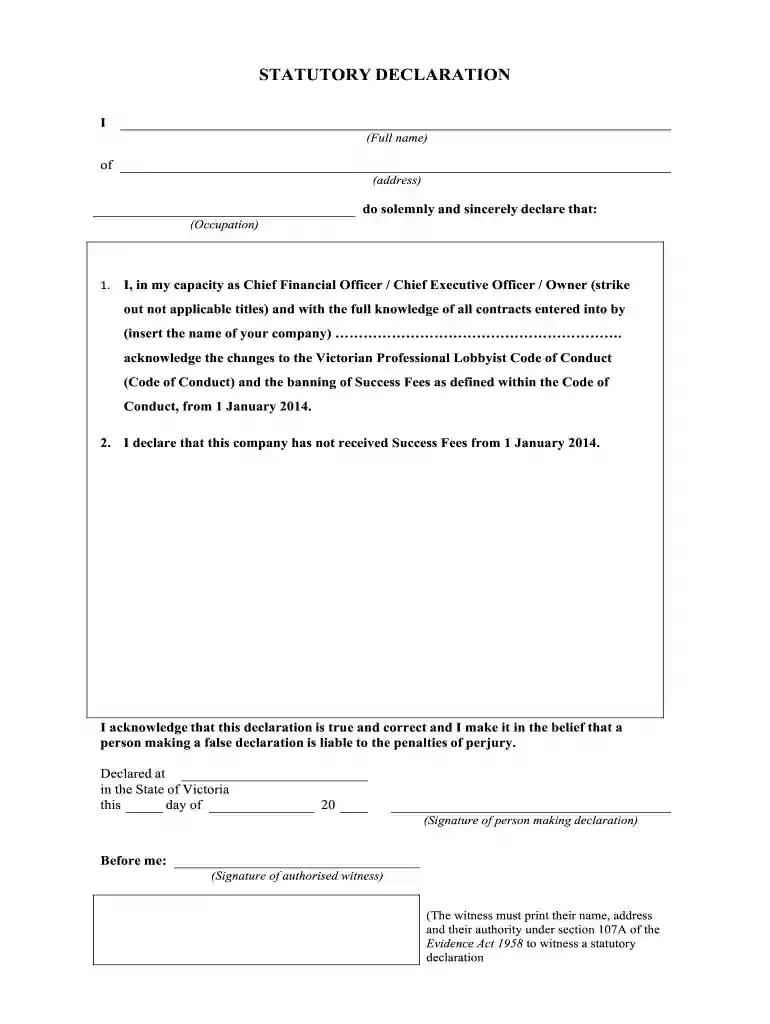
Definition & Meaning
A statutory declaration is a formal statement made under oath, affirming the truthfulness of specific facts as declared by the individual. In New South Wales (NSW), a statutory declaration serves as a legally recognized document, utilized when individuals need to affirm certain information without the necessity of appearing before a judicial authority. It is often used in scenarios such as verifying identity, confirming employment status, or attesting to the truth of various claims for legal or administrative purposes.
The statutory declaration form in NSW is essential for individuals who need to provide sworn evidence regarding particular facts. The process is governed by the Oaths Act 1900, ensuring that the declarations made are compliant with legal standards. Those who sign a statutory declaration in NSW must be mindful that providing false information can lead to penalties under criminal law, emphasizing the importance of honesty and accuracy when completing the form.
How to Obtain the Statutory Declaration Form NSW
Obtaining a statutory declaration form in NSW is straightforward. The form is typically available through various channels:
- Online Access: Individuals can download the statutory declaration form directly from the NSW government website or other official platforms. Many legal and governmental organizations provide a standard version that can be easily printed and completed.
- In-Person Locations: Public offices, including local council offices, courts, and legal aid clinics, supply statutory declaration forms. Visiting these locations can also offer assistance in understanding how to complete the form correctly.
- Legal Practitioners: Solicitors and legal professionals frequently have copies available and can assist with the process of completing and witnessing the declaration, ensuring compliance with legal requirements.
It is essential to ensure that you obtain the most current version of the form to avoid any complications with submission.
Steps to Complete the Statutory Declaration Form NSW
Completing the statutory declaration form in NSW requires attention to detail. Follow these steps for accuracy:
- Download or Obtain the Form: Start with the appropriate statutory declaration form from a reliable source.
- Fill in the Personal Details: Include your full name, address, and occupation. This information identifies you as the declarant.
- State the Facts Clearly: In the section provided, clearly outline the facts you are declaring. Use precise language to ensure clarity.
- Sign in Front of a Witness: Legally, you must sign the declaration in the presence of an authorized witness, such as a solicitor, court official, or a registered medical practitioner.
- Witness Confirmation: The witness will also sign the form, verifying your identity and that you executed the declaration appropriately.
- Submit the Document: Depending on the requirement, you may need to submit the form to a specific entity or keep it for your records.
Attention to detail at each step prevents errors that could invalidate the declaration.
Important Terms Related to Statutory Declaration Form NSW
Understanding key terminology associated with the statutory declaration form is essential for effective completion and usage:
- Declarant: The individual making the declaration, affirming the truth of specific facts.
- Witness: A person authorized by law to witness the signing of a statutory declaration. This can include legal professionals or other designated individuals.
- Oath: A solemn promise, often made to affirm the truthfulness of statements outlined in the declaration.
- Oaths Act 1900: The legislation governing the procedures surrounding oaths and declarations in NSW.
- False Declaration: Any misrepresentation or lie provided in the statutory declaration, which can lead to legal ramifications.
Clarifying these terms can improve understanding and ensure that all parties involved adhere to proper legal standards.
Legal Use of the Statutory Declaration Form NSW
Statutory declarations in NSW have a significant legal standing, being recognized in various contexts. Common legal uses include:
- Identity Verification: Individuals often use these declarations to confirm their identity for applications requiring personal verification, such as passports or licenses.
- Employment Evidence: Statutory declarations may assert an individual's employment status or work history, particularly in instances where formal documentation is unavailable.
- Legal Proceedings: When individuals need to provide sworn evidence related to court cases or applications for government-related benefits, a statutory declaration is often utilized.
- Affirming Personal Claims: These declarations can affirm personal claims, such as custodial arrangements or residency matters, in situations where formal evidence may not exist.
Understanding the legal uses of a statutory declaration form helps individuals leverage its power appropriately within legal and administrative frameworks.
Examples of Using the Statutory Declaration Form NSW
Statutory declarations can be applied in various practical scenarios across different contexts:
- Obtaining a Birth Certificate: Someone might use a statutory declaration to prove their identity when applying for a copy of their birth certificate, especially if standard identification documents are lacking.
- Business Registration: Entrepreneurs may declare information regarding their business entity or ownership to meet regulatory requirements for business licenses or registrations.
- Affidavit for Family Court: In child custody cases, parents may use a statutory declaration to support claims regarding their suitability as a custodian or to outline living arrangements.
- Proof of Relationship: Individuals may provide a statutory declaration in immigration applications to affirm a genuine relationship in partnership visas, where official proof may be limited.
Using real-world examples illustrates the diverse applicability of the statutory declaration form in various legal and personal settings.
State-Specific Rules for the Statutory Declaration Form NSW
Each state in Australia has its regulations regarding statutory declarations, with NSW following specific guidelines. Key rules include:
- Authorized Witnesses: Only designated individuals such as solicitors, commissioners for declarations, or registered medical practitioners can witness the signing of a statutory declaration in NSW.
- Adherence to Oaths Act 1900: Compliance with the Oaths Act ensures that all statutory declarations maintain legal integrity within NSW's judicial framework.
- Potential Penalties: Making a false declaration can incur criminal penalties, emphasizing the importance of honesty in the information provided.
Understanding these state-specific rules is crucial for anyone wishing to utilize the statutory declaration form in NSW to ensure legal compliance and avoid potential issues.