




01. Edit your 1008 form online
Type text, add images, blackout confidential details, add comments, highlights and more.

Type text, add images, blackout confidential details, add comments, highlights and more.

Draw your signature, type it, upload its image, or use your mobile device as a signature pad.

Send fannie mae 1008 via email, link, or fax. You can also download it, export it or print it out.
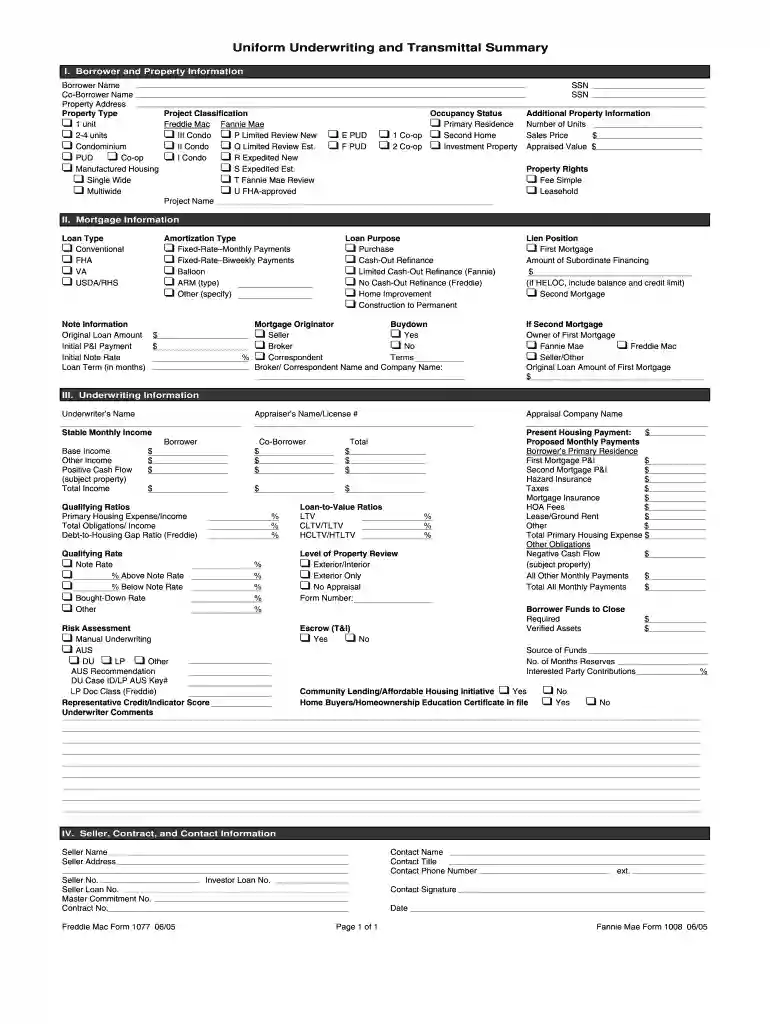
The Uniform Underwriting and Transmittal Summary, commonly referred to as Form 1008, is a crucial document in the U.S. mortgage lending process. It serves as a standard summary of essential information related to a loan application. The form consolidates data about the borrower, the property they wish to purchase or refinance, and the underwriting criteria associated with the loan decision. By serving as a comprehensive overview, Form 1008 streamlines the underwriting process, enabling lenders to make informed decisions based on uniform criteria and guidelines.
Key sections typically included in Form 1008 are:
Understanding the purpose and components of Form 1008 is essential for both borrowers and lenders involved in the mortgage process.
Completing Form 1008 involves several systematic steps that ensure accuracy and compliance. The following outlines the necessary steps and considerations while filling out the form:
Gather Required Information: Collect all necessary documents, including the borrower's identification, income verification, credit reports, and property details.
Personalize the Form:
Detail Loan Information:
Include Underwriting Information:
Review and Finalize: Carefully review all sections of the form to ensure accuracy. Confirm the accuracy of all figures and ensure that the borrower and co-borrower have signed where necessary.
Mistakes or incomplete information can lead to delays in the underwriting process, making it crucial to pay attention to detail at this stage.
Form 1008 plays a pivotal role in various stages of the mortgage underwriting process. It is primarily employed for:
Loan Processing: Lenders use the form to compile and assess the required information about borrowers and properties, ensuring compliance with underwriting standards.
Risk Assessment: The form provides a concise overview of critical data that helps underwriters evaluate the risk associated with a loan application, thus influencing the lending decision.
Record Keeping: Financial institutions use the completed form as part of their official records, which may be necessary for audit and compliance purposes.
Communication with Secondary Market: Fannie Mae and Freddie Mac require this form for loans that are sold in the secondary mortgage market, making it essential for lenders to include when submitting loans for securitization.
In summary, Form 1008 is integral to ensuring a smooth mortgage transaction, benefiting both lenders and borrowers by fostering transparent communication and consistent data presentation.
Form 1008 encompasses several key elements that facilitate its function within the mortgage process. Understanding these components can aid in the efficient completion and utilization of the form:
Borrower Section: This section collects personal information, financial background, and identification details of the borrower and any co-borrowers. It is vital to provide up-to-date and accurate data to avoid complications later in the process.
Property Section: Details about the real estate involved, such as its address, estimated value, and type (e.g., primary residence, investment property). Accurate property information is crucial for valuation and risk assessment.
Loan Information: This segment includes the loan amount, interest rate, and term of the mortgage. Not only does this reflect the borrower's funding needs, but it also aligns the lender's offerings with borrower requirements.
Underwriting Data: A comprehensive overview of financial metrics like credit scores, debt-to-income ratio, employment history, and reserves. Complete input in this area is essential for underwriters during the assessment process.
Requirements and Verification: This element captures stipulations that may be necessary for formal approval of the loan. Documentation supporting the entries on the form can significantly expedite the underwriting process.
Each element serves a specific purpose and, collectively, they form the backbone of the mortgage underwriting process, guiding decision-making from start to finish.
The Uniform Underwriting and Transmittal Summary (Form 1008) can be completed using either its digital version or a traditional paper format. Here are key differences and considerations for both options:
Ultimately, the choice between digital and paper versions depends on the user’s preferences, technological proficiency, and the requirements of the lender or institution processing the application. Both versions contain the same critical content and fulfill the same purpose in the mortgage underwriting process.
We've got more versions of the 1008 form form. Select the right 1008 form version from the list and start editing it straight away!
At DocHub, your data security is our priority. We follow HIPAA, SOC2, GDPR, and other standards, so you can work on your documents with confidence.


