Ta equal employment 2026

Get Form
ta equal employment Preview on Page 1

Here's how it works

01. Edit your form online
Type text, add images, blackout confidential details, add comments, highlights and more.

02. Sign it in a few clicks
Draw your signature, type it, upload its image, or use your mobile device as a signature pad.

03. Share your form with others
Send it via email, link, or fax. You can also download it, export it or print it out.

How to use or fill out ta equal employment with our platform

Form edit decoration
9.5
Ease of Setup
DocHub User Ratings on G2
9.0
Ease of Use
DocHub User Ratings on G2
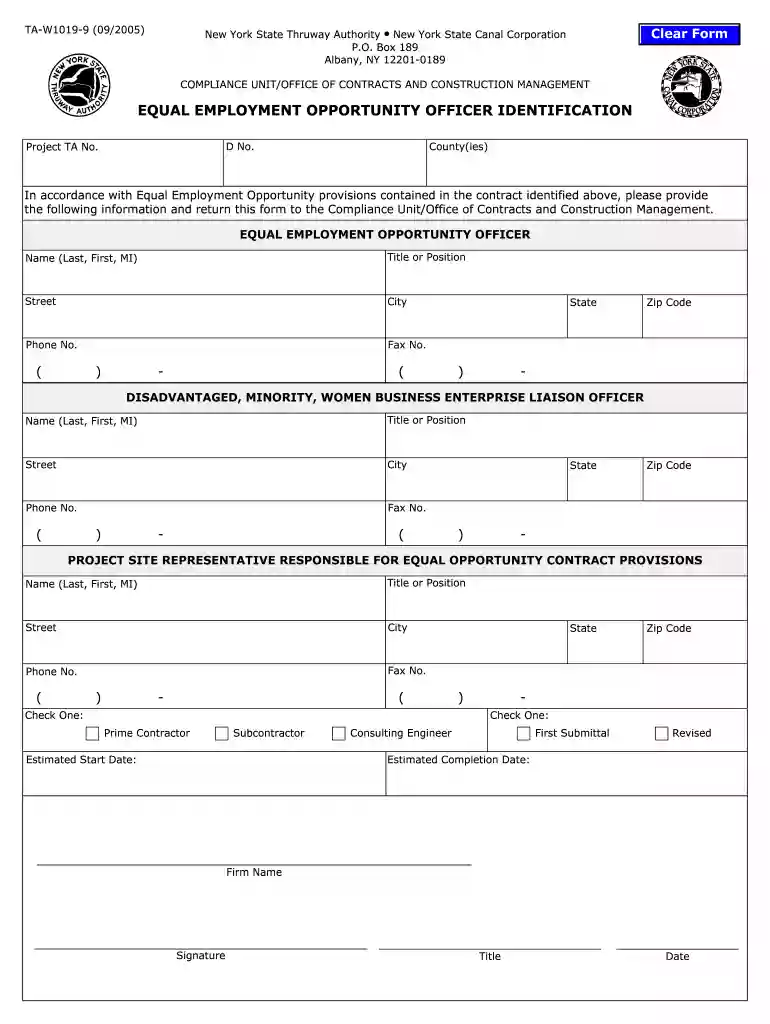
  1. Click ‘Get Form’ to open the ta equal employment form in the editor.
  2. Begin by entering the project details. Fill in the 'Project TA No.' and 'County(ies)' fields accurately to ensure proper identification.
  3. Next, provide information for the Equal Employment Opportunity Officer. Enter their name, title, street address, city, state, zip code, phone number, and fax number in the designated fields.
  4. Continue by filling out the Disadvantaged, Minority, Women Business Enterprise Liaison Officer section with similar details as above.
  5. Then, complete the Project Site Representative section. Ensure all names and contact information are correct.
  6. Select whether you are a Prime Contractor or Subcontractor by checking the appropriate box.
  7. Finally, enter your firm name, sign the document, and include your title and date before submitting it back to the Compliance Unit.

Start using our platform today to fill out your ta equal employment form online for free!

See more ta equal employment versions

We've got more versions of the ta equal employment form. Select the right ta equal employment version from the list and start editing it straight away!
Versions Form popularity Fillable & printable
2005 4.9 Satisfied (452 Votes)
be ready to get more

Complete this form in 5 minutes or less

Get form

Got questions?

We have answers to the most popular questions from our customers. If you can't find an answer to your question, please contact us.
Contact us
Over the past decade, the Equal Employment Opportunity Commission (EEOC) has reported that retaliation is the most common issue alleged by federal employees and the most common discrimination finding in federal sector cases.
Discrimination happens when an employer treats an employee or job applicant unfairly because of their race, color, religion, sex, national origin, age (40 or older), disability, or genetic information. EEOC laws do not cover all employers.
Discrimination. This includes unfair treatment based on religion, age, ethnicity, gender, disability, skin color, sexual orientation or race. Wrongful termination. According to the Equal Employment Opportunity Commission (EEOC), this is the most common claim brought against employers.
They cover the nine grounds of gender, marital status, family status, age, disability, sexual orientation, race, religion, and membership of the Traveller community.
According to the EEOC, ``It is illegal to ask a candidate questions about their: Race, color or national origin. Religion. Sex, gender identity or sexual orientation. Pregnancy status. Disabilities (except to ask if you need accomodation in the interview; for example, one may need a sign language interpreter).
be ready to get more

Complete this form in 5 minutes or less

Get form

People also ask

These laws protect employees and job applicants against employment discrimination when it involves: Unfair treatment because of race, color, religion, sex (including pregnancy, transgender status, and sexual orientation), national origin, age (40 or older), disability or genetic information.
More than half of all discrimination claims filed with the EEOC included an accusation of retaliation. Retaliation made up nearly 48% of all claimed filed with the agency, followed by race and color discrimination at 42%, disability discrimination at 38%, and sex discrimination at 30%.
The most frequently filed claims with the EEOC are allegations of race discrimination, racial harassment, or retaliation arising from opposition to race discrimination.

Related links