







Definition and Meaning
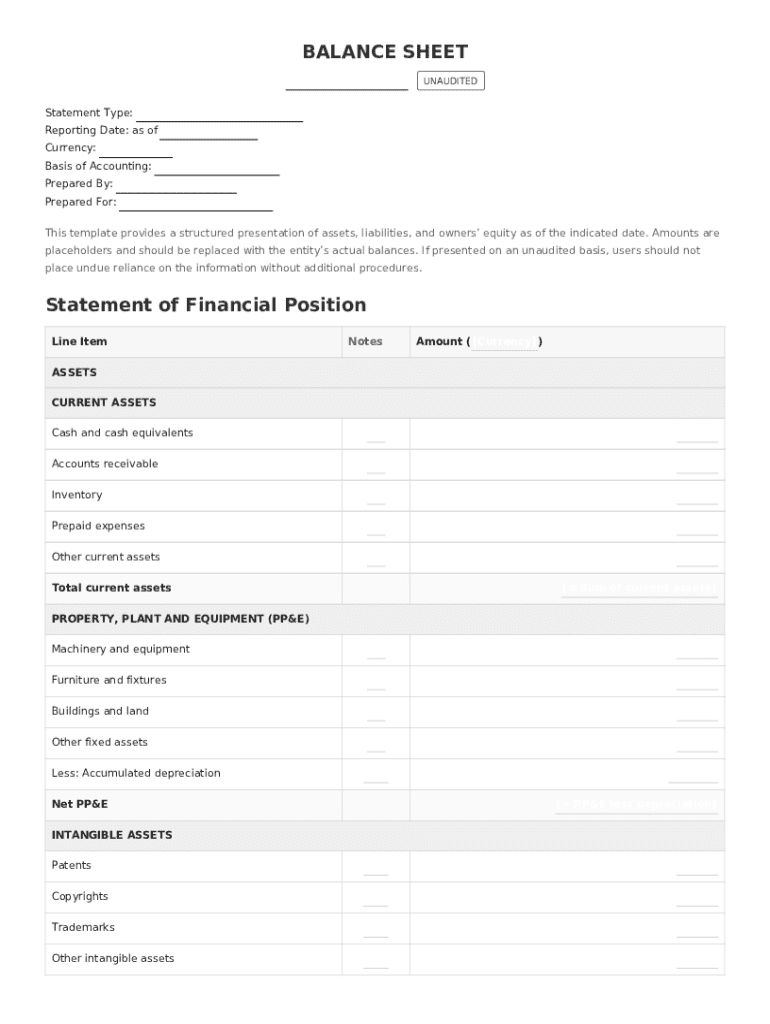
A balance sheet template is a crucial financial document that serves as a snapshot of a business's financial health at a specific point in time. It details a company’s assets, liabilities, and owner’s equity, offering a comprehensive overview of what the company owns and owes. This structured format is vital for accountants, investors, and stakeholders to assess the financial stability and operational efficiency of an organization. By providing a standardized template, users can ensure their financial statements are consistent and comparable across different periods or business entities.
Key Elements of the Balance Sheet Template
A balance sheet template typically consists of three main sections:
- Assets: This includes current assets like cash, accounts receivable, and inventory, as well as long-term assets such as property, equipment, and intangible assets.
- Liabilities: Divided into current liabilities, like accounts payable and short-term debt, and long-term liabilities, such as bonds payable and long-term loans.
- Owner’s Equity: This represents the residual interest in the assets of the business after deducting liabilities, often comprising capital, retained earnings, and additional paid-in capital.
Each section of the balance sheet template provides specific insights into the financial attributes of a business, supporting informed decision-making.
How to Use the Balance Sheet Template
Utilizing a balance sheet template involves a few systematic steps:
- Collect Financial Data: Gather information on all assets, liabilities, and equity components. Update these figures to reflect the most current financial state of the business.
- Fill Out the Template: Input the data into the assigned sections of the template, ensuring accuracy and adherence to standard accounting practices.
- Reconcile Totals: Verify that the total assets equal the sum of liabilities and owner’s equity, maintaining the balance sheet’s fundamental equation.
As an ongoing activity, regular updates to the template help track financial performance over time.
Steps to Complete the Balance Sheet Template
Completing a balance sheet template requires careful attention to detail:
- List Current Assets: Inventory, cash on hand, prepaid expenses, and accounts receivable.
- Record Long-term Assets: Enter fixed assets, minus accumulated depreciation, and any intangible assets like patents.
- Catalog Current Liabilities: Include items such as accounts payable, wages payable, and short-term loans.
- Identify Long-term Liabilities: Long-term debts payable within a period longer than one year.
- Calculate Owner’s Equity: Compile total capital invested by owners and retained earnings.
Thorough examination and validation of every entry ensure the accuracy of the financial assessment.
Who Typically Uses the Balance Sheet Template
The balance sheet template is an indispensable tool for various stakeholders:
- Accountants and Financial Analysts: To ensure compliance and aid in preparing financial statements.
- Investors and Lenders: To evaluate a company’s fiscal health and make informed investment decisions.
- Business Owners and Managers: For internal reviews, strategic planning, and monitoring company progress.
These users rely on the template to enhance financial transparency and strategic decision-making.


Examples of Using the Balance Sheet Template
Consider the scenario of a small retail business evaluating its yearly performance:
- Year-end Evaluation: The balance sheet reveals a sudden increase in inventory that might indicate issues with sales forecasts or procurement processes.
- Investment Readiness: Investors examining the template can quickly assess the company's net worth and the adequacy of their profits.
Industries ranging from manufacturing to service sectors use templates to streamline financial analyses.
Legal Use of the Balance Sheet Template
The balance sheet template must align with generally accepted accounting principles (GAAP), ensuring:
- Regulatory Compliance: Proper reporting and transparency reduce the risk of legal issues.
- Auditable Records: Provides a verifiable trail of financial transactions, crucial for audits and regulatory reviews.
- Integrity Maintenance: Accurate reporting fosters trust among investors and complies with financial disclosure laws.
Using the template in accordance with the law supports legitimate and ethical business operations.
Software Compatibility
Software like QuickBooks, Microsoft Excel, and other accounting platforms support balance sheet templates, facilitating:
- Ease of Use: Users can import and export data seamlessly between software applications.
- Automation: Automated calculations and formatting minimize human error and save time.
- Customization: Easily adaptable templates align with specific industry requirements or unique business needs.
Compatibility with digital tools enhances the effectiveness of the balance sheet template in modern accounting practices.
Quick Facts
- Frequency of Use: Typically completed at the end of each accounting period, such as monthly, quarterly, or annually.
- Complexity: The template can vary in complexity based on the size and nature of the business.
- Purpose: Primarily used to provide insights into a company’s liquidity, financial stability, and operational efficiency.
These facts underscore the importance and functionality of the balance sheet template in business accounting.




