
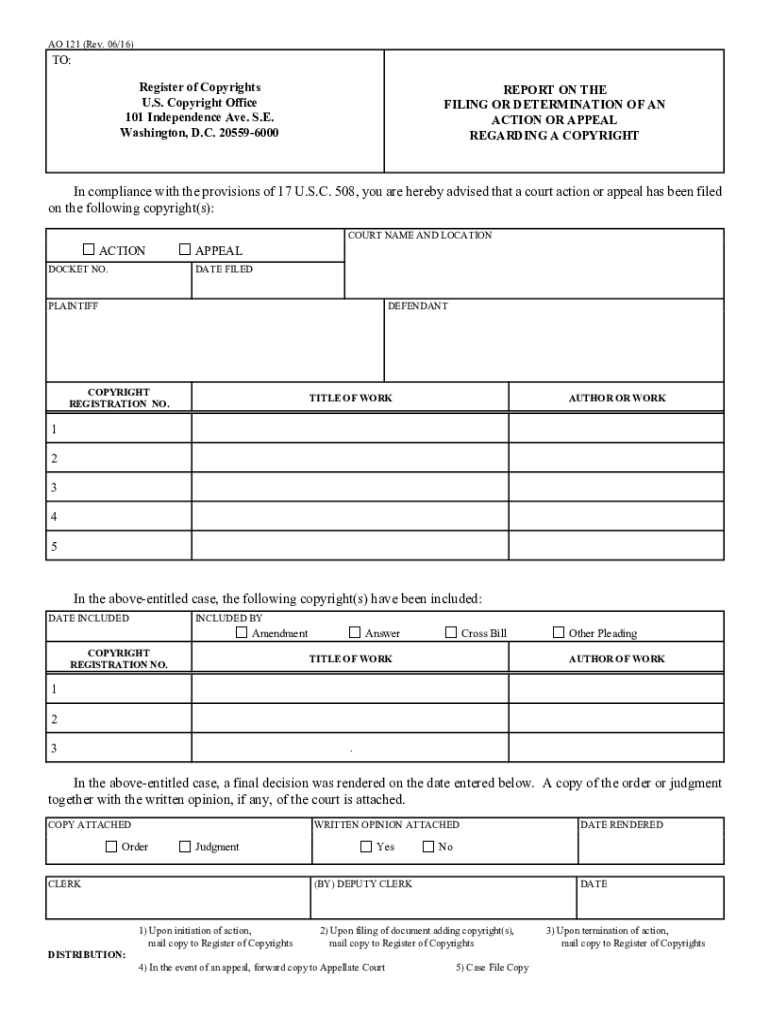







Definition & Meaning
The "Copyright Office Action or Appeal Report" is an official document used to report actions or appeals related to copyright cases to the U.S. Copyright Office. It serves as a formal communication method for addressing disputes, challenges, or determinations concerning copyright laws. This report is essential for tracking and documenting proceedings initiated by individuals or entities seeking legal clarity or resolution on copyright-related issues.
Importance of Accurate Reporting
- Ensures consistent communication between parties.
- Aids in maintaining a structured record for future reference.
- Supports legal integrity by providing a documented trail of actions and decisions.
Common Use Cases
- Addressing disputes over copyright ownership.
- Documenting appeals against decisions by the copyright office.
- Reporting outcomes of legal proceedings related to copyrights.
How to Use the Copyright Office Action or Appeal Report
Using the report involves several steps, each designed to ensure precise and complete submission. Understanding the process helps streamline this complex but crucial task.
Step-by-Step Instructions
- Collect Necessary Information: Gather all relevant details, including case numbers, parties involved, and documentation of the action or appeal.
- Complete the Form Accurately: Fill out each section of the report with meticulous attention to detail to prevent errors.
- Review and Edit: Double-check entries for accuracy and completeness to avoid omissions or inaccuracies.
Real-World Scenarios
- A copyright holder may file this report to appeal a denial of registration.
- An individual might use it to challenge the determination of fair use.
Steps to Complete the Copyright Office Action or Appeal Report
Filling out the form involves navigating various sections that require specific information and adherence to guidelines.
Comprehensive Breakdown
- Section A: Identify the parties involved, including their contact information.
- Section B: Describe the action or appeal in detail, citing relevant legal or procedural grounds.
- Section C: Attach required documentation, such as previous correspondences, judicial outcomes, or supporting evidence.
Ensuring Compliance
- Allocate time for careful proofreading.
- Confirm that all required fields are filled before submission.
Key Elements of the Copyright Office Action or Appeal Report
Certain fields and sections are crucial in conveying necessary information in this official report.
Essential Components
- Action Description: Clearly articulate the nature of the copyright action or appeal.
- Justification and Legal Basis: Provide a legal context supporting your case or appeal.
- Signatures and Dates: Ensure that all parties have appropriately signed and dated the document.
Detailed Examples
- A music producer details a dispute over song rights requiring precise documentation segments.
- An author might report a publisher's unauthorized use of literary works, supported by evidence and legal rationale.
Legal Use of the Copyright Office Action or Appeal Report
This report has a significant role in the legal framework of copyright law, affecting various stakeholders.
Legal Implications
- Acts as formal evidence in legal proceedings.
- Facilitates the accurate reflection of actions and appeals as mandated by copyright laws.
Stakeholders Involved
- Copyright owners and claimants.
- Legal representatives and law firms.
- Judicial and government entities assessing copyright disputes.
Who Typically Uses the Copyright Office Action or Appeal Report
The report caters to a wide range of users, each with unique needs and objectives.


Primary Users
- Creative Professionals: Authors, artists, musicians seeking to protect their intellectual property.
- Legal Practitioners: Attorneys and legal advisors managing cases of copyright infringement or disputes.
- Businesses: Corporations needing to safeguard copyrights of corporate materials and intellectual properties.
User Scenarios
- A software developer may report a case of unauthorized software duplication.
- A film producer disputes the non-crediting of copyrighted material in a public screening.
Required Documents
Preparing and submitting the report necessitates a collection of supporting documents to substantiate claims or appeals.
Document Checklist
- Proof of Ownership: Certificates or registration records illustrating copyright ownership.
- Legal Documents: Previous notices, court decisions, or other legal documentation relevant to the case.
- Correspondence Records: Emails or letters exchanged between disputing parties.
Tips for Preparation
- Organize documents systematically for quick retrieval and submission.
- Ensure all copies are legible and official.
Form Submission Methods (Online / Mail / In-Person)
Submitting the report correctly involves choosing the right method based on convenience, urgency, and official requirements.
Submission Options
- Online: Through official copyright office portals, which offer speed and reduced paperwork.
- Mail: Traditional postal services that provide physical proof of submission.
- In-Person: Direct interactions that can address immediate concerns or queries.
Considerations for Each Method
- Online submissions require digital copies of documents.
- Mailing must account for delivery times and receipt confirmations.
- In-person submissions may require scheduling and travel considerations.
By covering each of these sections in depth, individuals and organizations can ensure they are equipped to handle actions or appeals concerning copyright matters effectively.




