




01. Edit your form online
Type text, add images, blackout confidential details, add comments, highlights and more.

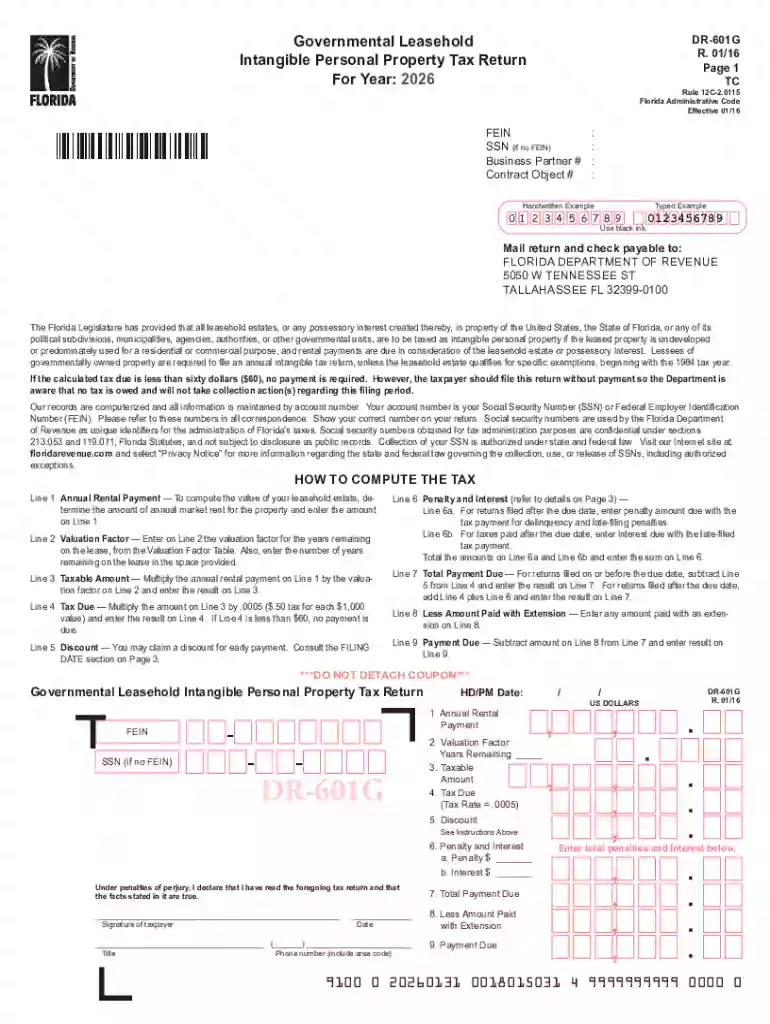
Type text, add images, blackout confidential details, add comments, highlights and more.

Draw your signature, type it, upload its image, or use your mobile device as a signature pad.

Send it via email, link, or fax. You can also download it, export it or print it out.
The Florida Governmental Leasehold Intangible Personal Property Tax Return is a specialized form used to report and pay taxes on intangible personal property such as leasehold agreements. This form is applicable to properties where government entities hold the lease, creating unique tax implications under Florida law. The tax is calculated on the value of the lease and is distinct from real estate taxes, emphasizing the intangible aspect of the leased asset rather than the physical property.
Completing the Florida Governmental Leasehold Intangible Personal Property Tax Return involves several precise steps to ensure accuracy and compliance.
Understanding specific terminology used in the Florida Governmental Leasehold Intangible Personal Property Tax Return is vital for accurate filing.
The form is legally required for entities with governmental leasehold interests to report taxes due on intangible personal property. Adherence to this requirement is crucial to avoid penalties.
The application of the Florida Governmental Leasehold Intangible Personal Property Tax Return varies by state statutes, indicating unique provisions and rules.
Failure to accurately and timely submit the Florida Governmental Leasehold Intangible Personal Property Tax Return can lead to several consequences.
To successfully file the Florida Governmental Leasehold Intangible Personal Property Tax Return, have the following documents ready.
Certain business entities may find particular advantage or obligation in engaging with the Florida Governmental Leasehold Intangible Personal Property Tax Return.
We've got more versions of the Florida Governmental Leasehold Intangible Personal Property Tax Return form. Select the right Florida Governmental Leasehold Intangible Personal Property Tax Return version from the list and start editing it straight away!
| Versions | Form popularity | Fillable & printable |
|---|---|---|
| 2026 | 4.9 Satisfied (39 Votes) | |
| 2025 | 4.1 Satisfied (51 Votes) | |
| 2024 | 4.7 Satisfied (30 Votes) | |
| 2023 | 4.2 Satisfied (57 Votes) | |
| 2022 | 4.7 Satisfied (85 Votes) | |
| 2021 | 4.8 Satisfied (224 Votes) | |
| 2020 | 4.3 Satisfied (191 Votes) | |
| 2019 | 4.4 Satisfied (141 Votes) | |
| 2016 | 4.1 Satisfied (52 Votes) | |
| 2014 | 4.2 Satisfied (68 Votes) | |
| 2012 | 4.2 Satisfied (38 Votes) | |
| 2011 | 4 Satisfied (28 Votes) |
At DocHub, your data security is our priority. We follow HIPAA, SOC2, GDPR, and other standards, so you can work on your documents with confidence.


LEASED, LOANED, OR RENTED EQUIPMENT. Complete if you hold equipment belonging to others. Lease. Purchase. Name and Address of Owner or Lessor. Description. Year.Read more
Taxpayers who receive a Governmental Leasehold Intangible Personal Property Tax Return (Form DR-601-G) from the Department for which no tax is due may file theRead more
Feb 26, 2021 In addition, some jurisdictions have taxed our personal property and leasehold interests in outdoor advertising locations using variousRead more


