







Definition & Meaning
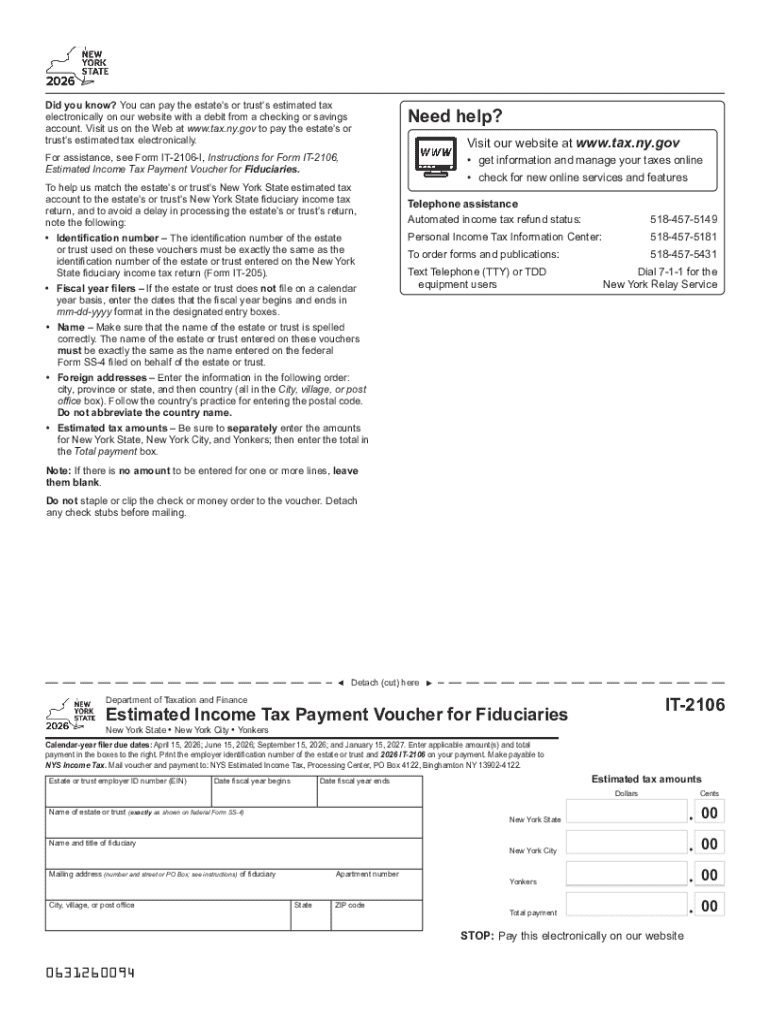
The Form IT-2106 Estimated Income Tax Payment Voucher for Fiduciaries Tax Year 2026 is a specific form used by fiduciaries in the United States to submit estimated tax payments. Fiduciaries are typically responsible for managing the assets of an estate or trust, and this form allows them to account for anticipated taxes based on projected income. Completing this form is a proactive measure to ensure compliance with tax obligations and avoid penalties associated with underpayment.
Core Components
- Fiduciary Responsibility: Acts on behalf of estates or trusts to manage financial matters.
- Estimated Payments: Prepayments of expected tax liability for the year 2026.
- Tax Obligations: Aligns with federal and state guidelines for fiduciary duties.
How to Use the Form IT-2106 Estimated Income Tax Payment Voucher for Fiduciaries Tax Year 2026
Proper utilization of the Form IT-2106 involves several key steps to ensure accurate tax filings. This task is not merely about form completion but involves a strategic approach to tax management.
Step-by-Step Process
- Gather Financial Information: Collect all relevant financial data for the estate or trust, including income projections and prior year’s returns.
- Calculate Estimated Tax: Use this data to compute estimated tax liability considering current IRS guidelines.
- Complete the Form: Accurately fill out required fields on the IT-2106, specifying details of the fiduciary and the estate or trust.
- Submit Payments: Determine submission methods—either electronically or by mail—and adhere to scheduled deadlines for payment.
Common Missteps
- Incorrect estimation of income leading to underpayment.
- Misinterpretation of tax brackets applicable to estates or trusts.
- Late submission resulting in penalties.
Filing Deadlines / Important Dates
Adhering to the filing deadlines is critical to avoid penalties. The deadlines for estimated payments generally follow a quarterly schedule, aligning with IRS timelines.
Key Dates
- First Quarter: April 15, 2026
- Second Quarter: June 15, 2026
- Third Quarter: September 15, 2026
- Fourth Quarter: January 15, 2027
Importance of Timely Filing
- Ensures compliance with federal tax regulations.
- Avoids interest penalties and fines.
- Maintains a clean tax record for the estate or trust.
Steps to Complete the Form IT-2106 Estimated Income Tax Payment Voucher for Fiduciaries Tax Year 2026
Accurate completion of the IT-2106 form requires attention to detail and a methodical approach. Here is a detailed guide to navigate this process:
Detailed Instructions
- Identify Fiduciary Information: Input the name, address, and identifying numbers of the fiduciary.
- Detail the Estate or Trust: Include the entity's tax identification number and name.
- Calculate Estimated Income: Assess various income streams such as dividends, interest, and other relevant financial data.
- Determine Tax Liability: Apply current tax rates to the estimated income to determine what should be allocated for tax payments.
- Fill Out Payment Amounts: Enter the calculated prepayment amounts in designated sections.
- Choose Submission Method: Decide on electronic payment or mail submission based on preference and convenience.
- Review for Errors: Double-check all entries for accuracy and completeness before submission.
Common Issues
- Overlooking specific tax rate changes from previous years.
- Omitting necessary signatures.
- Incorrectly calculated totals that affect payment accuracy.
Important Terms Related to Form IT-2106 Estimated Income Tax Payment Voucher for Fiduciaries Tax Year 2026
Understanding the terminology associated with the IT-2106 is critical for correct form processing and compliance.
Key Terms
- Fiduciary: An individual or professional entity responsible for managing another's assets.
- Estimated Taxes: Payments made based on anticipated income, aligned with future tax obligations.
- Tax Year 2026: The period for which the estimated tax payments are applicable.
Terminology Application
- Accurate comprehension of these terms assists in precise tax planning.
- Facilitates effective communication with tax professionals or advisors.
Who Typically Uses the Form IT-2106 Estimated Income Tax Payment Voucher for Fiduciaries Tax Year 2026
The primary users of this form are fiduciaries managing estates or trusts, as they must ensure the entities they oversee are in compliance with tax requirements.


User Profiles
- Estate Executors: Manage the financial disposition of a deceased’s estate.
- Trust Administrators: Oversee the assets held in trust agreements.
- Tax Consultants: Aid fiduciaries in proper form completion and filing.
Use Cases
- Managing taxation for long-term trusts with substantial income.
- Facilitating tax compliance for an estate undergoing probate.
Legal Use of the Form IT-2106 Estimated Income Tax Payment Voucher for Fiduciaries Tax Year 2026
Completion and submission of Form IT-2106 are bound by legal responsibilities and expected to comply with IRS regulations.
Legal Implications
- Compliance with Tax Laws: Ensures estates and trusts are adhering to applicable federal and state tax mandates.
- Record-Keeping Requirements: Legal necessity to maintain accurate tax records for fiduciary operations.
- Penalty Avoidance: Legal implications for non-compliance can result in financial penalties and audit risks.
Fiduciary Duties
- Fiduciaries are legally obligated to manage and report financial activities accurately.
- Mismanagement can result in personal liability for fiduciaries in some jurisdictions.
IRS Guidelines
The IRS provides specific guidelines to assist fiduciaries with Form IT-2106, ensuring compliance and understanding of legislative requirements.
Guidelines Overview
- Tax Calculation: Directions on accurate estimation and calculation of taxes.
- Form Instructions: Detailed line-by-line guide for form completion.
- Submission Protocols: Defined procedures for how and where to send completed forms and payments.
IRS Resources
- Online resources for further clarification and examples.
- IRS helpline to assist fiduciaries with unique queries or complex scenarios.
Penalties for Non-Compliance
Failure to comply with Form IT-2106 requirements may result in financial and legal consequences. Understanding these penalties can motivate timely and accurate form submission.
Possible Penalties
- Underpayment Penalties: Interest and fines imposed for insufficient tax payments.
- Late Filing Fees: Charges incurred from missing submission deadlines.
- Legal Ramifications: Potential audits or inquiries from the IRS due to non-compliance.
Preventive Measures
- Regular review of deadlines and payment schedules.
- Consultation with tax professionals to ensure compliance and accuracy.


