






Definition & Meaning
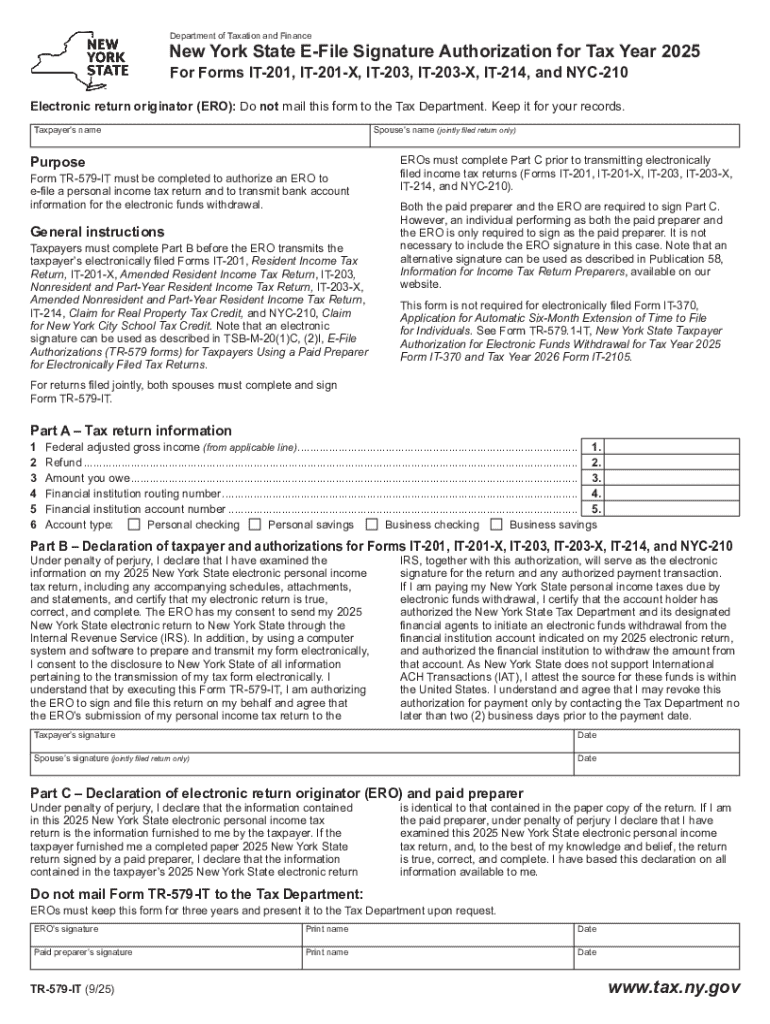
The New York State E-File Signature Authorization form, commonly referred to as Form TR-579, is a document used to authorize the electronic filing of tax returns in New York State. This form provides a convenient and secure way for taxpayers to consent to the e-filing of their tax returns by a tax preparer. By completing this form, taxpayers essentially confirm that they have reviewed their return, agree with its contents, and authorize the electronic submission to the New York State Department of Taxation and Finance.
How to Use the New York State E-File Signature Authorization
To properly utilize the New York State E-File Signature Authorization, taxpayers or their representatives must follow several steps:
-
Review the Tax Return: Before authorizing e-filing, thoroughly review the prepared tax return to ensure all information is accurate and complete.
-
Complete Form TR-579: Fill out the form with required details, including taxpayer identification information, tax year applicable, and any other pertinent details as specified by the form instructions.
-
Signature Authorization: The taxpayer must sign the form to consent to the e-filing, either physically or using a legally-binding electronic signature if the process is conducted digitally.
-
Submission for Records: It is crucial for the taxpayer or tax preparer to keep a copy of the signed form for their records. Usually, this form is retained by the tax preparer and not sent to the tax department unless specifically requested.
Steps to Complete the New York State E-File Signature Authorization
Completing the New York State E-File Signature Authorization involves a few straightforward steps:
-
Gather Information: Collect all relevant information needed for the form, including personal identification details and a summary of the tax return for verification purposes.
-
Fill Out the Form: Enter the necessary details into each field of the form. Be meticulous in ensuring accuracy as any mistakes could delay the processing of your tax return.
-
Review and Authorize: Carefully review the completed form before proceeding to authorize it. Ensure the information matches that of the tax return and that you understand all declarations stated on the form.
-
Sign the Form: Provide your signature as a form of consent to proceed with the e-filing of your return. For electronic submissions, follow e-signature protocols to ensure compliance with legal requirements.
-
Store Form Securely: Once signed, the form should be stored securely by either the taxpayer or tax preparer. This documentation is crucial in case of audits or inquiries from the taxation authorities.
Important Terms Related to New York State E-File Signature Authorization
-
Taxpayer Identification Number (TIN): A unique identifier used in tax documents for individuals and businesses.
-
E-File: The process of submitting tax returns electronically, rather than via traditional mail.
-
Tax Preparer: An individual or service authorized to prepare and file tax returns on behalf of taxpayers.
-
Authorization: Consent given by a taxpayer to allow another party to perform a specific action, in this case, filing a tax return electronically.
Legal Use of the New York State E-File Signature Authorization
The use of the New York State E-File Signature Authorization form is governed by specific legal guidelines to ensure the integrity of the electronic filing process:
-
Compliance with ESIGN Act: Electronic signatures used on this form must comply with the federal Electronic Signatures in Global and National Commerce Act (ESIGN Act) to be considered legally binding.
-
Retention Requirements: Tax preparers must retain the signed form for a period specified by New York State tax laws, typically for three years from the filing date.
-
Privacy and Security: Any transmission of this form and associated data must safeguard taxpayer privacy, ensuring compliance with applicable data protection laws.
State-Specific Rules for the New York State E-File Signature Authorization
New York has specific rules that must be followed when using the E-File Signature Authorization:
-
Mandatory E-Filing for Some Preparers: Tax preparers who file more than a set number of New York state tax returns per year are required to e-file these returns.
-
Paper Submission Restrictions: The paper submission version of tax returns is discouraged for most taxpayers unless certain exceptions apply, such as technical difficulties with e-filing.
-
Designated Use: The form must be used exclusively for authorizing the electronic filing of New York State tax returns.
Examples of Using the New York State E-File Signature Authorization
-
Example 1: A small business owner employs a tax preparer to file the annual business taxes. After reviewing the prepared return, the owner signs Form TR-579, authorizing the electronic submission of the document to the state's tax department.
-
Example 2: An individual taxpayer opts to use a popular tax software that facilitates e-filing. After completing the self-prepared tax return, the individual uses the software's electronic signature feature to submit Form TR-579, thereby authorizing the e-filing.
Required Documents
When preparing to authorize an e-file using the New York State E-File Signature Authorization, certain documents may be required:
-
Taxpayer Identification Documentation: Such as a Social Security Number or Employer Identification Number.
-
Prepared Tax Return: The completed tax return that you wish to electronically submit.
-
Previous Year's Tax Documents: These may aid in filling out the current return accurately.
Ensuring that you have all necessary documentation at hand can streamline the authorization process.
Form Submission Methods (Online / Mail / In-Person)
While the focus of the New York State E-File Signature Authorization is on electronic submissions, understanding the available methods is important:
-
Online Submission: Typically involves the use of specialized tax software that supports e-signature capabilities.
-
Mail Submission: Though less common, specific circumstances might warrant mailing the signed form, particularly for returns that cross certain thresholds or exemptions.
-
In-Person Submission: Generally not applicable for signature authorizations purely intended to facilitate electronic filings.