
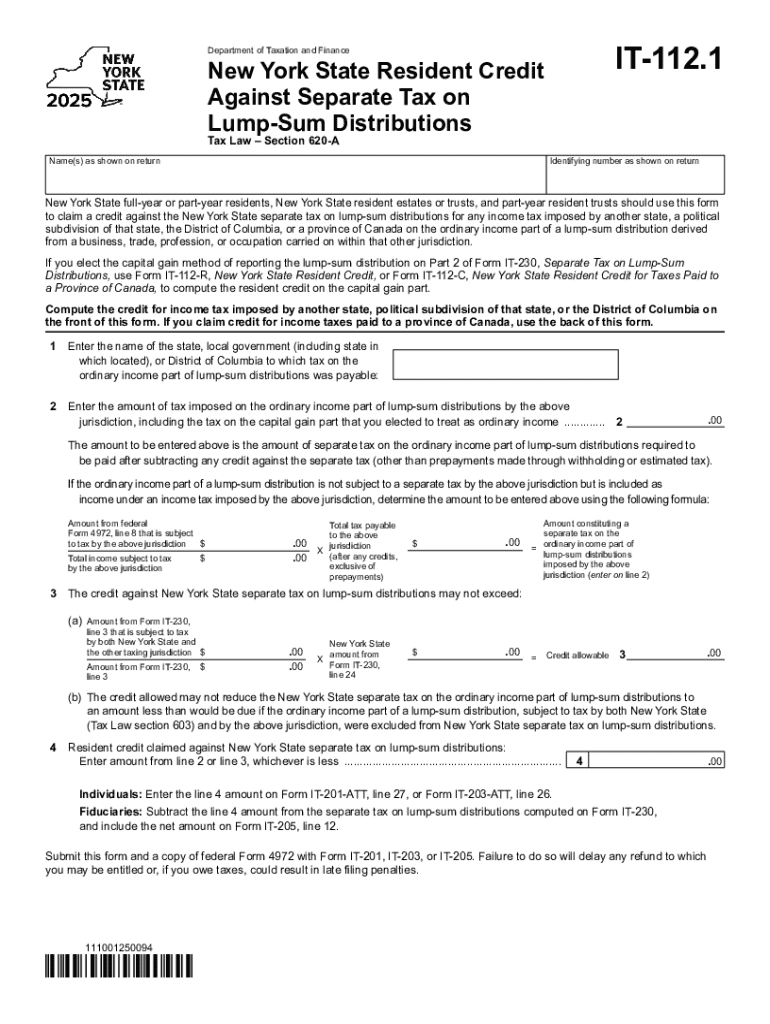







Definition and Purpose of Form IT-112
Form IT-112, also known as the New York State Resident Credit Against Separate Tax on Lump-Sum Distributions, is designed to provide tax credits to residents who have paid taxes on lump-sum distributions in other jurisdictions. This form serves to prevent double taxation for New York State residents by allowing them to claim a credit against their New York State taxes for taxes paid to another state on specific retirement distributions.
Key Features of Form IT-112
- Applicable to residents of New York State who pay taxes on lump-sum distributions in other states.
- Targets distributions from retirement accounts or pension plans.
- Provides a mechanism to claim a credit and reduce the tax liability in New York.
Eligibility Criteria for Claiming the Credit
To utilize Form IT-112, taxpayers must meet certain eligibility requirements which ensure that they rightfully claim the credit against their New York State taxes.


Eligibility Requirements
- Must be a resident of New York State.
- Should have received lump-sum distributions subject to taxation in another state.
- Must have paid taxes on these distributions to the other state.
Common Scenarios
- Retired individuals receiving distributions from out-of-state pension plans.
- Individuals who have relocated to New York but had contributions taxed elsewhere.
Steps to Complete Form IT-112
Completing Form IT-112 involves several systematic steps that facilitate accurate reporting and credit claims.
-
Gather Relevant Information
- Organize documentation for lump-sum distributions.
- Acquire tax statements from the out-of-state jurisdiction.
-
Calculate Eligible Credit
- Determine taxes paid to the other state on these distributions.
- Assess the limit of credits as allowed by New York State tax laws.
-
Fill Out the Form Accurately
- Enter names and identifying numbers as shown on previously submitted returns.
- Carefully complete each section based on gathered information.
-
Review and Submit
- Double-check calculations and ensure all form fields are filled.
- Submit through designated channels (mail or electronic submission).
Important Terms Related to Form IT-112
Understanding the terminology associated with Form IT-112 enhances comprehension and ensures correct usage.
- Lump-Sum Distribution: A one-time payout from a retirement or pension account.
- Resident Credit: A tax credit provided to residents to offset taxes paid to other states.
- Double Taxation: Paying taxes on the same income in more than one jurisdiction.
Legal Use and Compliance
Ensuring legal compliance when submitting Form IT-112 is crucial for avoiding penalties and securing eligible tax benefits.
Legal Considerations
- Accurately report all pertinent financial data.
- Maintain transparency regarding out-of-state tax payments.
Consequences of Non-Compliance
- Possible denial of credit claims.
- Penalties or additional interest on incorrectly reported taxes.
Methods to Obtain Form IT-112
Accessing the Form IT-112 is a straightforward process, with multiple channels available for convenience according to taxpayer preference.
Available Methods
- Online Access: Direct download from the New York State Department of Taxation and Finance website.
- Physical Copies: Request via mail or obtain from local tax offices.
Benefits of Different Methods
- Digital Download: Quick access; environmentally friendly.
- Paper Forms: Suitable for those less comfortable with digital formats.
State-Specific Rules for New York Residents
New York State residents must adhere to specific regulations when claiming credits through Form IT-112.
State Regulations
- Credits must only be claimed for taxes paid on distributions recognized by New York State.
- Each credit claim should align with state thresholds and income brackets.
Notable Exceptions
- Certain municipal or county taxes may not qualify for credit.
- Income types distinct from lump-sum distributions might require separate forms.
Filing Deadlines and Important Dates
Taxpayers must be mindful of deadlines associated with submitting Form IT-112 to ensure timely processing and acceptance of their claims.
Key Deadlines
- Submit alongside state tax returns, typically due April 15th.
- Extensions might apply under specific conditions, subject to approval.
Impact of Missing Deadlines
- Delays in refunds or credits.
- Potential fines and interest on underpaid tax liabilities.




