
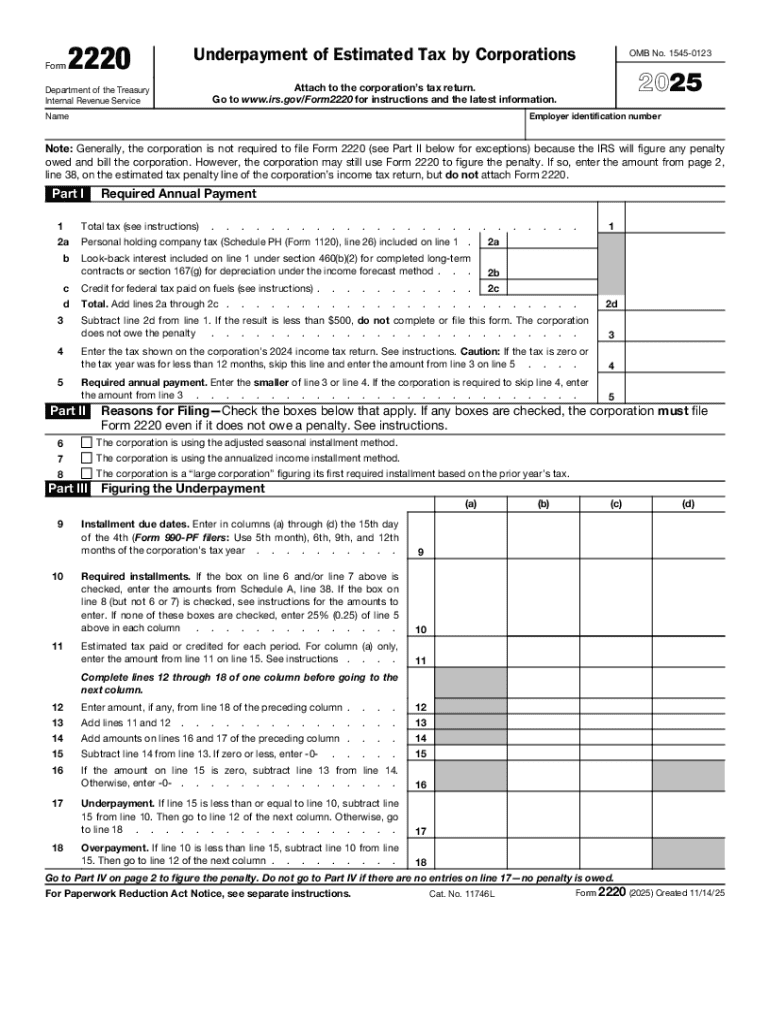







Definition and Purpose of Form 2220
Form 2220 is primarily used by corporations to document and report the underpayment of estimated taxes to the Internal Revenue Service (IRS). This form helps determine if corporations have underpaid their estimated tax liabilities throughout the year and if they owe a penalty. Generally, the IRS calculates any penalties for underpayment, but certain conditions might necessitate a corporation to file Form 2220 to comprehensively assess their tax obligations and penalty.
Importance of Understanding Form 2220
Grasping the significance of Form 2220 is essential for corporations since underpayment can lead to penalties that affect financial strategies and cash flow. This form provides a methodical approach to evaluate estimated tax payments and verify if sufficient amounts have been remitted to avoid penalties.
How to Use the Instructions for Form 2220
Corporations should carefully adhere to the instructions provided with Form 2220 to ensure accurate completion. The instructions detail the calculations needed to determine the correct amount of underpayment and any penalties due. They provide insights on how to navigate each section, including completing required installments and calculating total tax.
Detailed Section-by-Section Guidance
The instructions break down each part of the form and offer guidelines on how to fill it out. Here's a brief overview of what these sections generally include:
-
Determining Total Tax: Understanding this section is crucial, as it forms the basis of calculating your corporation's tax liability.
-
Calculating Required Installments: Provides the sequence and amounts your corporation should have paid at each installment period.
-
Penalty Computation: These steps involve applying various calculations to ascertain underpayment penalties if applicable.
Steps to Complete Form 2220
Form 2220 requires several calculations and disclosures. Here’s a step-by-step guide:
-
Gather Necessary Information: Collect all records of estimated tax payments and any documentation on tax liabilities for the year.
-
Complete Part I – Required Annual Payment: Determine the total tax and subtract any credits.
-
Fill Out Part II – Underpayment of Estimated Tax: Calculate your underpayments for each installment period.
-
Use Part III – Figuring the Penalty: Apply the IRS formulae to calculate any penalties due on underpaid amounts.
-
Review and Submit: Double-check for accuracy and submit with your tax return as required.
Filing Deadlines and Important Dates
Staying informed about filing deadlines is crucial to avoid additional penalties. Here are the significant dates associated with Form 2220:
-
Installment Due Dates: Generally, these are on the 15th of April, June, September, and December.
-
Form Submission Deadline: Typically aligned with corporate tax filing deadlines, often March 15th for calendar-year corporations.
Impact of Missing Deadlines
Missing a deadline may result in additional penalties or interest added to the already existing underpayment penalties. It's essential to plan accordingly and ensure timely submission.
Required Documents for Form 2220
The completion of Form 2220 necessitates specific documents that support your estimated tax payments and liabilities:
-
Estimated Tax Payment Receipts: Documentation of quarterly estimated tax payments.
-
Tax Liability Records: Financial statements or tax liability projections used to determine estimated payments.
-
IRS Correspondence: Any communication from the IRS previously addressing underpayment issues.
Who Typically Uses Form 2220
Corporations are the primary filers of Form 2220, particularly those that face complex estimated tax payment computations. Specific types of businesses that might utilize this form include:
-
Large Corporations: Due to complicated tax calculations involving numerous transactions and deductions.
-
New Corporations: Establishing their first-year tax payment routine and figuring out their responsibilities.
Intersection with Other Business Types
Other entities, such as LLCs taxed as corporations, might also need to familiarize themselves with the applicability of this form, further understanding their role and responsibilities.
IRS Guidelines and Compliance
Understanding IRS guidelines is imperative in completing Form 2220 accurately and effectively. Compliance involves following the structured methodology that the IRS uses for calculating penalties and determining tax owed.
Penalties for Non-Compliance
Non-compliance with the IRS’s requirements can lead to significant penalties. If a corporation underpays its estimated tax and doesn't correctly complete Form 2220, the IRS may impose penalties including interest charges that can affect a company’s overall profitability.
Business Entity Types and Form 2220
Different business entities might have varied requirements when it comes to engaging with Form 2220. Here's how different types typically interact with it:
-
Corporations: Given their tax responsibilities, corporations use this form to prevent or reduce penalties related to estimated tax underpayments.
-
Partnerships and LLCs: If taxed as corporations, they would also need to complete this form, making sure to account for unique tax code implications that apply to their structure.
Real-World Scenarios and Examples of Using Form 2220
Practical scenarios illuminate how Form 2220 might be used in varying corporate circumstances:
-
Scenario 1: A tech startup experiencing rapid growth: As new revenues unfold unpredictably, calculating correct estimated tax payments becomes a task, and Form 2220 aids in recalibrating their tax obligations.
-
Scenario 2: An established manufacturing firm's fluctuating cash flows: Utilizing Form 2220 helps in adjusting estimated tax payments based on seasonal business trends, thus optimizing financial planning.




