




01. Edit your form online
Type text, add images, blackout confidential details, add comments, highlights and more.

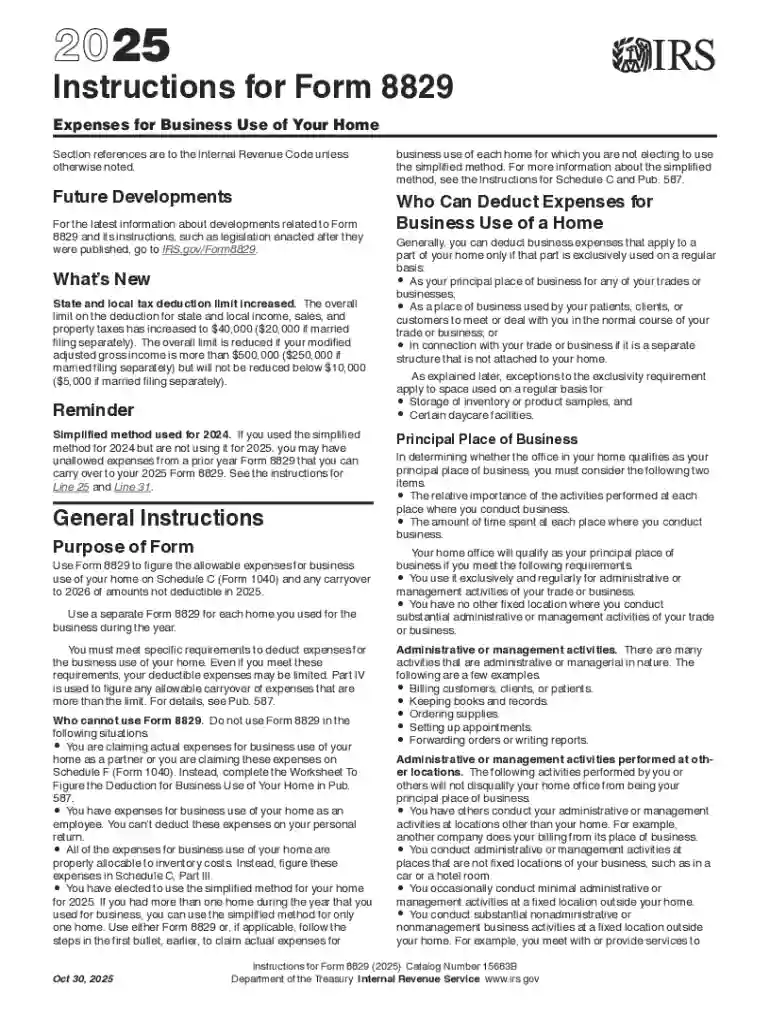
Type text, add images, blackout confidential details, add comments, highlights and more.

Draw your signature, type it, upload its image, or use your mobile device as a signature pad.

Send it via email, link, or fax. You can also download it, export it or print it out.
IRS Form 8829, officially known as "Expenses for Business Use of Your Home," is a document used by taxpayers to calculate and report allowable expenses related to their home office for tax deductions. This form is essential for self-employed individuals, freelancers, or small business owners who regularly and exclusively use part of their home for business activities. By providing a structured calculation of expenses, IRS Form 8829 helps to determine the portion of home expenses that are deductible against business income, ensuring accurate compliance with IRS requirements.
To use IRS Form 8829, the taxpayer's home must meet specific criteria. The workspace must be used regularly and exclusively for business purposes. This means the area should be the principal place for business operations or a place for meeting patients, clients, or customers. Examples include a dedicated room transformed into a full-time office. Taxpayers must prove that the space is purely for business, with no personal activities conducted in it. Specific scenarios, such as nurseries or storage facilities, may have different rules and exemptions.


Calculate the Home Office Percentage: Measure the square footage of your office space and divide it by the total square footage of your home.
Direct vs. Indirect Expenses: Differentiate expenses directly related to the office space, like painting, from indirect expenses, such as utilities, which apply to the entire home.
Report Expenses: Using these calculations, enter the amounts in the respective lines. For example, utilities are included as indirect expenses, while repairs directly impacting the office should be noted as direct expenses.
Depreciation: Calculate the depreciation of the home office space. This includes determining the basis of the residence and applying the office space percentage.
Carryover Unallowed Expenses: If you cannot deduct all expenses due to income limitations, carry them over to subsequent tax years.
These steps require careful documentation, with precise calculations to ensure compliance and accuracy on tax returns.
Adjusted Basis: This refers to the cost basis of a property, adjusted for improvements or depreciation.
Exclusive Use: The requirement that the workspace is used solely for business purposes without personal use.
Regular Use: The criterion that the area is used consistently for business tasks.
Understanding these terms helps ensure the taxpayer can accurately complete Form 8829, adhering to IRS standards.
The IRS provides guidelines specifying what constitutes a qualifying home office. It outlines eligibility requirements, permissible deductions, and how to categorize direct and indirect expenses. Recent updates by the IRS also affect aspects like state and local tax deduction limits, reflecting in the amounts claimable through Form 8829.
IRS Form 8829 is predominantly used by:
These scenarios depict the range of applications for Form 8829, highlighting its diverse usability across different business models.

To fill out IRS Form 8829 accurately, a taxpayer needs:
These documents are necessary to justify the deductions claimed, backed by tangible documentation.
IRS Form 8829 is typically filed with the annual tax return. Consistent with Form 1040, it should generally be submitted by April 15 of the following year, or October 15 if an extension is filed. Keeping track of these dates is crucial for compliance, avoiding penalties, and ensuring timely submissions.
Failure to accurately report home business expenses using IRS Form 8829 may result in penalties. Incorrect deductions may lead to audits, imposing additional taxes owed, interest, and potential fines. Ensuring meticulous record-keeping and adherence to IRS standards helps avoid these repercussions, securing rightful tax benefits for eligible home office spaces.
We've got more versions of the IRS Form 8829: Expenses for Business Use of Your Home form. Select the right IRS Form 8829: Expenses for Business Use of Your Home version from the list and start editing it straight away!
| Versions | Form popularity | Fillable & printable |
|---|---|---|
| 2025 | 4.8 Satisfied (21 Votes) | |
| 2024 | 4.1 Satisfied (40 Votes) | |
| 2023 | 4.2 Satisfied (27 Votes) | |
| 2022 | 4.7 Satisfied (53 Votes) | |
| 2021 | 4.8 Satisfied (266 Votes) | |
| 2020 | 4.4 Satisfied (141 Votes) | |
| 2019 | 4.4 Satisfied (183 Votes) | |
| 2018 | 4.4 Satisfied (94 Votes) | |
| 2017 | 4.3 Satisfied (217 Votes) | |
| 2016 | 4.4 Satisfied (184 Votes) |
At DocHub, your data security is our priority. We follow HIPAA, SOC2, GDPR, and other standards, so you can work on your documents with confidence.




Expenses for business use of your home. Attach Form 8829. 29. 30. Lower of cost or market. (3). (4). %. Part I. Part II. 27. Net profit or (loss). Subtract line
Aug 19, 2025 Use Form 8829 to figure the allowable expenses for business use of your home on Schedule C (Form 1040) and any carryover to next year of amounts not deductible
Part of Your Home Used for Business. 1. Area used regularly and exclusively for business, regularly for day care, or for storage of inventory.See more


