01. Edit your form online
Type text, add images, blackout confidential details, add comments, highlights and more.

Type text, add images, blackout confidential details, add comments, highlights and more.

Draw your signature, type it, upload its image, or use your mobile device as a signature pad.

Send it via email, link, or fax. You can also download it, export it or print it out.
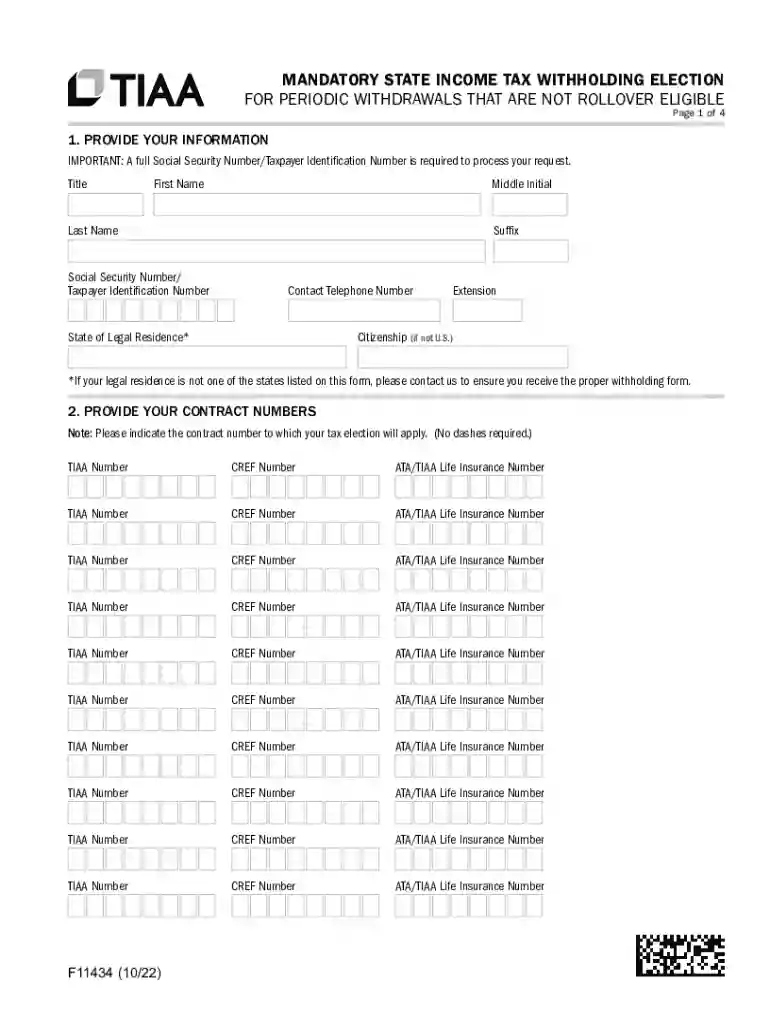
The F11434 form is a documented procedure designed for those needing to make a mandatory state income tax withholding election for periodic withdrawals that are not eligible for rollover. This form serves as an official communication to declare the appropriate tax withholding status based on the individual's legal residence. It ensures compliance with state tax laws, aiming to prevent underpayment penalties by facilitating accurate tax deduction during periodic fund withdrawals.
Individuals who are looking to manage their state income tax liabilities through periodic withdrawals will utilize this form. To begin, evaluate your taxable withdrawals and assess your state's withholding requirements. The process includes selecting the appropriate withholding rate, considering any financial penalties for failing to meet these obligations, and ensuring that this alignment supports your overall tax planning strategy. This form is crucial to ensure that correct amounts are deducted from withdrawals, preventing any disruptions in cash flow or unexpected tax liabilities.
Gather Necessary Information:
Determine Withholding Requirements:
Complete the Form:
Review and Verify:
Submit the Form:
Different states have varying requirements and rules concerning tax withholding for periodic withdrawals. For example, Michigan and Minnesota residents might encounter specific directions on completing this form to adhere to local tax laws. It's essential to understand these regional nuances, as they may impact the deduction amounts and penalties for non-compliance if incorrectly filed. Paying attention to these guidelines ensures that the elected withholding aligns with both state mandates and personal financial planning goals.
Filing the F11434 form serves as a protective measure against potential legal issues arising from insufficient tax withholding. It is legally binding, with each submitted form representing an agreement with the state's taxation department on how funds are withdrawn and taxed. The document facilitates accuracy in reporting and helps maintain transparency between the taxpayer and the state, significantly reducing the risk of penalties.
Understanding the lexicon associated with form F11434 is critical for accurate completion and compliance. Terms like "withholding election," "periodic withdrawals," and "non-rollover" dictate the form's application and the legal obligations tied to withholding taxes. Grasping these core terms simplifies the filing process and enhances the taxpayer's ability to manage withdrawal elections efficiently, avoiding misunderstandings and ensuring legal alignment.
Failure to appropriately complete the F11434 form or meet the stipulated withholding criteria can lead to significant penalties. States may impose fines for underpayment, legal action for continued non-compliance, or additional interest charges. It's essential for taxpayers to not only fill out the form correctly but to also ensure that periodic withdrawals reflect the elected withholding to avoid future complications.
Real-world scenarios illustrate the practical application of the F11434 form. For instance, consider a retiree with regular annuity withdrawals who must select an appropriate withholding rate to match their anticipated tax liability. Another example involves a self-employed individual drawing periodic payments from investments – the form assists in defining how much to set aside for state taxes to avoid breaking state rules. Each example underscores the form’s utility in facilitating strategic tax planning in various financial contexts.
While traditional methods offer paper or PDF-based submissions, modern financial and tax software applications, such as TurboTax or QuickBooks, can support the F11434 form. These tools offer digital assistance, reducing mistakes through automated calculations and electronic submissions. Users can seamlessly integrate form completion with existing accounting setups, enhancing accuracy and efficiency in managing tax withholding elections.
At DocHub, your data security is our priority. We follow HIPAA, SOC2, GDPR, and other standards, so you can work on your documents with confidence.