
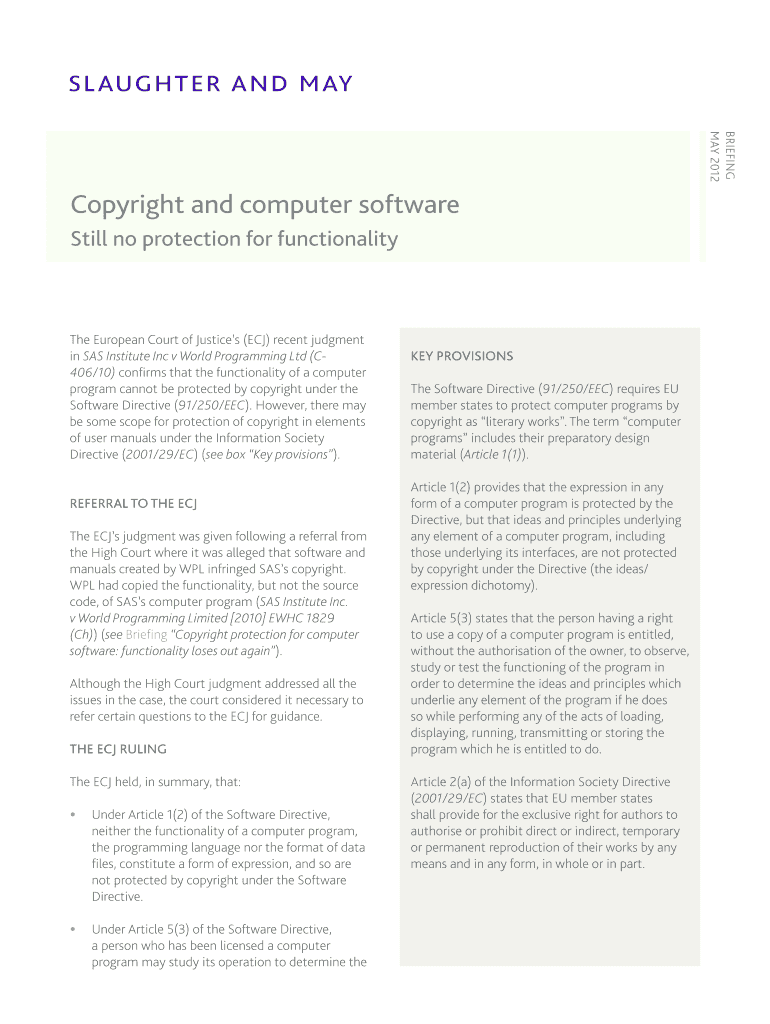







Definition and Meaning of Copyright and Computer Software
Copyright and computer software involve the legal protection granted to the creators of software programs. Under copyright law, software is treated as a literary work, affording it protection against unauthorized reproduction, distribution, or any form of misuse. This protection encompasses the code, both source and object, and sometimes even the software’s structure, sequence, and organization. While copyright safeguards the expression of ideas in software, it does not extend to functionality or underlying ideas.
Key Elements Covered in Copyright
- Source Code and Object Code: Both forms are protected as the literal elements of the software.
- User Interfaces: Graphical elements might be protected if they are sufficiently original.
- Documentation: Manuals and guides accompanying software can be protected.
- Non-literal Elements: Structure and sequence may be protected if they are creative and original.
How to Use Copyright and Computer Software
When software developers create a program, they instantly acquire copyright protection once the code is manifested in a tangible format. Registering this copyright with the U.S. Copyright Office, while not mandatory, offers additional legal advantages.
Steps to Ensure Proper Use
- Develop Original Code: Ensure the code is original to avoid infringement issues.
- Register the Copyright: Filing with the U.S. Copyright Office provides a public record and is crucial for legal enforcement.
- Mark the Software: Use copyright symbols to inform users of your rights.
Legal Use of Copyright and Computer Software
Using copyrighted software legally involves adhering to licensing agreements and avoiding unauthorized duplication or modification.
Compliance Steps
- License Agreements: Read and understand the end-user license agreements to ensure compliance.
- Backups and Archiving: Permission for making backup copies usually falls under specific licensing terms.
- Public Domain Software: Some software is free from copyright and can be used without restrictions.
Why You Should Copyright Computer Software
Protecting software with copyright can prevent unauthorized use, distribution, or reproduction and is crucial for software developers to secure financial and creative interests.
Benefits of Copyrighting
- Economic Incentives: Ensures rightful compensation through sales or licenses.
- Market Advantage: Protecting unique software components can offer a competitive edge.
- Legal Recourse: Facilitates legal protection against infringement.
Important Terms Related to Copyright and Computer Software
Understanding key terms helps navigate copyright laws effectively, ensuring compliance and protection.
Common Terms
- Patent vs. Copyright: Patents protect inventions or processes, while copyright protects the expression of ideas, like code.
- Trade Secrets: A form of protection that encompasses unpublished software details.
- Derivative Works: Modifications based on existing software that still fall under copyright protection.
Steps to Complete the Copyright and Computer Software Registration
Registering software copyright is a straightforward process, providing public documentation and enhanced legal standing.
Registration Process
- Application Form: Complete the necessary forms for software registration via the U.S. Copyright Office's webpage.
- Submit Copies: Provide copies of the code—only source code is required.
- Pay Fees: A fee is applicable for registration, which varies based on the copyright service used.
- Receive Certificate: Upon successful registration, a certificate of registration is issued.
Who Typically Uses Copyright and Computer Software
Both individuals and companies heavily rely on software copyright to safeguard their technological products.
Typical Users and Beneficiaries
- Software Developers: Protect their creations from unauthorized use.
- Corporations: Secure proprietary technology and maintain competitive edges.
- Independent Programmers and Startups: Use copyright as a tool to protect novel software.
Penalties for Non-Compliance
Failure to comply with copyright regulations can result in significant legal and financial consequences, emphasizing the importance of adherence.
Consequences of Infringement
- Financial Damages: May include statutory damages and compensation for losses.
- Legal Proceedings: Risk of legal action, leading to costly litigation.
- Reputation Damage: Possible harm to brand reputation and market trust.
Examples of Using Copyright and Computer Software
Real-world scenarios highlight the practical applications and implications of copyright protection for software.
Practical Scenarios
- Game Development: Companies protect gameplay mechanics and narrative elements through copyright.
- SaaS Platforms: Protect algorithms that deliver unique service functionalities.
- Open Source Projects: Utilize licenses that dictate how software can be used or shared, such as GNU GPL.




