




01. Edit your form online
Type text, add images, blackout confidential details, add comments, highlights and more.

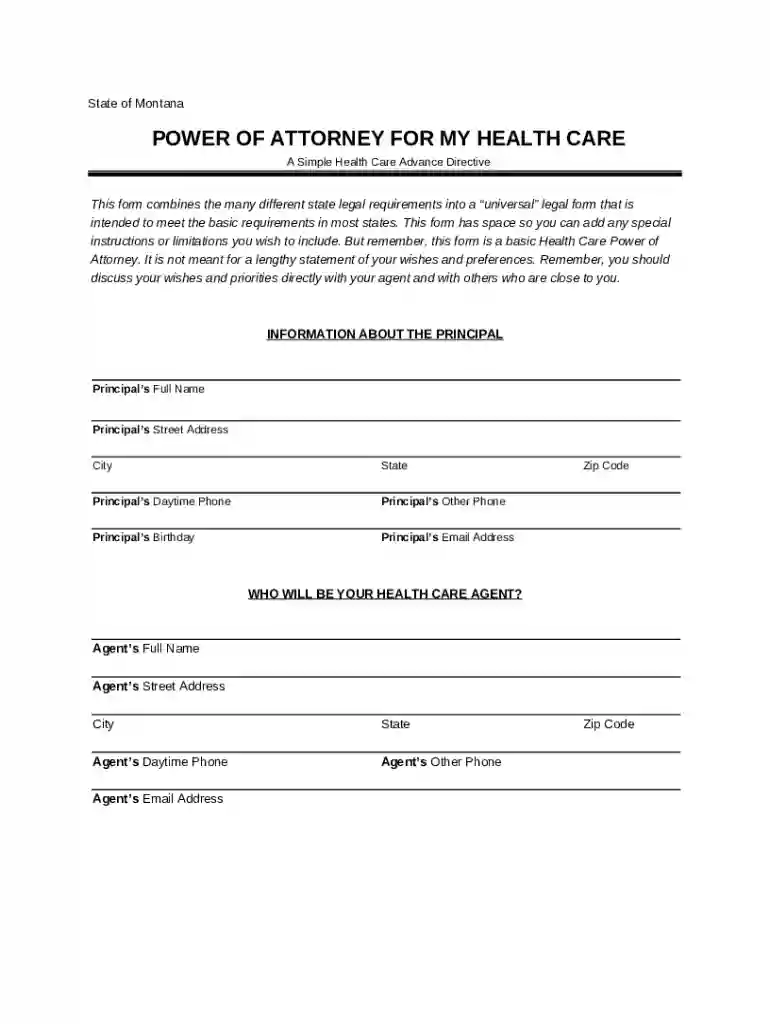
Type text, add images, blackout confidential details, add comments, highlights and more.

Draw your signature, type it, upload its image, or use your mobile device as a signature pad.

Send it via email, link, or fax. You can also download it, export it or print it out.
Montana Advance Directive Forms are legal documents that allow individuals to outline their medical care preferences in situations where they may not be able to communicate their decisions themselves. These forms help residents of Montana to appoint a health care agent, specify preferences for end-of-life care, and document any instructions regarding medical treatment in case of incapacity. It serves as a crucial tool in ensuring that an individual's medical and personal wishes are respected when they are unable to advocate for themselves.
Using the Montana Advance Directive Forms involves several crucial steps. First, review the form to understand the types of decisions that can be made through it. Carefully select a trusted person to act as your health care agent, someone who will respect your wishes and advocate on your behalf. Complete all sections of the form, including appointing the health care agent and providing specific instructions for medical treatment. Once filled, the form should be signed in the presence of a notary public or two witnesses, depending on the legal requirements in Montana. Keep a copy for personal records, and provide copies to your health care agent, family members, and healthcare providers to ensure that it is accessible when needed.
Montana Advance Directive Forms can be obtained from various sources. You can download them from official state or health department websites, medical facilities, or legal aid organizations. Some non-profit organizations also provide these forms to help residents plan for future health care needs. Ensure that you acquire the most recent version of the form to comply with current legal standards.
Read Thoroughly: Begin by reading the entire form to understand its purpose and the decisions you need to make.
Select a Health Care Agent: Choose a responsible adult who you trust to make health care decisions for you.
Detail Your Health Care Preferences: Clearly indicate your wishes regarding medical interventions, life-sustaining treatments, and any specific instructions.
Sign the Document: Validate the form with your signature. Ensure it is signed according to Montana state law, either in front of a notary public or two adult witnesses.
Distribute Copies: Provide copies to your appointed agent, family members, doctors, and keep one for your own records.
Review Regularly: Periodically review and update the directive as needed to reflect any changes in your preferences or circumstances.
The Montana Advance Directive Forms include several key components:
Montana has specific regulations governing the use of advance directives. For instance, a health care agent must be a competent adult and cannot be the individual's primary health care provider or an owner/employee of a medical care facility currently treating the individual unless related by blood, marriage, or adoption. The form must be executed in writing and signed in the presence of two adult witnesses or a notary public. It is crucial to adhere to these rules to ensure the directive is legally enforceable.
Legally, the Montana Advance Directive Forms serve as binding instructions for health care providers and loved ones to follow your medical preferences in case you cannot communicate. The form gives your appointed agent the authority to make decisions on your behalf. It is essential to ensure the form is filled out accurately and stored safely but accessibly so that it can be readily used by your health care agent and medical professionals when necessary.
Consider a scenario where a Montana resident, due to a sudden illness, loses the ability to communicate. With a properly filled advance directive, their health care agent can make informed decisions about their treatment, respecting their previously articulated wishes for life-support measures or pain management. For instance, if the directive indicates a preference against life-sustaining measures in terminal conditions, the attending medical professionals will adhere to these instructions, thus honoring the patient's autonomy and legal rights.
Incorporate this structured approach to understand the scope and importance of Montana Advance Directive Forms, ensuring that your health care decisions are respected at critical moments.
We've got more versions of the Montana Advance Directive Forms form. Select the right Montana Advance Directive Forms version from the list and start editing it straight away!
| Versions | Form popularity | Fillable & printable |
|---|---|---|
| 2024 | 4.6 Satisfied (43 Votes) |
At DocHub, your data security is our priority. We follow HIPAA, SOC2, GDPR, and other standards, so you can work on your documents with confidence.



Examples of advance directives include health care directives, living wills (called declarations in Montana), health care (medical) powers of attorney, A form
Advance Directive (Medical POA Living Will) We provide all the information you need about getting a power of attorney for you, free power of attorney


