







Definition and Meaning
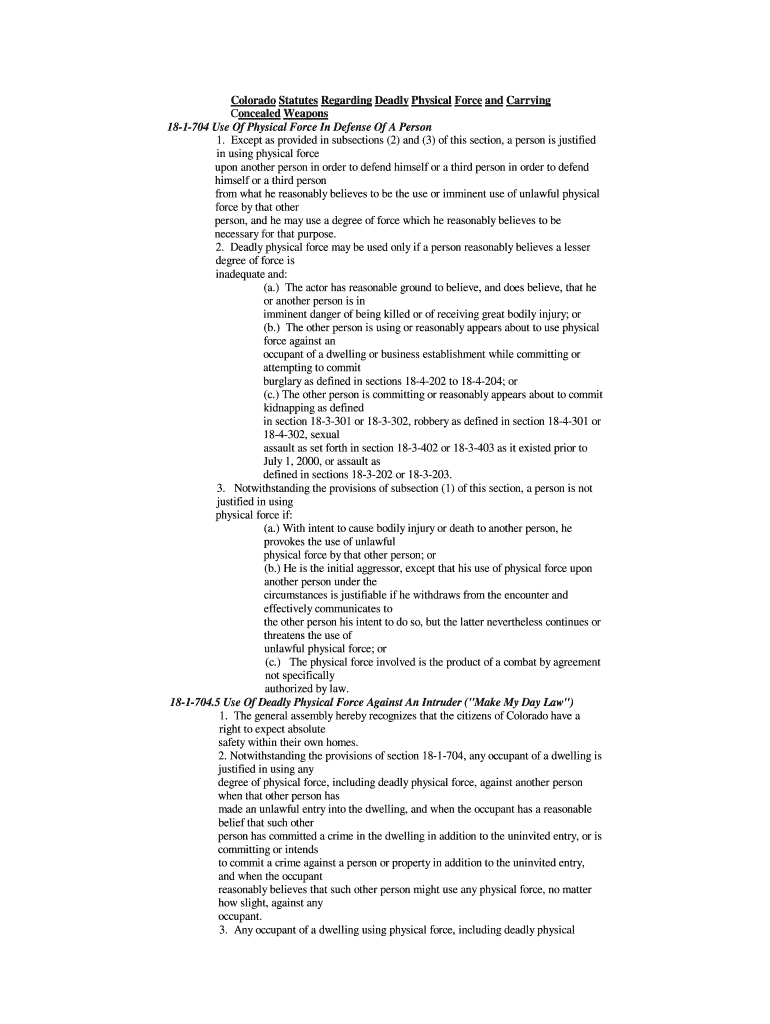
Colorado statutes regarding deadly physical force and carrying encompass laws that define the legal parameters for the use of physical and deadly force in self-defense, defense of property, and the regulations surrounding the carrying of concealed weapons. These statutes establish the conditions under which individuals may lawfully resort to using varying levels of force to protect themselves, their families, or their properties. Understanding these legal definitions is critical for ensuring compliance and protecting one's legal rights in the state of Colorado.
Key Elements of Colorado Statutes
These statutes include essential elements such as the 'Make My Day Law' which permits homeowners to use deadly force against intruders in their homes. This section serves as a cornerstone of Colorado's self-defense laws, granting individuals the legal right to protect their residence against unlawful entry with necessary force. Additionally, the statutes define the legal framework for obtaining permits to carry concealed weapons, guiding citizens through the necessary qualifications and procedural requirements to legally carry firearms.
Legal Use of Force
The legal use of force in Colorado is governed by specific provisions, which outline distinct scenarios where physical force is justified. Individuals may use non-deadly force in self-defense or defense of others when they reasonably believe it to be necessary. Deadly force, however, is permissible only under certain circumstances, such as in response to an imminent threat of unlawful force that poses a risk of death or serious bodily injury. Understanding these distinctions ensures proper application of the law.
Steps to Complete Statute Compliance
- Understand the Statutes: Familiarize yourself with the detailed contents of the relevant statutes to fully comprehend your rights and limitations granted by the law.
- Determine Eligibility: Assess your current legal standing to determine if you meet the criteria to apply for a concealed carry permit.
- Application Process: Gather necessary documentation, such as identification and proof of residency, and submit an application to the appropriate local authority.
- Complete Training: Enroll in and complete any required firearm safety training programs as mandated by Colorado law for concealed carry applicants.
- Await Approval: Submit your application and wait for the adjudication process to be completed. Approval times can vary based on local administrative processes.
State-Specific Rules
Colorado has unique rules governing the use of force and concealed carry, reflecting state-specific cultural and legal contexts. For example, Colorado maintains restrictions on carrying firearms in certain locations, such as federal buildings, schools, and other designated gun-free zones. Citizens must be informed of these location-specific restrictions to avoid legal repercussions and ensure they remain compliant with state law.
Examples of Use
Several real-world scenarios illustrate the application of Colorado's statutes regarding deadly force and carrying. For instance, in a situation where a homeowner is confronted with an intruder in the middle of the night, they are permitted under the 'Make My Day Law' to use deadly force to protect themselves and their property from an apparent threat. Another example includes situations in public venues where an individual carrying a concealed weapon may intervene to prevent a crime if they perceive an immediate threat to their life or the lives of others.
Permits and Licenses
Obtaining a concealed carry permit in Colorado requires applicants to fulfill specific eligibility requirements, such as age and residency status. Typically, applicants must be at least 21 years old, a resident of Colorado, and able to pass background checks and training programs specific to firearm safety. The permit process is designed to ensure that individuals who wish to carry concealed weapons do so with a full understanding of their responsibilities and obligations.
Important Terms Related to Colorado Statutes
- Deadly Physical Force: Force that a person uses with the intent to cause, or that they know will likely cause, death or serious bodily injury.
- Concealed Carry: The practice of carrying a firearm in public in a concealed manner, typically beneath clothing or in a concealed compartment.
- 'Make My Day Law': A statute that allows individuals to use deadly force without a duty to retreat when their home is threatened by unlawful entry or attack.
Penalties for Non-Compliance
Failure to adhere to Colorado's statutes regarding the use of deadly physical force and carrying can result in severe legal consequences. Potential penalties include fines, revocation of firearm permits, and even imprisonment, depending on the severity and circumstances of the infraction. These penalties underscore the importance of compliance and the need to thoroughly understand and follow the state's legal framework governing the use of force and weapon possession.




